
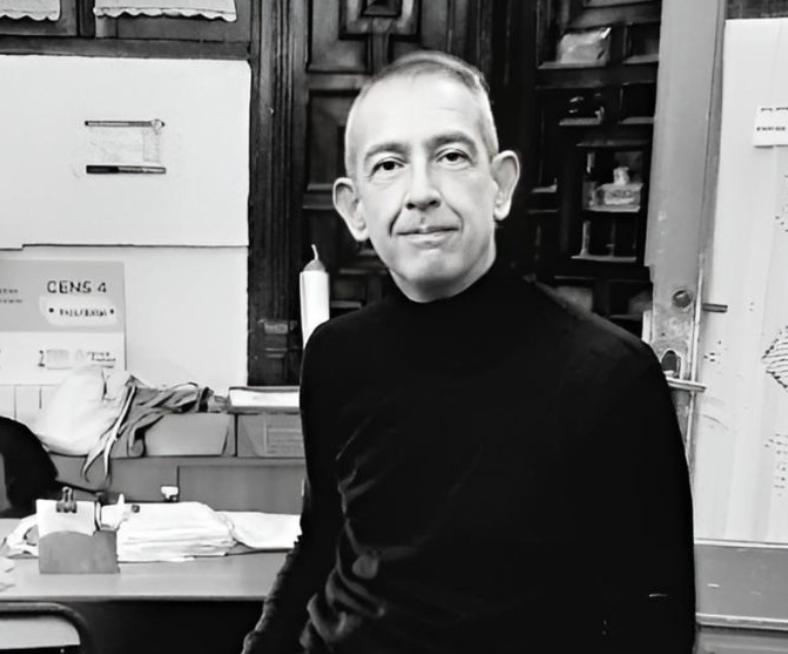
Enrique Solinas, born in Buenos Aires in 1969, is a poet, fiction writer, teacher, and researcher, and collaborates with publications in Argentina and abroad. His published poetry collections include Signos Oscuros (Buenos Aires, 1995), El Gruñido (Buenos Aires, 1997), El Lugar del Principio (Buenos Aires, 1998), Jardín en Movimiento (Buenos Aires, 2003), Noche de San Juan (2008), Corazón Sagrado (Buenos Aires, 2014), Barcas sobre la zarza ardiente (2016), El libro de las Plegarias (2019), El pozo y la cima (2022), and El grito en el cielo (2025). He has received several awards for his literary work, including the 1st National Initiation Prize for the 1992/1993 Biennium from the Argentine National Secretariat of Culture. Award for Creative Writing, 2000, Argentine National Secretariat of Culture; Shanghai Writing Program Residency Grant 2014; 1st Municipal Prize for Literary Production 2022/2023, etc. His work is included in national and international anthologies and has been translated into English, Italian, Portuguese, French, Greek, Chinese, Romanian, and Tamil.
Ming Di: I have noticed profound pain and sorrow in your poetry and I happen to have met your partner, the writer Jorge Paolantonio, years ago in Morocco, before I met you and before he passed away. How is LGBTQ poetry perceived in your country?
Enrique Solinas: Jorge Paolantonio and I were a couple and we were married, sharing a life together for 29 years. His death was painful and unexpected for me, filled with thoughts and emotions that I expressed in two books of poems, *El pozo y la cima* (Pre-Textos, 2022) and *El grito en el cielo* (Pre-Textos, 2023). It was both the beginning and the end of the grieving process I went through, and although I know that Jorge will always be with me because he is part of who I am and my story, I also know that I can start again.
In Argentina, LGBTQ poetry exists naturally. There is no special emphasis or prominence on this topic. Argentina is characterized as a country where we can all coexist with acceptance of one another. It is also true that this happens more frequently in the large cities of Argentina, and that in places further from the center, in small towns, androcentrism and patriarchy continue to have a strong influence.
MD: How was LGBTQ poetry received historically? Any changes over the last few decades?
ES: In Latin America, historical perspective and liberation are two sides of the same coin, whose increasingly profound and accelerated changes shape our perception of the contemporary world, and in my case, of poetry. We are aware of this and we want literature to be transformative in the here and now, that’s why committed writing (whether from a social perspective) is inherent to human thought as a consequence of the different past and current stages that we have experienced.
LGBTQ poetry currently has a strong presence in Latin American poetry. While the community faces a constant struggle for visibility, in Argentina it has always enjoyed acceptance and a space for expression.
MD: To you, what is the function of poetry?
ES: The function of poetry—for me—is primarily to better understand reality and thus be able to transform it. To show new and renewed ideas about the world we know. To create beauty where there is none.
MD: Can you talk about what inspired you to become a poet? And who are your favorite poets? (from anywhere and from any period of time)?
ES: Before I began writing poetry, I was an avid reader (and still am). I started writing and publishing very young; my first poem appeared in the Cultural Supplement of the Argentine newspaper La Prensa when I was 16, and I believe that opportunity set the course I followed.
Poetry was my first form of expression, and I believe that through it I can express what I cannot in any other language. This ability to say without saying, to suggest, to hint, and the precision of expression, are what determined that poetry is my language.
Among my favorite poets, I would mention Olga Orozco and Joaquín Giannuzzi, 20th-century Argentine poets. Besides being personal friends, they were and are great poets who represented for me what poetry truly is.
MD: Your mentioning of Olga Orozco reminds me of Alejandra Pizarnik. I’ve noticed surrealism in your poetry too.
It’s possible
that it will rain in a little while
because the smell
of wet earth
invades the air
already in the distance
the echo of thunder
is heard,
as if it were
of the steps
that lead us
toward the future.
–”The Beginning”, from The Cry in the Sky (2025)
(Google translation)
ES: I believe that 20th-century Argentine poetry—Neoromanticism, Inventionism, Surrealism, and Objectivism—are direct influences on my poetry, as are English and American poetry.
Regarding Alejandra Pizarnik, I believe she is an essential poet in Argentina, but Olga Orozco is a significant poet who built an entire body of work. In contrast, Alejandra became trapped in a dead end, repeating her themes in her later books without offering anything new.
MD: What do you think of Juan Gelman? Is he too political for you?
ES: Not at all, I don’t think in political terms. Juan Gelman is a great poet with a political and social commitment, whose work I’ve read in depth—colloquial and dialogic.
I believe that poetry is either present or absent in a poem, regardless of the subject matter. When we read it, we realize it immediately.
MD: You wrote “and love wasn’t enough/ for you to stay”. Love and death seem to be two of the primary themes in your poetry, timeless and out of this world. What do you think of the relationship between poetry and reality?
ES: Poetry is reality and reality is poetry, both concepts in their proper measure. One permeates the other. And if one does not exist, the other would cease to exist.
I understand the world when I read a poem, when I write one, when I share it.
MD: What are your other interests besides poetry and how do they interact with your poetry writing?
ES: My other interests include sports: I fence, I’m a fencer. But, for me, they are separate worlds; I can’t connect them. So far, I haven’t been able to write about fencing, and I can’t write poetry about fencing.
What interacts most with my poetic writing is reality, what I observe in it, what I translate into my language.
MD: Fencing requires concentration, speed and precision. Writing poetry in a way is similar when one tries to capture the fleeting impression in words. Or do you think you are a completely different person when engaged in writing?
ES: In that sense, it’s as if writing is like fencing. I never thought about it in these terms before; I think fencing is so ingrained in my life that I didn’t realize I write with the characteristics of my favorite sport.
MD: You’ve been to Shanghai several times. How do you compare Shanghai with Buenos Aires?
ES: Shanghai and Buenos Aires are very different, yet they also have points in common. The difference lies in Eastern and Western thought; they are often diametrically opposed in their perspectives and ways of understanding the world. On the other hand, while I lived there and now I travel there occasionally, there are parts of Shanghai that remind me of Buenos Aires, especially in the French Concession. Sometimes I find a place in Shanghai that is just like the Palermo neighborhood in Buenos Aires, for example. And everything there is wonderful, comfortable, and pleasant.
MD: Your poems about Shanghai are realistic snapshots with the details of the streets and people there. Imagine how Jorge Luis Borges would respond to your poems...
ES: I think he would have liked these poems, since they deal with a perception of Shanghai that, to a certain extent, coincides with Borges’s books Fervor de Buenos Aires, Luna de enfrente, and Cuaderno San Martín. Those planes of observation and poetic translation characteristic of Ultraism, the Spanish movement that Borges learned in Spain and brought to Buenos Aires, can be found in the collection of poems I wrote in Shanghai.
MD: Can you talk about the contemporary literary scene in Argentina or in Buenos Aires post Jorge Luis Borges and post Juan Gelman?
ES: Jorge Luis Borges, in poetry, has not been a major influence on 20th-century Argentine poetry, nor on contemporary poetry. The situation is different with his narrative, which is highly poetic and has influenced many writers worldwide.
Juan Gelman is an influential poet from the second half of the 20th century, but in the current landscape of Argentine poetry, the influences are much more varied and diverse, both in their themes and forms. We can speak of a tradition with poets such as Alejandra Pizarnik, Olga Orozco, Diana Bellessi, Joaquín Gianuzzi, Enrique Molina, Santiago Sylvester, Paulina Vinderman, and Dolores Etchecopar, each with their own distinct tradition, but all powerful voices representing contemporary Argentine poetry.
What is truly interesting is that, in both Argentina and Uruguay, poetry written by women carries more weight or has produced more important poetic voices than poetry written by men.
MD: Thank you for sharing your insightful view on Argentine poetry. Your observation of the women’s writing in Argentina and Uruguay is fascinating, a topic I was going to explore. It’s very nice meeting you in person at the Lima festival. There seemed to be a homogeneous poetry, i.e. poetry from Latin American countries and Spain, the Spanish speaking world, the Pan-hispanic poetry. But I’m sure there are subtle differences. Can you talk about regional variations in poetics and practice?
ES: As a reader and researcher of Latin American poetry, I can say that there is indeed a formal, thematic, and linguistic diversity. Perhaps we can find a certain homogeneity in Central American Baroque poetry, but the truth is that the prevailing diversity is immense.
The Spanish spoken in Argentina is not the same as that spoken in Spain, Mexico, or Chile. The same is true of the themes and their local flavor. We can see poets from different countries who respond to dissimilar trends, but who shine in their own right through their work and perspectives. This diversity makes us greater and stronger.
MD: Is there a division between right-wing and left-wing writers in Argentina? If so, what is the fundamental difference?
ES: While the policies governing Argentina are brutal, and it has been a long time since such a devastating advance of the right wing has been seen, in the artistic sphere, such irreconcilable differences do not exist. Perhaps we could define “leftist poetry” as that which addresses social issues with classical themes, but in art, ideologies coexist, dialogue, feed off each other, and express themselves.
Art, in its essence, is art, and it is humankind that creates it, to speak to people of all times. Ideology is present in contemporary literature to reveal the different facets of an increasingly dehumanized world.
MD: You have a line in a poem you wrote while in Shanghai, “…I look at the river/ and I find that I am/ in my own eyes” which, like many of your other poems, strikes me as an extremely introverted voice with constant, profound introspection. Now that you are walking out of the deep cave of loss and wounds and facing the social reality, what do you think poets can do to promote world peace?
ES: Every artist is a witness to their time and, as such, must narrate what they see, express what they feel, denounce what they consider unjust, and decide which battles to fight and which to be vigilant about.
Art cannot stop wars, nor can it be part of interests that transcend them. But it can disseminate the artist’s truth, their conception of beauty and peace.