
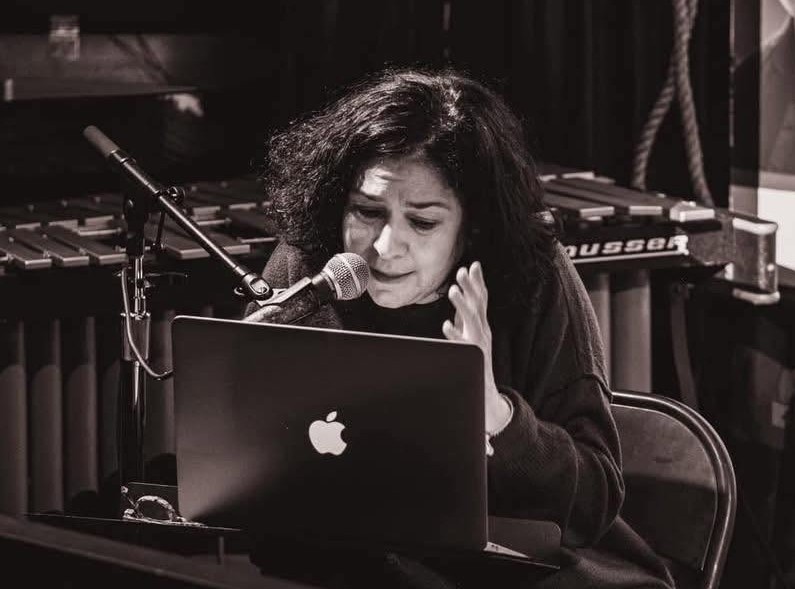
Ely Rosa Zamora (Venezuela, 1967) is an actress, writer, and scholar. She has lived in the United States since 1998, where she was trained with the legendary experimental theater company The Living Theatre under the direction of Judith Malina. In 2009, she earned a Master of Arts in Creative Writing from New York University (NYU). Her publications include He sentido un gesto removerlo todo (Proyecto Editorial La Chifurnia, El Salvador, 2019), La nitidez delembudo (Newmark Press, New York City, 2015), Unspecific Object / Objeto Indefinido (Choir Alley Press, New Jersey, 2015), Sin lengua y otras imposibilidades dramáticas (Editorial La Caída, Buenos Aires, 2013); Sin lengua / No Tongue (Heptameron Books, New York City, 2011); and Detrito olvidado / Forgotten Detritus (Choir Alley Press, New Jersey, 2009).
Her book, Objeto Indefinido, created in collaboration with visual artist Barbara Madsen, is part of the permanent collection of the Fine Arts Museums of San Francisco, Legion of Honor. In 2019, it was featured in the exhibition Strange Days: Dada, Surrealism and the Book at the same institution. The work was also acquired by the Firestone Library of Rare Books collection at Princeton University. Her poetry has appeared in numerous anthologies and has been presented at international festivals. Ming Di: Before talking about Venezuela, I would like to talk about your poetry. Your poems give me the impression of a snapshot, a moment of highlight, a breath of intensity, an epigram, or a few lines of revelation. Are you also a visual artist? Ely Rosa Zamora: I’m not a visual artist, yet poetry, for me, begins in much the same way as painting: with an image emerging from feeling and memory. Before language arrives, there is often a scene, a gesture, a shadow, or a rhythm searching for form. I follow that rhythm as one follows a brushstroke across a canvas, allowing words to reveal what is hidden beneath thought. In that sense, visual art is not separate from my writing; it lives within the imagination that shapes it. Imagination is our infinite canvas. MD: When we met in Morocco in 2018 for the international poetry festival, I remember you preferred lyrical poetry more than narrative poetry. Can you elaborate on that? To you, what makes a poem a good poem? ERZ: Yes, I’ve always felt more drawn to the lyrical than to the purely narrative. Narrative poetry can be powerful, but for me, the poem begins not in plot, but in vibration. It begins in an image, in a rhythm, in a fracture of language that opens something interior. I am less interested in telling a story than in revealing a state of being.A good poem, to me, is one that transforms language — that creates a space where silence and sound are in tension. It doesn’t explain; it resonates. It doesn’t instruct; it unsettles or illuminates. Even when a poem contains narrative elements, what makes it alive is the music beneath it — the compression, the breath, the precision of image. A poem should feel inevitable, as if no other arrangement of words could hold that experience.Because I write in Spanish, I am especially attentive to the weight of syllables, to cadence, to the way a line breaks and leaves an echo. Poetry, for me, is not reportage. It is distillation.Ultimately, a good poem enlarges perception. It leaves the reader changed — even if only slightly — in how they inhabit the world. MD: What do you think of weaving political elements into a poem? ERZ: I believe politics enters the poem naturally when it is part of the poet’s lived reality. Whether this reality is past or present. I do not think poetry should be reduced to slogans or arguments; that flattens its complexity. But neither do I believe poetry must be apolitical. Politics can be present as atmosphere, as pressure, as absence, as memory or as a sharp reflection of our time. For me, the lyrics allow the political to breathe. It prevents it from hardening into rhetoric. It reminds us that history is not abstract — it passes through the intimate, through the sensory, through the human voice. MD: How do you identify yourself? Immigrant poet? Diaspora poet? Venezuelan poet or Venezuelan-American poet? How do you feel about the conflict between your adopted country and your home country? ERZ: I consider myself a Venezuelan poet. Although I have lived in the United States since 1998, Spanish remains the language of my soul, the language in which I dream, remember, grieve, and love. It is the emotional and imaginative territory where my poetry is born. My earliest memories, my cultural references, and the rhythms that shaped my sensibility all come from Venezuela. That foundation has never left me.At the same time, after nearly three decades in the United States, it would be impossible for this country not to have influenced my work as well. My daily life unfolds here. The landscapes, the tensions, the social conversations, and the experience of migration itself inevitably nourish my poetry. I inhabit a space between cultures, and that in-between space has become fertile ground for reflection. Although I identify deeply as a Venezuelan poet, I also recognize that my perspective has been shaped by the political violence I witnessed in my homeland during “El Caracazo” and by the displacement that has marked much of my life.Regarding the tensions between Venezuela and the United States, I cannot separate it from the fact that Venezuela possesses the largest proven oil reserves in the world. In my view, Venezuela has had to become a nation in resistance against the imperialist and colonial strategies of domination pursued by the United States in order to preserve its independence and sovereignty. Today, the country faces a particularly critical moment. Following the bombing of January 3, 2026, the United States assumed control over Venezuela’s oil revenues and oil exports. For many Venezuelans, this represents a profound violation of national sovereignty and a deeply troubling development.U.S. foreign policy toward Venezuela is often framed in terms of strategic interests, geopolitical calculations, and shifting political priorities. Yet for those of us who have lived through its consequences, these realities are not abstract. They shape migration, separation, uncertainty, and loss. Exile is not merely a change of geography; it is a rupture in one’s sense of belonging. For many migrants, it means living for years in a state of suspension—between identities, between memories and realities, often without a language that feels entirely our own or a reality that feels fully tangible. MD: I know how devastating it is and it has been. Are you still in contact with the poets/writers in your home country? Can you talk about some of the most engaged poets in Venezuela? (I have actually been to the international poetry festival there but I would like you to talk about the current literary scene in Venezuela.) ERZ: I am not deeply connected to the contemporary literary scene in Venezuela, largely because I became a poet after emigrating to the United States. While I was born and raised in Venezuela, my development as a writer took place elsewhere, and most of my literary relationships have been formed within international and U.S.-based literary communities.That said, Venezuela has a rich and distinguished literary tradition, with many remarkable poets and writers across different generations. I would hesitate to single out only a few names, as doing so would inevitably leave out many others whose contributions have been equally significant. For that reason, I would prefer not to speak as an authority on the current Venezuelan literary scene. MD: How did you become a poet? Who was your early influence? Whose poetry do you read now?ERZ: I became a poet after my daughter was born because I could no longer attend rehearsals as an actress. Since I was no longer rehearsing, I began channeling that creative energy into writing. When my daughter turned three and started preschool, I applied to NYU’s Creative Writing Program in Spanish.My earliest influences were inevitably shaped by the theater. I was particularly drawn to postwar playwrights such as Samuel Beckett and Eugène Ionesco, whose work I read extensively. I was also deeply interested in Twentieth-century avant-garde theater, including writers and theorists such as Heiner Müller, Antonin Artaud, Bertolt Brecht, and Federico García Lorca, among others.Later, my experience with The Living Theatre, under the direction of Judith Malina and Hanon Reznikov, had a profound impact not only on my work as a writer but also on the way I came to view the world.My poetry is lyrical, but it has also been shaped by experimental theater and avant-garde traditions that taught me to think of language as material, fragmentation as meaning, and silence as an active element of the poem.My first book, Sin lengua y otras imposibilidades dramáticas (No Tongue and Other Dramatic Impossibilities), is a work of dramatic poetry. Although there are no characters, the entire book is composed of poetic dialogues.During my MFA, I gradually shifted my focus from theater to poetry. We studied both the classics and contemporary writers in depth, and that immersion significantly influenced my development as a poet. The dialogic form slowly disappeared from my poems, although I occasionally return to it deliberately as a creative device.Today, I read widely and somewhat intuitively, depending on my mood. At times, I revisit the classics; more recently, however, I have found great pleasure in reading the books of friends and colleagues. I am fortunate to know many outstanding contemporary poets with whom I share readings, festivals, and literary events around the world. Their work continues to inspire and accompany me as a writer. MD: Prose (novels), Plays, Poetry—I spent most of my time reading novels in the literature classes. Did you spend more time in playwriting or performing? What’s the difference between poetry and theater to you? ERZ: During different periods of my life, poetry and theater have occupied different spaces in my creative energy, but both have deeply shaped me as an artist. In theater, I worked primarily as an actress, with some experience directing, so my relationship to drama comes from performance and interpretation rather than playwriting. Theater taught me how to inhabit language physically and emotionally, how to understand silence, rhythm, and human tension from within a character.Poetry, on the other hand, is a much more solitary and interior process for me. It is where I explore voice, memory, emotion, and reflection in a more intimate way. While I don’t write dramatic scripts, my experience on stage has strongly influenced my poetry. I think it gave me a heightened sense of cadence, presence, and the musicality of language.For me, the two art forms complement each other beautifully. Theater trained me to embody words, while poetry allows me to distill experience into language. Even though they are very different creative practices, they constantly nourish one another in my work. MD: In times of war, what do you think you can do with your writing? Can poetry make the world a better one? ERZ: I do not believe poetry can stop wars directly, but I do believe it can preserve our humanity during times when humanity is most at risk. In moments of violence and division, writing becomes a way of bearing witness, of refusing indifference, and of reminding people that behind political conflicts there are human beings with fears, memories, losses, and dreams.For me, poetry is not propaganda or a slogan. Its power lies in its ability to create empathy and reflection. A poem can cross borders that politics cannot. It can make someone pause, feel, remember, or question what they had accepted without thinking. Sometimes that inner movement is small, almost invisible, but culture and conscience are also shaped through those small transformations.I think writers have the responsibility to remain honest and sensitive to suffering, without simplifying reality. In times of war, writing can become an act of memory, resistance, and compassion. Even if poetry cannot change the world overnight, it can change the way people look at one another, and perhaps that is where every lasting change begins. MD: Thank you for spending the time doing this interview at such a difficult time. ERZ: I actually wanted to tell you how grateful I am for your patience throughout the process. When you first invited me to do this interview, my mother had just passed away. A week later, while I was in Venezuela, the country was bombed. Experiencing that so soon after my mother’s death was deeply painful. I found myself grieving while also reliving memories of the political violence I had experienced years earlier when I lived there. It was emotionally overwhelming.When I returned to the United States, I came back carrying the anxiety of leaving my family behind in the middle of a conflict involving the country where they live and the country where I have lived for nearly three decades and built much of my life. For several months, I struggled with grief and fear while continuing to teach six courses and meet my daily responsibilities. What made your interview especially challenging was that the questions invited me to reflect deeply on my poetry, my creative process, and my journey as a writer. Your questions also encouraged me to think more deeply about identity and the role it plays in my poetry. Some of my answers even surprised me because they helped me articulate things I had felt for a long time but had never fully expressed. (Feb 16 to June 14, 2026)
Poems by Ely Rosa Zamora
Translated from Spanish to English by Frances Siman
The Tickle of Exile
My breath is water
before the wolf’s mouth.
The road has left behind
the dried sores.
The noise that threatens
to carry us away
does not topple the plants.
And the condor’s gaze
is the tickle of exile.
Crown
There is a drowned car
in the flooded street
The whole town has disappeared
leaving desolation
Hell is an airplane
full of money and red lights
The petrified queen
rests in her castle
In the newspaper photo
five men in suits
walk together
organizing the future
of the world’s economies
Among ruins
where I once
played.
Assonants
That white we see as black
is red
That black we see as white
is red
And it tastes like a bullet
on the tongue
A taste of powder
of smoke
of a wild cloud that rains
shivers
Along the road
the flowers have withered
and the rivers covered in blood
We have trampled heads
and painted the tanks
in colors
In this hour of the one-eyed,
I still sleep with one eye
open
I am a divided woman;
the other eye
I cannot find.
Pendulum
To exist in the possibility
Hanging from the pendulum
unaware of the end
Holding on and oscillating
as between two eyes
that look for each other
Living the entire parable
Without sutures
Without separation
Without letting go of a hand
that disrupting the balance
throws us into the void
where morality
awaits.