
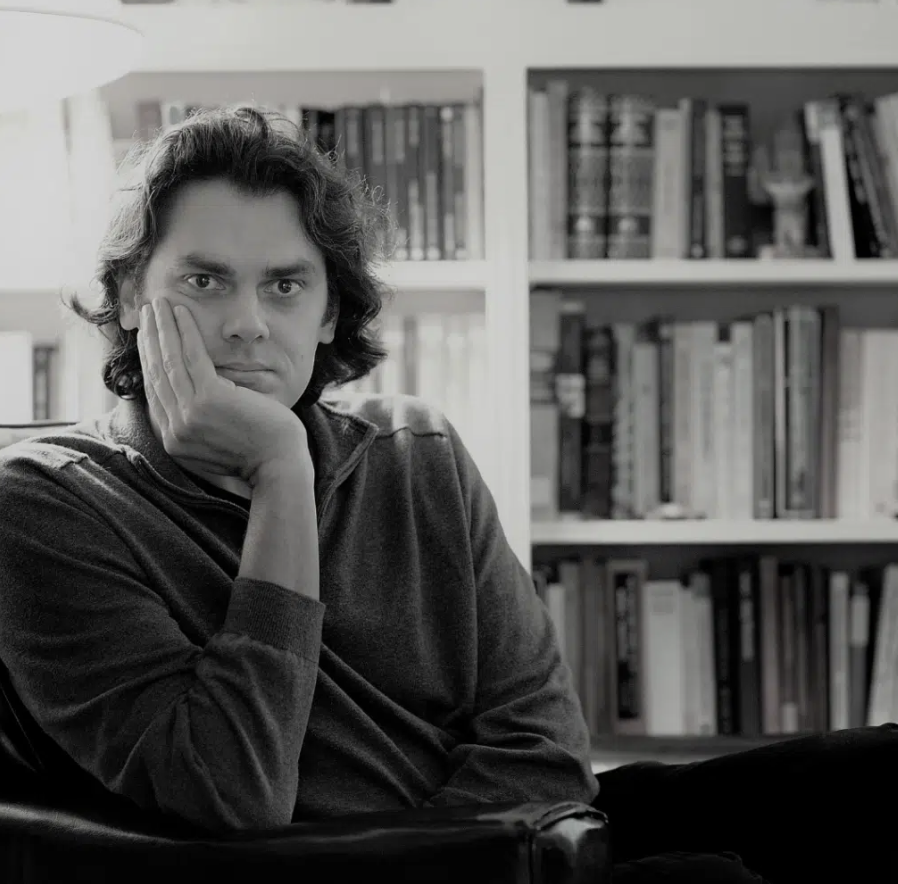
Born in Milan, Italy, Jeremy was raised in various southern states of the United States of America, in Nicaragua, Costa Rica, and the Dominican Republic. On his mother’s side he is of Puerto Rican descent. He completed his PhD in Spanish at Emory University and is Professor of Spanish and Latin American Literature at Transylvania University in Lexington, Ky. He is also on faculty at Spalding University’s Low-Residency MFA. He is the author of various books of poetry in English and Spanish and has translated Latin American, Spanish, and American poets into both English and Spanish.
His classes at Transylvania University include everything from beginning Spanish to courses on Don Quijote, Pablo Neruda, Latin American Poetry, and Latin American Philosophy. At Spalding University he teaches and mentors in Literary Translation and Poetry.
He is a member of the Affrilachian Poets and received an Al Smith Fellowship from the Kentucky Arts Council in 2019.
Under the Ocelot Sun/Bajo el sol del ocelot co-won the 2020 Campoy-Ada Prize for Illustrated Book with Special Cultural Content.
His poems and translations have appeared in many journals and a number of anthologies, including: Asymptote Journal, Atlanta Review, Beloit Poetry Journal, California Quarterly, Cincinnati Review, Cortland Review, Drunken Boat, Hampden-Sydney Review, Louisville Review, Rattle, Words Without Borders, and others.
Ming Di: Your life story is fascinating. What’s the most memorable place or stopover for you (with its geography or social environment) on your transcontinental journey that shaped you into what you are?
Jeremy Paden: For some poets deep ties to a specific landscape place or city is essential. I think of the importance that Patterson played in the poetry of William Carlos Williams, New York to the poetry of Frank O’Hara, the coastal mountains of Sonoma to Ada Limón, or how Spain’s landscape, whether the high plains of Castille or the coastal mountains of the south, is deeply woven throughout Antonio Machado’s verse. Truth is, the world about us does seep into our work, whether it is the natural world or the social one.
It is hard to say what place is most memorable. By the time I went to college at 18, I had lived on three continents, one isthmus, and on an island in an archipelago. Another way to count that is 6 different countries. And, if we just limit the count to states within the United States, 5 different states before going to college in a 6th one.
Moving as much as I did has made me both able to appreciate where I am by finding what is special and unique wherever I happen to be. Yes, it has also given me an itch to be always on the move and made me always an outsider. But if you ask me, to name one memorable place, I will tend to think about different things that I loved about each of the places I’ve lived. My earliest memory, I think,—and I do think it is mine and not one of those that others tell you about and which you make into your own—I remember the smell of an open-air fish market in Lagos, Nigeria. I would have been two and half at the time. The bright sun, the smell of fish, and my mother putting me down in the open market with people speaking in languages I did not understand and in brightly colored clothes are all I remember. At times, I do wonder if it was a dream. But Nigeria was such a different place than Milan, where I was born and where we lived until I was 4 and ½, except for the 6 months we spent in Nigeria while my father worked with Nigerian Christian Hospitals. With Milan, I have a number of intense memories, snapshots: the snow, the tall buildings, the layouts of an apartment or two, walking home from daycare, and the pigeons. In fact, when my wife and I traveled to Italy for our 20th wedding anniversary and we went to Milan and stood in front of the cathedral, I was overcome with a sense of déjà vu when a flurry of wings lifted off the ground in front of me. I had walked among those pigeons many times before. I loved the dusty roads of Nicaragua and staring down into a volcano crater when on a 2nd-grade fieldtrip. The lush green of Costa Rica and its forests and seeing sloths hanging in the overstory. The autumn leaves of North Georgia, the loblolly pines and red earth of Louisiana, the beaches and rivers of the Dominican Republic, the wild blueberry patches of North Carolina’s Blueridge mountains, and cedar forests, and aspen stands of the mountains in Northern New Mexico. I love many geographies, and I love the taste of foods grown close to where they are cooked and served. I love the slant of sun wherever I happen to be.
MD: What inspired you to become a poet? What do you think makes a poet different (from the rest of the world)? Any other careers/paths you would have chosen? Do you have hidden passions for other things besides poetry?
JP: Bai Juyi, or Po Chü-I, has a lovely poem that Arthur Waley translated as “Madly Singing in the Mountains.” It starts saying, “There is no one among men that has not a special failing, / And my failing consists of writing verses.” This failing, this verse making, is how he copes with exile. Of course, it was his political poetry that got him in trouble with the authorities, but I like how he speaks of poetry as his special form of failing, and that we all have some such unique failing.
I think there are multiple paths into the practice of poetry. One trait that poets share is that of being an observer, of deeply looking at the self, at others, and at the world. Mine was not a political exile, but a nomadism which was the result of my father’s profession, that of being a medical missionary, and the political upheavals of Central America in the 1980s. Still, I wonder, at times, if this constant moving from country to country which forced me into always being an observer, into always being on the outside, I wonder if this might have drawn me toward poetry.
Certainly, another thing that drew me was being raised in two languages. English was spoken at home in the family and Spanish among friends and out in the city. So, I was caught between the play of two languages, the borders of multiple countries, the space between different cultures, and the music, not just of the different languages I spoke growing up, but also the various dialects within these. Caribbean Spanish is very different from what is spoken in the mountains of Costa Rica. And, on television one would hear the lilt of Mexican Spanish in shows like El Chavo del Ocho or in comedies that featured Cantinflas.
But a poet does more than observe, a poet also plays with language. And it wasn’t until I started consciously listening to the music of language that I started writing. What called me first was how the music of the two languages I grew up speaking, English and Spanish, played off each other. And I would write in Spanglish, paying more attention to sound than sense. But soon, I came across William Carlos Williams, H.D., and other imagists. And soon after that, George Oppen and Denise Levertov. These poets all worked with a stripped-down language. And I really was drawn to them, so I began to work toward a different, less ornate style that focused almost exclusively on English. That said, there are Spanish language poets that also worked toward a spare, precise language: Juan Ramón Jimenez, Pedro Salinas, and Octavio Paz being a few of these. In those early years, I thought you had to choose one or another language and I chose the language of the country where I was living—English, even if I was pursuing graduate studies in Spanish. So, for a while, I wrote principally in English, even as I read mostly in Spanish.
I went to graduate school to study literature because I fell in love with poetry. Though, honestly, I loved reading most anything. But I spent most of my weekends in graduate school daydreaming of becoming a chef. Had I known that cooking could be a career, I might have been drawn to the kitchen. As it is, I am happy cooking for my family and loved ones. I am even happier that this daily chore is something I love as much as I do and that I don’t have to live by it. I think it is good and important to have multiple creative outlets. And I do think that they feed into each other.
MD: Spanglish is an interesting word. How do you feel about being a hybrid or bilingual poet? What language do you speak in your dreams?
JP: Well, I have written a whole book of poems about writing in Spanish. It is called Exofonías, o cartas versadas a Luis. It is a series of epistolary poems to a dear friend, a Chilean poet named Luis Correa-Díaz that meditates on the act of writing in a language other than my most dominant one. And, though I did grow up speaking Spanish and though I teach it, ever since college English has been both the language I speak at home and out in the world. Thus, my Spanish is not as strong as my English.
Samuel Beckett wrote in French rather than English. Joseph Conrad wrote in English rather than Polish or French. The Italo-Mexican writer Fabio Morábito writes in Spanish, the language he learned as a teenager, rather than the one spoken in his home. I find writing in my less dominant language a way of providing me with an interesting constraint. This struggle to express myself well when faced with limitations is, I think, productive.
I dream in both languages. It often depends on the intensity of the experience that my dreams are processing and the language in which I have had those experiences. When I am in the throes of white-hot creation, I will dream in the language I have been writing in.
MD: You have written many poems about food. Have you ever compared cooking with poetry writing? What ingredients are essential in a poem to you?
JP: The American writer and anthropologist Mary Catherine Bateson in Composing a Life compares cooking, home cooking for a family, with life. Her point is that life isn’t a set of rules and recipes you follow to the letter of the law, but an improvisation that happens in the moment with the ingredients the home cook has on hand. You thought you might make chicken pasta in a vodka cream sauce, but it turns out you only have sundried tomatoes, so along with the sun-dried tomatoes you add smoked paprika and olives instead of just basil.
Image and rhythm are really important. I cut my teeth on free-verse and Imagism, on Whitman and that line of poets that come out of him, William Carlos Williams, Carl Sandburg, Denise Levertov, Ernesto Cardenal, Alfonsina Storni, Nicanor Parra, Rosario Castellanos, and Pablo Neruda. This is an incomplete list... all lists are incomplete. And while my sense of what makes a poem is always under consideration, these are a few of those early names who I read obsessively and who taught me what makes a poem.
I learned to cook from my mother, and learned to cook in the way that mothers cook and teach their children to cook... by feel. You are shown how to make something by another cook and practice it with them and then you improvise and change as you make the recipe your own.
MD: And as a poet-translator, what attracts you most and makes you jump into translating a poem?
JP: I first came to translating because I thought that this was the best way to hone my own craft. Indeed, the art of translating has played a central role in my apprenticeship to poetry, which is a life-long apprenticeship. What draws me to any given project is different: it could be the use of language (the way the poet plays, the way the poet pares down embellishment); it could be the compelling set of images they work with; or, the twists and turns their poem takes as they bring together disparate things.
MD: You wrote about state violence in South America. As P and O are shared by Poetry and Politics, what do you think of political ingredient(s) in poetry? Have you ever been concerned about readers’ possible reactions to your personal political views?
JP: Dante was exiled, not because of what he wrote, but because of his opposition to papal power. Bai Juyi was also exiled, though in his case part of the blame has to do with his poetry. It is true, especially in a polarized, political world, that many things will get read from a partisan point of view.
Poetry because it sings of desire, because there are almost always two subjects involved, the singing self and the listening self, is going to be political. Poetry because it seeks beauty, truth, and justice is also going to be political. I don’t know how to get around that. Poetry is a space, a utopian one, where we dream of what life can be and we lament the state of life when it fails to come close to that dream.
I think of Walt Whitman’s Leaves of Grass and those vast, democratic vistas that his verse opens up. I think about how he sings and celebrates the self and all its possible modes of expression. His is a deeply political vision. And then I think of Robinson Jeffers’s powerful poem, Shine, Perishing Republic (1925), written in the years following World War I and lamenting where the United States was headed. It begins,
“While this America settles in the mould of its vulgarity, heavily thickening to empire
And protest, only a bubble in the molten mass, pops and sighs out, and the mass hardens,
I sadly smiling remember that the flower fades to make fruit, the fruit rots to make earth.”
And I think of Langston Hughes’ response to Whitman, I, too sing America (1926). A poem that takes Whitman’s vision seriously enough to speak back to it and the nation and indict the nation for how it has mistreated its “darker brother.” But, because I grew up in Central America and the Caribbean, I cannot think of Whitman and not think, also, of Rubén Darío’s masterful A Roosevelt (1904) or Pedro Mir’s Contracanto a Walt Whitman (1952). These last two poems respond to Whitman by noting how the democratic utopia he sings about has turned into an empire.
And poetry has always been that space where we put up competing visions for what we can be, who we can be, and how we can live.
It is true that much of what I write about is empire and a critique of empire. If there is one through line in my poetry, it is that. I grew up in the shadows of the American empire, in countries that were directly affected by its foreign policy. And I grew up with parents who sacrificed the potential of a very comfortable life as a doctor’s family inside the United States for one where they treated the poorest of society, where the hungry and sick routinely ate at our table. So, even as I grew up in the shadow of the American empire, I grew up with a deeply ingrained vision of justice and mercy, of a way to be in the world that cared for others, no matter who they were. These two strands, this love for justice and this identification with the dispossessed, come together in my poems. They form the still and quiet point around which my poetry circles. I cannot worry about whether the critique of power and that dream of justice at the core of my poetry pushes people away. All I can do is write what I am given.
Two poems by Jeremy Paden
not all madness is descent
some is flight the rise
of a million wings
that darken the sun
some is leave
of home & name
& rights to wander
some
is gift
but how are we to know
if the barber’s basin
that glints on the barber’s head
as he rides his donkey
to the next town
was bequeathed to us
by the gods to ward off
evil enchanters
or if it’s the happy barber’s
& no one else’s
must we always fight
to own by merit
the madness that is ours
& what of the madness
of finally knowing who we are
who can live with such a gift
smooth pour
let the minor accidents of drought & flood
color the kernel/temper the grain/
the seed must be strong enough
to pass through fire
it must die to save the sugars
& in dying remember
its first death/the darkness of earth/
beauty is born from pain
it rises up from the trampling floor
wash the wounded seed
abandon it to the baptismal font
let it stew & ferment
I speak of conversion/of the waters of life/
of how fire is a great
& mighty transformation
hide that water cured by flame
in oak for an age or two
let it rust/mingle
with years of drought & plenty
I speak of how conversion is a fire
how beauty is born in maceration & want