
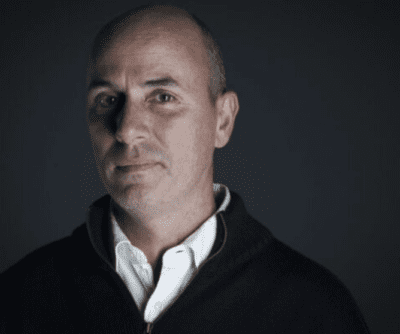
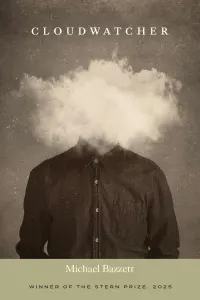
I had the great-good fortune of spending a deliciously sunny June day talking to Michael Bazzett about his fourth volume“Cloudwatcher,” a recent American Poetry Review Stern-prize winning volume of poems just out from Copper Canyon Press. The book and the conversation delivered me to the fundamental nature of why I love poetry, how it asks us to question existence from myriad angles. In these poems, the river, the cloud, the dog constantly search for source. Replete with rivers, enigmas, desires, understandings, Bazzett constructs a world, surreal and philosophical, that is mapping out what it means to be human. I found joy and revelation in its pages, a sharp wit, a vision, technical virtuosity.
Liz Powell: The landscapes in Cloudwatcher—weather, water, source—feel less descriptive than psychic, almost like states of consciousness. What I deeply admire is the mythology that emerges through each poem. It feels discovered rather than invented. In particular, the poem “Foundational Myth” cements the river as a central character in the book , but it also cements a central tenet, too: “The human imagination is strange.” Do you think mythology in poetry comes from conscious construction, or from returning obsessively to the same images and emotional terrain over years? Indeed, your recurring images/figures in the book—cloud, river, sea, —start to feel mythic by the end of the book, like they belong to a private symbolic system. At what point do recurring images become a kind of personal cosmology? Or, maybe, how does a personal cosmology become an amalgamation of images? I guess I am asking about your clear role here, poet as magician or seer.
Michael Bazzett: “It feels discovered rather than invented.” I love that. It feels apt. The process is very unconscious for me, especially in the composition phase. I feel, more and more, that I listen for poems more rather than compose them. They’re already out there, swimming and darting and burrowing into the world, and my job is just to listen, to track them, to map their tiny footprints in the mud or snow so that we might follow and catch a glimpse. That said, my ears are undoubtedly more attuned to certain frequencies, so over time I think I do “return obsessively to the same images and emotional terrain.” There’s an old city I’ve been dreaming about for years, an imaginary city that’s a kind of pastiche of all the places and landscapes where I’ve lived (the driftless region of Minnesota, Appalachia, Paris, central Mexico, California, Dakar, Minneapolis). It’s my psychic “city underneath the city” and exists somewhat outside of time: it has weird tunnels and staircases and cobblestone streets, the bars of the Left Bank, but also limestone quarries, screen porches, and verdant ravines. There’s a spine of arid hills that runs through it, too, almost mountains... The outskirts are full of ruins, covered in vines. It’s a very real place to me, and the “here” that many of my poems come from.
LP: One of the things I admire in Cloudwatcher is its treatment of time, especially in poems like “Time Blindness,” not simply as chronology or duration but almost as a living character with its own temperament and agency: “I have never seen a minute. You have never seen a second.” I kept thinking of T. S. Eliot’s lines: “Time present and time past / Are both perhaps present in time future, / And time future contained in time past.” In your poems, time feels tidal, recursive, dreamlike, sometimes even sentient, as though it exists not outside consciousness but within it. When the poem asks, “How will we tell time without the river?” it seems to relocate time into the elemental world itself—rivers, weather, light, the body—as though these are older and more sacred clocks than anything mechanical or modern. Were you consciously imagining time as a living force while writing these poems? And do you think poetry has a unique capacity to recover forms of time-consciousness—cyclical, ecological, mythic, even sacred—that contemporary life has largely trained us to ignore?
MB: I love this question, Liz. What a gift, to be read so thoughfully! I wasn’t consciously thinking of time as something living, but I was very much feeling it as something vital and elemental and unclockable, so I think you’re on to something. If I have a life-long obsession, it is Time. And if my poems could be even an infinitesmal part of recovering cyclical, ecological, mythic, or sacred forms of time-consciousness, I would die a happy man. I think one of the most pernicious constructs humans ever invented is the notion of “progess,” which is yoked absolutely to notions of linear chronology, and it’s all a preposterous lie. As Humberto Ak’abal said: “I don’t want to pass through time. / Let him pass through me.” A river is a good clock, a tree an apt calendar, and mountains are temporary.
LP: In “Autobiography of a Poet,” I admire how the poem weaves together infancy, language learning, and mythmaking into a growing sense of self. It reads like a record of consciousness’s development. It’s as if the self builds its own mythology in real time through sensations, images, and the discovery of object permanence. I was especially wowed by lines such as, “I thought birds were pure / sound / until I was five months /old and saw on flicker to my sill/ quick as air/ and made of light.” I wonder if you see poetry as a way to reveal a world inside this one. I also love how growing perception becomes a vehicle, much like childhood is a world that resides in the adult. In these poems, are you trying to bring back the way we saw things as children, or are you more interested in how poetry shows the mind’s ongoing effort to create a self and a reality from fragments, dreams, humor, and language itself?
MB: I have a lot of faith in the eyes of children. They have wonderful built-in bullshit detectors, especially before they’ve been acculturated. (I almost said adulterated, which is of course where the word adult come from...lol) I think every poet, on some level, is trying to hang onto their child-eyes, hang onto the strangeness, the delight, the terror, the wonder of that lens. When he was writing the first big dictionary for the English language, Samuel Johnson defined wonder as “a pause of reason.” I love that. Wonder is when the rational mind turns off, pauses, looks out the window. The trick is to bring that clear-eyed lens to bear, unclouded by cynicism or cleverness or knowing, onto the present moment, onto 59 years of a life where today is still the only day I’ll ever be conscious. So while I’m clearly obsessed with myth-making and our need to build a nest of narrative (Autobiography of a Poet was the working title of the collection, actually), in the end, I’m inclined to trust that clear-eyed wondering, with its chin propped in its hand, staring out the window.
LP: Rainer Maria Rilke famously said we should “live the questions,” and your poems seem to do that in the way they explore consciousness through confusion and absurdity, rather than clear answers. What questions are you living with in this collection?
MB: Well, in in the middle of the book, in the ‘missing river’ section, I think I was trying to inhabit the reality of a dwindling natural world, where so much is disappearing, and how that’s normalized so quickly for each ensuing generation, in a world where all the people are replaced every century or so. Sometimes I think all poetry is elegy now, but the elegaic mode isn’t a natural default for me, so I turned to something more fabulist...
I also think there was a little bit of taking stock in this book, intermingled with the myth-making, given that it does have a bit of an arc: i.e. How does this happen? How does a boy who grew up among the cornfields and bluffs of southeastern Minnesota turn out to be a poet? What does it mean to dedicate a life to this weird and lovely pursuit that offers immense reward and almost no remuneration? I mean, given that my first book didn’t come out until I was 48, I lived that question for quite some time, and found that the work, yes, becomes the answer to itself – yet there’s still something amusing to me about a grown man writing absurd little stories that try so hard to tell the truth.
LP: I keep thinking of Paul Éluard’s line, “There is another world, but it is in this one,” and how many poems in Cloudwatcher seem animated by that tension, especially in “The Sea Was Dark as Polished Stone”: “the pilot said half of what / we drag up from the deep/ has yet to be discovered.” This poem, like many others in the book, suggests poetry continually reveals hidden dimensions within ordinary reality, as though the visible world is only the surface of something stranger, more dreamlike, and more alive beneath it.
MB: That’s it, pretty much exactly. That’s the Catholic boyhood coming through. “All things seen and unseen.”
LP: I’m curious whether you think poetry functions as a way of accessing or revealing that “other world” inside this one. Poetry often seems to bridge the boundary between the visible world and hidden depths, as in your work. Does writing poetry help you access or reveal that “other world” within this one?
MB: Put simply, yes. It does. It all goes back to paying attention. There’s a reason we use the verb “pay” in that expression. It costs something to see what’s really there. Mary Oliver said “Attention is the beginning of devotion,” and I imagine she was in conversation with Simone Weil, who said that “Attention, taken to its highest degree, is the same thing as prayer.” I’m only a very secular Catholic now, intermingled with a bit of Mahayana Buddhism, but I do find the practice of deep looking and listening, where the self disappears or is suspended, to be the most joyful aspect of poeting.
LP: In “Other Day,” the dog appears to guide the speaker toward a Borgesian realm of los espejos, an infinite labyrinth of mirrors in which consciousness becomes recursive, uncanny, and elusive. I was reminded of Borges’s lines from “Mirrors”:
“God has created nighttime, which he arms
With dreams, and mirrors, to make clear
To man he is a reflection and a mere
Vanity.”
What begins in your poem as a creature “given to obedience, naps / and hunger” becomes something metaphysical: a guide leading the human speaker beyond conventional assumptions about animal consciousness and possibly beyond the stability of the self.
As an animal given to obedience, naps, and hunger, I fully approve of this line of questioning.
The moment is simultaneously surreal, witty, and philosophically expansive. I noticed a similar energy in “Every Onion a Perfect Minaret,” especially in lines like “the sky / holds the patent on feathers” and “I bought my dog a watch / to inspire him / to industry / yet still he dozes / in sunlight.” There’s a wonderful deadpan humor here, almost like the Mel Brooks Borscht Belt wit that I really enjoy.
Can you talk about how the “animal” outside us and inside us can help us interrogate and find a lower-case and uppercase Truth?
MB: Love the Borscht Belt reference! The humor comes, in part, from the absurdity of being an ape who wears clothes, who uses money bearing emblems of other apes, who has spent many thousands of hours manipulating abstracts signs and symbols to construct scale-model representations and facsimiles of how this particular 59 year-old ape sees and feels the world, i.e. my personal umwelt.
(Of course there’s a German word for it, yes? Umwelt – (n.) the specific way in which organisms of a particular species perceive and experience the world, shaped by the capabilities of their sensory organs and perceptual systems.)
One reason poetry draws me so endlessly into its rooms is because I love the jolt, the recognition, the yes! of entering a poem that offers me a window, an aperture into a shared sense of being alive in this world through time. A counter-reason I love poetry is that it tries to speak the unspeakable, to say what cannot be said, the break out of the husk of living into the ecstatic, into the energy and charge around the words, beyond language itself... In essence, Poetry embodies the collective human umwelt, while also trying to crack it open and peer beyond it..
This is where, as a writer, living with an animal can be such a blessing. When my dog, Pasha, leaps gracefully onto the leather couch where I’m reclined to write, turns two or three delicate pirouetted circles, then curls into an oval and rests the undercurve of his chin onto my crossed legs, it’s a form inspiration in the oldest sense of the word. He usually exhales loudly as he settles in, which serves a sort of breathing in for me, and the spirit of something larger visits (even if I’m not consciously attuned in the moment) from this little companion and cousin from the great divine web of life who’s tangled up his limbs with mine. We become conspirators in the old sense of the word, from the Latin, con spirare, to breathe together. It’s a good reminder that what we think of as“the self” is tangled so resolutely with the world around us. Any sane notion of “the self” would include a much broader swath of the lives intermeshed with our own, human and otherwise.
It helps of course that Pasha has dark brown eyes like me, and that evolution has coaxed him to reveal the whites of those eyes, yearningly, and that he tilts his head so intelligently when I speak fake-German to him on our walks. Thousands of ancestors nudged him in this direction;they thrived by mirroring us: clever, egoistic primates who too often forget we’re animals.
As Camus put it, “Man is the only creature who refuses to be what he is.”
LP: When I was in grad school, Charles Simic used to say that a poetic line needs timing, just like a joke. You seem to be great at those quick shifts in tone—where a line break or turn brings surprise, humor, and suddenly, deeper meaning. How do wit and absurdity come together in your poems, and how that might reflect your view of the world?
MB: I love the tradition of the Fool, who could say things to the king nobody else could –– and given that Catholic upbringing, I have an almost innate tug toward irreverence, the bite of truth muttered under your breath, amongst friends. If you get people laughing, it loosens up the abdominal muscle so what comes next can find it’s way into the gut more deeply.
Yet that makes it sound more considered or intentional than it often is. Composition, for me, contains a lot of play, and what reads later as humor, is often simply a function of accident or surprise. And then I revise. Enjambment in particular can serve as a form of timing, creating a “head-fake line break” where the line (briefly) seems to mean something at odds with the sentence that contains it. Then you get the reversal, just as you do in a joke, and everything slides into place, balancing the startlement with a sense of recognition. I’m a sucker for that kind of doubleness, when poems move like jokes. Or like the mind. The hinges and swervings and recursive backtracking. Because poems are made of lines, as well as sentences, yes? And riding the tension between those two very different syntactical units can allow the poem to unfurl with a delicious slipperiness, like consciousness, which both lives in real time and also operates resolutely outside of it.
Today, for instance, I was on the highway and I saw a shattered arm-chair on the shoulder, its torn upholstery glistening in the rain, and the upholstery became a hide, unpeeling from a body, and the chair was suddenly a doe, I realized, and I could see the pale hair on her throat crimped white in the drizzle. So in the end, it was a deer. And yet it was also somehow a chair. And for a brief glimmer, it was both. That shift in perception alone might lead to a poem, yet then my mind darted to yesterday afternoon, when I was coming down Portland Avenue, which runs parallel to that same highway here in Minneapolis, and I realized with a start that I was on the block where Renee Nicole Good was murdered by ICE. And then I passed the bedraggled shrine, with its wilted flowers. My eyes suddenly welled. I felt it in my chest. I find myself wondering now if that’s why my mind slipped into a liminal state this morning, why it intermingled broken furniture and a dead mother. I don’t know. The mind is its own poem. We just eavesdrop.
LP: Your work as a translator from Spanish into English feels connected to the atmosphere of Cloudwatcher, especially the poems’ associative movement and surreal drift. The dream logic in these poems feels organic, like the unconscious has its own weather patterns. I kept thinking of “Another Republic.” Was that anthology important to you? More broadly, did Latin American poetry open up imaginative permissions in your work?
MB: Ha, I just took a peek at “Another Republic” online and will no doubt order. Strand and Simic! But your mentioning it now is the first I’ve heard of it. I think the translation work was very present in the writing the writing of this book, more the practice of it, than the content. Translation gets you outside of yourself, and it also serves as a reminder that a fair amount of writing is just carpentr,y and there are many different ways to join the wood together. In the end, all writing is a form of translation. As Virginia Woolf said: “We all indulge in the strange, pleasant process called thinking, but when it comes to saying. . .what we think, then how little we are able to convey!”
LP: Throughout the book, I kept thinking about the river as both an image and a structure. At times it feels Styx-like—not just a river but a crossing place carrying memory, death, and transformation. Even the missing river in the poem “The Missing River” declares: “You could smell the rank/ emptiness everywhere, the fecund silkiness/ that greased the stones along the bottom./ People did not like the reminder that they/ live in such proximity to the stink of decay” as if the river, elemental symbol, has succumbed to the great missing we all eventually face. Were you consciously drawing from underworld myths, or did the river emerge more intuitively as a narrative current?
MB: It wasn’t a conscious mythic choice, but it did kind of grow into one with the Orpheus allusion in “They Say”... It’s the current and currency of creation, I think, as well as Time, running above and below ground, occasionally disappearing, yet it’s also its own vital self, an organism expanding the boundaries of what might be considered alive,
LP: I would like to ask about the title itself. A cloud watcher is someone attentive to continual change, observing forms that are always dissolving and reforming, i.e. a poet! Can you address that idea of the poet as a seer who interprets the mutable patterns of the natural and psychic world, striving to remain present to flux rather than impose fixed meaning? Does the title, for you, serve as a means of contextualizing the book’s relationship to perception, change, and the inherent instability of things?
MB: Again, you’ve hit the nail on the head. Or thrown a lasso around the cloud. I’ve always loved Ovid. The only constant is change, and all that. A standard-sized cumulus cloud weighs roughly a billion pound. Yet it’s only around for a day or two, at most. And where that cloud ends and other clouds begin is open to discussion, and that conversation is ongoing and unending and calling a cloud “it” is a lesson in absurdity. My sense is that“remaining present in flux” (as opposed to imposing fixed meaning) is perhaps the best we can do, as people –– and I imagine it might have something to do with why we chose to name ourselves with a verb: we’re human beings, humans being. As usual, the words are smarter than we are.
Elizabeth A.I. Powell is the author of three books of poems, most recently “Atomizer” (LSU Press). Her second book of poems, “Willy Loman’s Reckless Daughter: Living Truthfully Under Imaginary Circumstances” was a “Books We Love 2016” by The New Yorker. The Boston Globe has called her recent work “wry and fervent” and “awash in synesthesiastic revelation.” Her novel, “Concerning the Holy Ghost’s Interpretation of JCrew Catalogues” was published in 2019 in the U.K. Recent poems appear or are forthcoming in The New Republic, American Poetry Review, Women’s Review of Books, among others. She is Editor of Green Mountains Review, and Professor of Creative Writing at Northern Vermont University.