
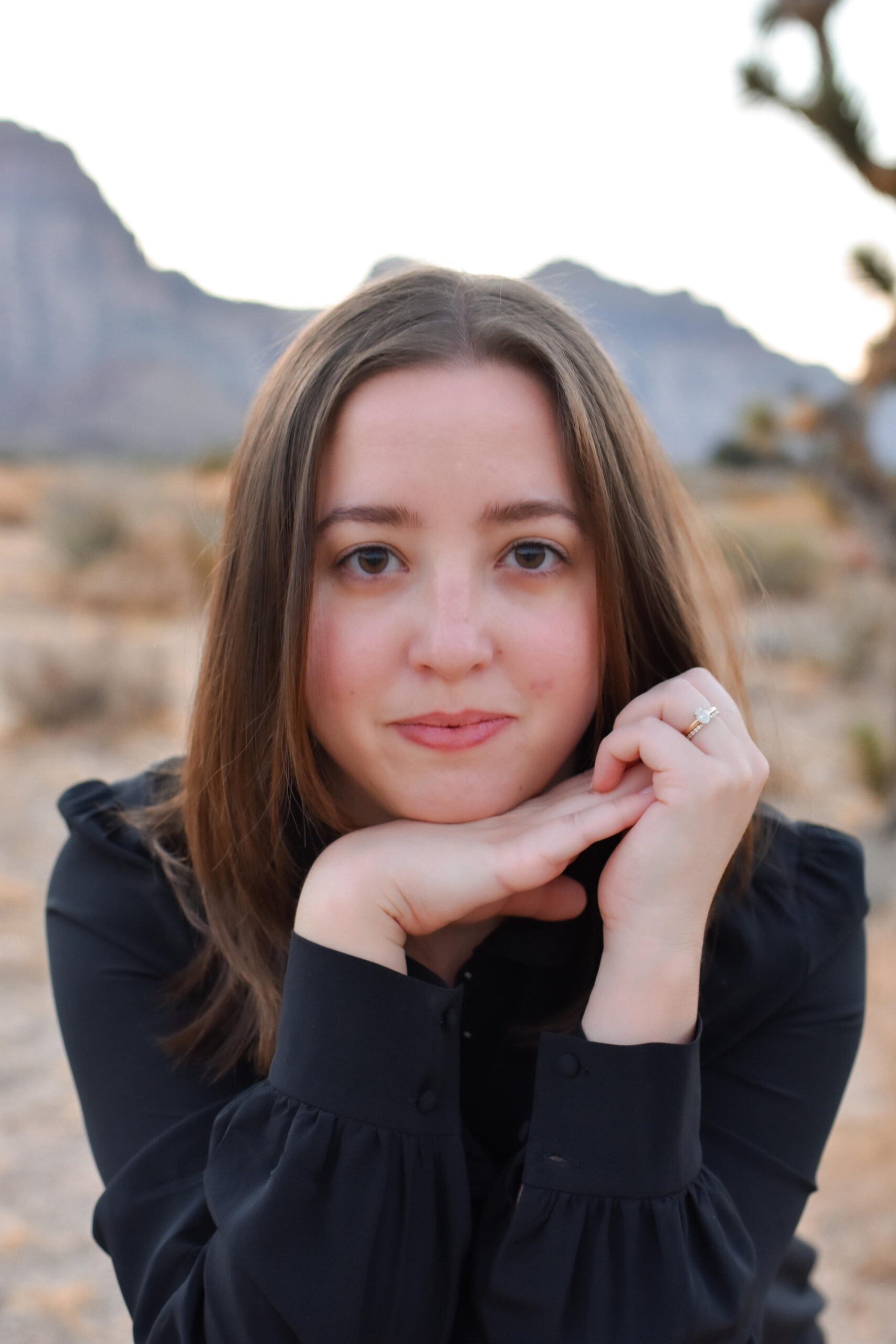
How can forms of grief serve as a form of protest? What are the ways in which we inhabit states of mourning? How can we articulate the gestures and movements of survival? Gasher Press editor Whitney Koo’s debut poetry collection Any Gesture (Black Lawrence Press, 2026) maps the complex landscape of grief and what it means to live after encountering death. This landscape is not a neat or productive one, nor is it inherently full of meaning; rather, this landscape is creviced with shadows, specters of twins and doubles, black holes, and also flashes of shimmering lightness. I was delighted to interview Koo about how this astonishing collection came together.
Wendy Chen: In the poem “Any Gesture,” which the collection takes its title from, you write “Good grief: the work of the living. ...To know you must start again / but cannot get beyond the gesture” (53). The work of grief, the work of surviving after grief, of “start[ing] again” but failing, perhaps, to do so—these are central questions to the collection Any Gesture. Later in the poem, you write “Good grief tells us Get up! Go to work!” which I see as a commentary on the ways we are often expected to process grief—that is efficiently, with minimal disruption to our lives. Your collection is powerful for the ways that it works against this injunction, lingering instead in the “gestures” we try to take to live after grief. Can you discuss the importance of the gesture, and what it means to this collection?
Whitney Koo: Traditionally, the central task of the elegy is to reanimate loss and provide resolution or consolation for those left behind—a desperate task. What is interesting is how the tradition has, historically, then been manipulated for other more sinister intentions: civil obedience, gender oppression, and capitalism, preying on readers at their most vulnerable and seeking times to fulfill these agendas. For example, we get the word elegy from the ancient Greek word elegos, which was a term to describe (in addition to a couplet comprised of a hexameter and pentameter) a male-performance of grief (a mournful song), sung singularly, at professional spaces, such as the symposium or public festival, while women performed a lament, called prothesis, later in private, as public displays of excessive mourning were banned as being uncivilized in the 6th century BCE. So, elegy began as a civic duty, one that women threaten. Later, in the 15-17th centuries, we have another kind of professionalization of grief in The Elegist, who was someone hired to write and deliver an elegy beside the grave, and those elegies were also printed and sold for the occasion. So, for men, the elegy was a performance of genius, and it was meant to console, to make sense of death, and to instruct the survivors on how to “get on with it,” namely by turning back to God, the church wanted people to reinvest in it. It was religiously seen as a crisis of faith not to move on, and we see this distinctly in a pamphlet put out by a preacher of the time that criticized women who were grieving excessively—and we continue to see this attitude adopted in our contemporary times in which you are expected to carry on after these mass shootings, after the industrial war machine wiping out populations of people...
Women have always been the ones to care for the dead. Kim Hyesoon said that death was women’s language. Before funeral homes, you kept the body at home, and it was the women who sat with and prepared the body for burial. Then in the 19th century Queen Victoria popularizes elaborate mourning rituals (Hamlet gets put back on stage in London) and evolving from that later in the 20th century in the work of poets such as Slyvia Plath in the sixties, we see more women refuse to hide their grief and rather embrace a “melancholy knowingness” as Karen Weisman writes—which I see as a living with death that is particular to women—and I was thinking about this history while writing the book. The refusal to tidy up death for convenience or for the sake of productivity serves as a form of protest. The gesture is that melancholy knowingness.
WC: The title of the opening poem, “Shuyet,” meaning “shadow” refers to the ancient Egyptian belief of this shadow as a representation of the self, as part of the soul. Throughout Any Gesture, you also explore the idea of darkness through the concept of black holes, such as in the poem “Black Holes and Memorial.” As a reader, these images lingered with me for the ways they reflected on grief, absence, and loss. How did you come to these focal images for the collection?
WK: Any Gesture often gets misread to believe that the character Sister and the character Ophelia are the same person, but they are actually two different people: my older sister who I was pre-mourning when she was very seriously suicidal and a teenage girl from my childhood, renamed as Ophelia in the collection, who died by suicide while I was at her house and her parents were out-of-town. They are often read as one person in the book, and this was intentional because the central idea of the collection is the haunting of loss, how it lingers and recolors our days, plays tricks on us—what we think we hear or see—and so the person is both forever present and absent. You are not haunted by the person; you are haunted by the loss of that person, their shadow. So, the void that is loss becomes particularly consuming and destructive, much like a black hole, not only in how death serves as this crossing over into the unknown place of no return, but also how that absence is consuming of those that remain behind—and the black hole emits sound and energy, a lot of people don’t know that, and I think of this energy and these fragments produced from loss as the haunting.
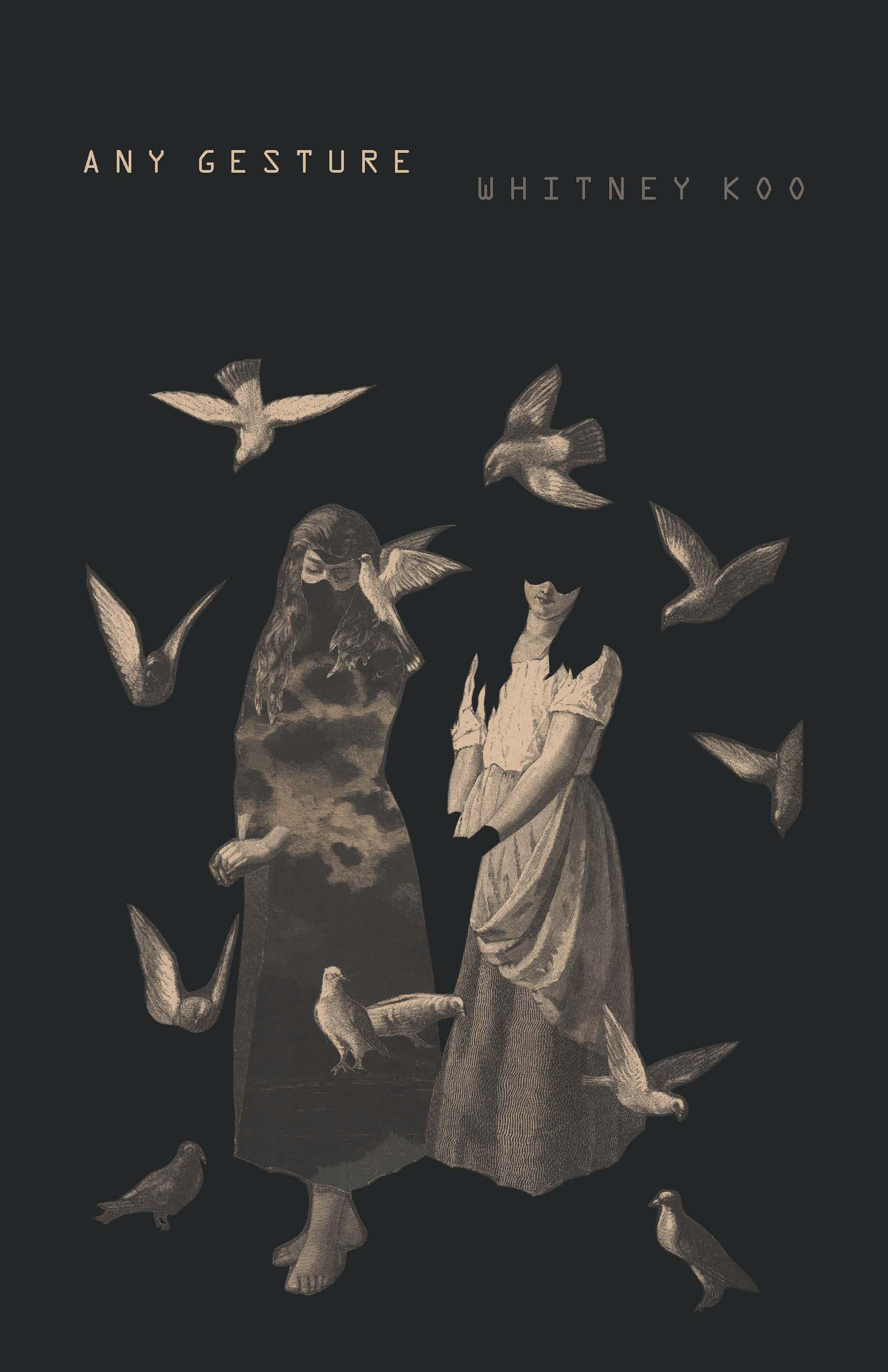
WC: This image of darkness is reflected on the cover as well, the image of two women standing side by side in the same pose, one with clouds and shadows on her dress, the other with black hair and hands. Thus, intertwined with this theme is also one of doubleness, twinness, or another self. At certain moments in poems, we see a noticeable distance from the body and the self, particularly in moments of grief or fear, where the body or self is viewed almost as another separate figure, such as in the poem “The State.”There is also the idea of the sister figure as another self, for example in the poem “Sister as Outlasting Character” where you write about a “doppelgänger sister.” What draws you to the image of a double or twin? What can viewing the body or the self as a separate other reveal about ourselves or our identities?
WK: Elegy is not an excavation; it’s a collection of fragments that we piece together in narrative to suggest reanimation and wholeness. With that said, I felt it was important to keep the narrative project visible throughout the collection as a kind of ethics. What right does the elegist have to speak for the dead? I think of the pastoral tradition, which was very popular among elegists in the Victorian era, and I think: these are characters—the dead man is now a shepherd surrounded by nymphs? No. The dead man is now the most righteous person to have ever lived? No. These are stories that give us meeting-places, termed by Muriel Rukeyser, to reanimate and visit our departed loved ones in ways that sustain time, for our own sense of survival as those left behind to deal with this incredible grief. Twinness is a form of mercy we give ourselves to process the most painful aspects of life.
WC: Any Gesture has an incredibly inventive and moving structure, which intersperses poems with pages that have a single line of text running vertically down the middle. This vertical text is made up of about 20 sentences, some of which continue across multiple pages, and examines black holes, the process of reading and writing, love, loss, the passage of time, aging, and more. I find the texts on these pages quite moving in the ways they reveal the inner life of the writer of the book. Visually, there is something beautifully gestural about their presence on the page, and they function almost as a spine to the body of the collection. Can you speak about this choice of structure and formatting for the collection?
WK: The vertical running “ticker” came at the very end of the drafting process. The book’s subject is quite heavy and requires some points of brevity, whether in syntax or humor, to ask anyone to stick with it until the end, but also, melancholy is a useless emotion, and a major project of the book was to refuse to make grief productive or meaningful. When I, as the poet, am present on the page, it isn’t with genius or importance per se, as the elegist historically has represented themselves to be. Rather, I wanted to be there pathetically. Death didn’t make me a better person. Death is simply the end of life, which is to say, when we stop making death mean something, we allow it to move beyond language, our framework for being, to possibility—similar to a black hole: we think whatever falls into the black hole is forever lost, but only if we think about it being lost in relation to being on our side of the black hole.
WC: While reading Any Gesture, I was struck the ways that the figure of Ophelia comes up, again and again, in the collection. A character from Shakespeare’s Hamlet, Ophelia is the archetype of a tragic female figure, who eventually goes mad with grief and drowns. What draws you to the figure of Ophelia, and what other texts or kinds of media were you engaging with while writing Any Gesture?
WK: I was deeply concerned with the ethics of elegy while writing this collection. Part of my emphasis on the role of narrative in elegy is to highlight the ethical concerns of the tradition (who gets to write the last words about this person’s life, which they will then be represented by in death?). I chose Hamlet’s Ophelia to represent the teenage girl, we’ll call her M. here, for three reasons: 1) it calls attention to the narrative quality of elegy, and how it fictionalizes real persons, 2) Hamlet is put back on stage in London during Victoria’s reign, which marked a time of real anxiety about death, and Ophelia becoming a celebrity figure of the time is the response of that obsession and anxiety, and finally 3) Ophelia’s character is a teenage girl who ultimately dies by suicide, so I could rely on her character to give readers background of this event and person without having to exploit M.’s life and death for context. M. has a family who shares in this memory of loss—and I both recognize that what I write is my experience, but it is not only my experience—so I wanted to honor her and them a degree of anonymity. Loss is private, and I wasn’t interested in laying it all out for others to take part in; my goal was to speak to the aftermath that loss has on the surviving person. I have a severe anxiety about death, to the point that I cry if my spouse leaves the house some days because I’m convinced he’ll die if he does—that’s the legacy of witnessing such a violent death at such a young age; it lives in my house, in my clothes, in my child’s face...
WC: Can you tell us a little about this collection’s journey? What was the first poem you wrote for this collection, and how did you decide on which poems to include? Were there any poems you ended up excluding from the collection?
WK: “Shuyet” was the first poem I wrote for the book, and it just so happens to have remained as the first poem in the book. I wrote the book probably four times, finishing it and deleting it, rewriting it and deleting half of it, rewriting and deleting half of it again. I had a great friend from my MFA that I sent the manuscript to when I was really stuck—I’d spent my entire PhD in a writing slump—and he, very honestly, said, “I don’t understand, you used to be such a good poet” (sounds harsh but you have to hear it in his very loving, supportive voice). Hearing that gave me this incredible permission to delete everything, and I leaned into weirdness a bit more. I was stuck because I was trying to be very serious, death is very serious, but it’s also strange, unassimilable, and unknowable—so I reapproached death on the page as this field of imaginative play, and then the book started to take shape.
WC: What was the revision process like for Any Gesture? What was the most difficult part of revision?
WK: The hardest part was finding restraint and variety. I have these three narrative threads (four if you include the vertical ticker), but I didn’t want the book to pursue the project so heavily that it became trapped by the project’s narrative, writing into the form rather than the form opening doors to new corridors of thought. I ran into that problem several times, where the book felt one-note or circling too tightly around itself. I don’t have a good answer about how I went about fixing it, I just tried to take an editorial eye and rid myself of feeling too attached to any one poem.
WC: Do you have any advice for revising or editing a poetry manuscript? What advice would you give for emerging writers, or what was the best piece of advice you received as a young writer?
WK: I’ve always had a real affinity for poems that heavily fragment narrative in favor of essence, but it takes incredible skills in craft to do so successfully. My mentor during my MFA, Noah Eli Gordon, RIP, one day looked at me while we were discussing my poems in his office and he said, “what are you trying to say here?” So, I told him plainly what I wanted to say, and he placed a pen down in front of me and said, “Write that. Sometimes, you can just say the thing it is you want to say.” Recently. I was speaking to a graduate workshop class about the press I run, Gasher, and about our editorial approach. I said we didn’t like cleverness, and the students were confused by this. When I say cleverness, I mean that emerging writers sometimes work too hard on the page. They want genius but end up doing gymnastics, and they can rely too much on the subject or project to produce interest in the collection. What I’ve learned, and continue to develop in my own writing, is to strive for a sustained attentiveness, which doesn’t need decoration to generate emotional response in a reader. It is the difference between essence and subject; one has a pulse that pulls you, almost unwillingly at times, like a river’s current, through a collection. The other is just talking loudly.
WC: You also serve as the executive editor of Gasher Press, an independent press that publishes poetry, chapbooks, and multilingual books and books in translation. How does your experience as an editor influence how you write or revise your own work?
WK: I read my own work as I would read other manuscripts in a submissions pool, which can be helpful in some ways and maybe also unhelpful in other ways. It has taught me a great deal about ordering a book and trajectory. I see manuscripts that place the poet’s favorite poems first, or worse, they favor the poems that were published in the best journals, whether they make sense for the book or not. I think books of poetry are not simply collections of related poems but that each poem serves as a limb or organ of a living thing, which is to say that I see books of poetry as being quite physical in terms of movement rather than narrative progression, which may be because I grew up dancing and later spent time working as a choreographer and dance instructor. I think a poet should approach their book as a terrain: where are the hills, the shaded areas, the ditches...I have a lot of poems that never come out of the drawer, and some that have won prizes that I chop down and rewrite for the hell of it—I think poems are created, not birthed, so I don’t see my work as being overly precious—and so when I put a collection together, I am looking at the book in terms of a “variated terrain of emotions,” a term that was taught to me in undergrad by Joshua Marie Wilkinson; I arrange based on movements layered to create shifting pace and depth—something with a gravitational pull and center much like in dance.
WC: What are you working on next?
WK: I recently finished drafting (which is a redrafting of an earlier version from last year) a new collection about my experience with postpartum blues. I couldn’t stop crying for weeks after I delivered my baby, and my anxiety was debilitating. And then Trump was elected for a second term a month later, and the world quickly went deeper into hell, and I should have been in this joyous time in my life, but it wasn’t, and I started to ask myself the question, “How complicit are we in our own demise?” In the book there are a lot of circles, women from Greek tragedies, attempts at naming things, time, the body—all around a good time.
Whitney Koo is the author of Any Gesture (Black Lawrence Press, 2026). Her work has appeared in Poetry Magazine, Georgia Review, Hayden’s Ferry Review, the Los Angeles Review, Colorado Review, and others. She holds a PhD in English from Oklahoma State University and an MFA from the University of Colorado Boulder. Whitney is the Executive Editor of Gasher Press.
Wendy Chen is the author of the novel Their Divine Fires (Algonquin) and the poetry collection Unearthings (Tavern Books). Her poetry translations of Song-dynasty woman writer Li Qingzhao are published in a collection titled The Magpie at Night from Farrar, Straus & Giroux and Penguin UK. She is the associate editor-in-chief of Tupelo Quarterly, and prose editor of Tupelo Press. Currently, she is an assistant professor of creative writing at the University of Nevada, Las Vegas.