
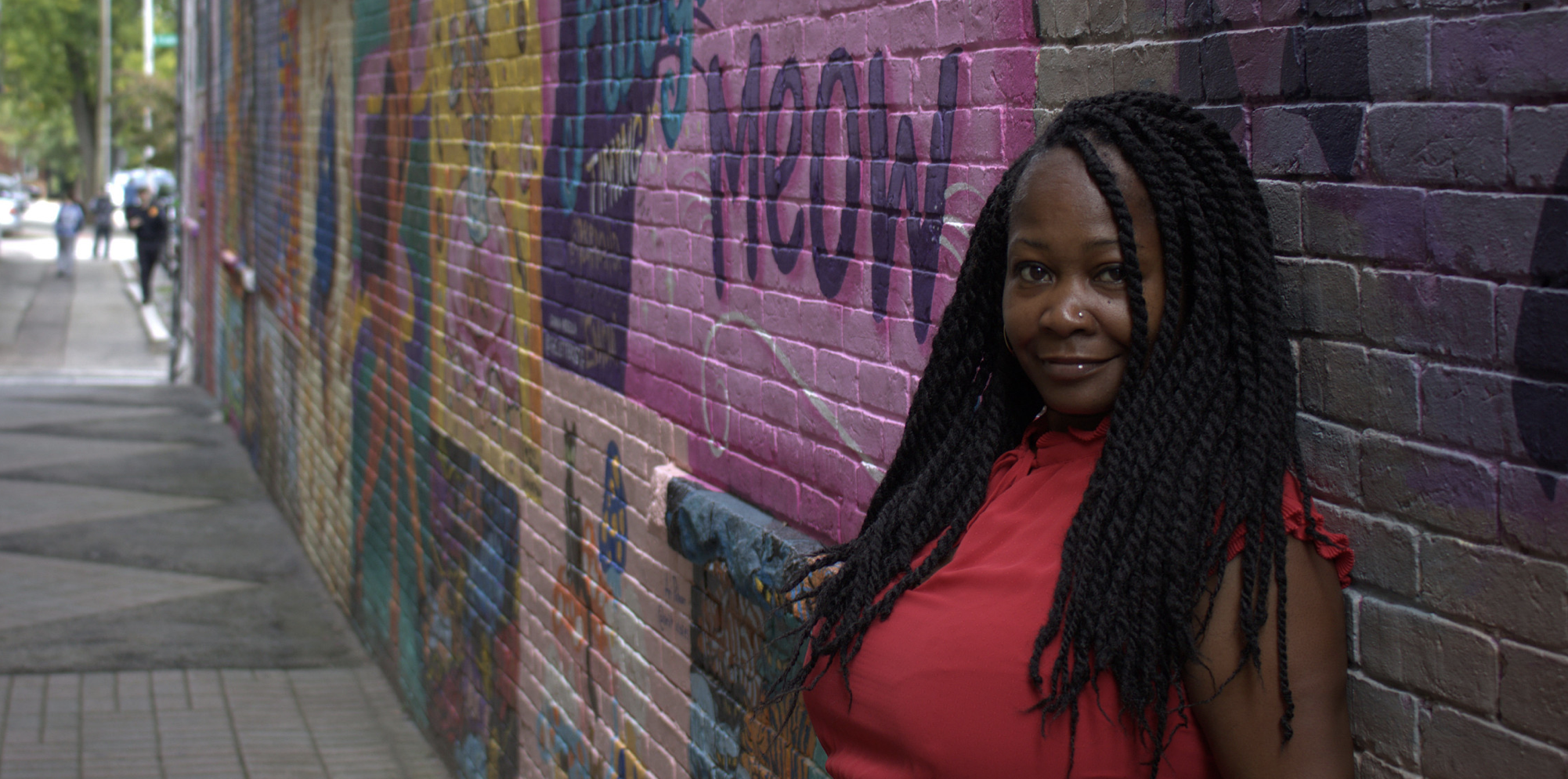
Shanta Lee Honeycutt is an award-winning visual artist, writer across genres, author, and scholar who often says she is a “...practitioner of entanglement” for all of the ways she brings things together in her work.
Winner of the New England Poetry Club’s Grant for Poetic Achievement, Abel Meeropol Social Justice Writing Award, and a 2024-25 National Arts Strategies Creative Community Fellow (the outcome of her fellowship can be seen on the website she created, Foodmemorystories.com). Her work has been widely featured in the Edinburgh University Press journal, CounterText: A Journal for the Study of the Post-Literary, The Poetry Foundation, Harper’s Magazine, The Massachusetts Review, ITERANT Literary Magazine, Palette Poetry, and elsewhere, alongside several published books. Her latest 5th book, Do Words Dream Themselves Into Silence Told In Riddles? (Harbor Editions) is a hybrid collection of prose, poetry, and visual elements that explores themes of the uncanny, psychological unrest, and the blurring of reality with dreams, and other things unseen with the help of a trickster entity. To see more of her work, visit: Shantalee.com
Abigail Ardelle Zammit: Although Do Words Dream Themselves into Silence Told in Riddles? is a much more playful and wildly experimental collection than Black Metamorphosis (Etruscan Press, 2023), your engagement with the themes of hunger and cannibalism persists: from hunting and predatory sexual practices to sin eating and ritualistic consumption of wafer, body, word. I am intrigued by the idea that the hunted can also become predatory, that the quarry’s skin has as much agency as the knife that skinned it.
Give us an overview of how your research into hunting practices paved the way for a philosophical enquiry into what it means to kill and consume a body. How is it like consuming a text? And more dangerously perhaps, what does it suggest about the co-creators-consumers of this incredibly hybrid collection?
Shanta Lee Honeycutt: The predecessor to this collection, my chapbook, This Is How They Teach You How to Want It… The Slaughter: A Field Guide for the Hunted & the Hunter, The Dead-Alive, The Live-Dead Ones, The… (Harbor Editions), was really the root of this. The concept for the chapbook is linked to my deep fascination with Wilde Jagd, Wild Hunt or Chase in German — in which supernatural/ghost riders are pursuing a target. Each time I heard versions of this mythology, the images of what this could look like took up residence within me.
I explored this mythology in addition to thinking about what it actually means to hunt and the concept of slaughter. I thought about the distance we have from what we consume and its end point (most of us, for example, have never snapped the neck of a chicken, skinned a rabbit, or hunted for our meat...this does not include practices of using all parts of the animal for living). So, I thought about that gap. It did not work out for me to go on an actual hunt, so I looked at a number of videos (and field experience is the best, so I do want to go observe hunting at some point). There was one video I found in which an individual talked about a way to keep a goat calm just before a slaughter was by folding its ears over or covering its eyes.
I also asked several people about the concept of the bloodless slaughter based on the feedback from one potential publisher who stated that they did not see enough blood in what I was presenting. It got me thinking and I kept saying to myself: The bloodiest slaughters – especially what humans can potentially do to each other just on a psychological level – are bloodless. I thought about all of the instances of hunting and consuming between humans and watched shows like Obsessive, which features a main character I would identify as a huntress. I sat with questions that you could say continued into the fuller, current collection. But this time, instead of exploring levels of the hunt within or across all spectrums of life, it is about the chase within and outside of perceptions of reality.
What does it mean to be consumed by a dream or a figure that may or may not be real? And for that matter, returning to one of your questions, what is consumption?
I believe we can be consumed by things and that things (people or places) can consume us. And by consumption, it can be through longing or desire, or a curiosity. Like many things, consumption or desire is a continuum. It also makes me think about this level of inquiry: If we consume or can be consumed (or have something take up space within us) on physical, psychological, and psychospiritual levels, shouldn’t we consume wisely and carefully? Or be consumed consciously?
On another level, when we think about American culture, there is so much within the language that is all about consumption which feels hollow or very base. Phrases like “food porn” or any upcoming series where potential audiences are told that they can “binge watch.” All of which leads to an outcome of a quick fix with no real depth. To clarify, that is not the kind of consumption I am after or interested in.
When I think about the human relationship to consumption, I am really also talking about the ability for one to give themselves over. So to consume a text (I love that question by the way), hmmm....I want to use an example of the book I ache to touch and see in person. The Voynich Manuscript within the Beinecke Rare Book & Manuscript Library is a 15th century text that is one massive mystery due to everything, from its symbols to the unknown authorship. It is in their storage and can’t be taken out for viewing due to its fragile state, but that kind of thing makes me salivate. If I think about the way I have the feeling of longing to see the text, touch it, and sit with its unknown nature, it helps me answer how I enjoy consuming texts. They have to stay with me after I’ve read them, leaving memory and touch points unforgettable. All the better if there are different textures and layers of meaning and some mystery.
I seek to create work that invokes hunger or longing, creative work that calls forth a need and desire, perhaps one never realized before, along with the invitation to go “there” and beyond. When I consider what this work says about those who consume it, I’d like to think that they are fearless in terms of how they engage with text or even think about it. Perhaps they long for adventure and this allows them to journey mentally. Maybe the most ideal consumer is as dangerous as all of the questions that I have been sitting with to create this work. On a most simple level, the ideal audience or reader starts with a “Yes,” open to the call of the adventure that exists within the pages.
AAZ: The ritualistic elements of Christianity, particularly the idea of transubstantiation and communion, are neatly melded into your creative enquiry. Murder, fanaticism and perversity are fodder for the uncanny, offered to us via poems and short stories like ‘When He comes, Will You Be Ready?’, ‘Sisters of She of Feral Souls, She Thanks, and...’, as well as all those references to criminal nuns and scandalous convents.
Since you say that you are ‘a sucker for all things horror and true crime’, to what extent is this a way of engaging with your favourite genres? How much of your creative practice is deliberately iconoclastic and to what extent are you writing in order to destabilize systems of patriarchal control?
SLH: I have had a love affair with horror ever since the drive-in movies my parents would take me to when I was a little girl. This latest work was most definitely an avenue for me to dive into everything, from the titillation of an unsolved mystery or bizarre cases, like the 1929 Lawson Family Murder (the photograph just before it happened is what called me in immediately), to the way that the real horror can be more nuanced. I can’t quite say I have fully earned my stripes to be a Shirley Jackson disciple, but I adore her ability to take something as mundane as a train ride (like in her short story, “The Witch”) and place the reader on edge. This was definitely an opportunity to not only explore horror, but to play with the concept of whether I could take a dive into what starts to cause an internal unease. The scariest forms of unease, in my opinion, are those aspects that we refuse to look at within ourselves, or the things that may come out to play when our eyes are closed (within our dreams).
My creative practice is not really about destabilizing a system, but starting with seeing if I can sit with shaking things up within myself or inviting another to set with the uncomfortable. When it comes to thinking about systems and how I co-exist with them, my question is always this: If we do not wish to cooperate within the system, do we have something better to offer in terms of solutions? In other words, can we start with and within ourselves? It is kind of like my thoughts about decolonization before jumping to tear down what we think is not working. Are we able to start with where the gaps are within ourselves, and then close those gaps through meaningful action?
Personally, I find starting with the self is the hardest part. Thus, the systems that I am most interested in bucking up against are the ways that individuals hold themselves back. My goal has always started with you, the reader, the individual in the world. How can I help you realize your freest state of being through either questions you were too afraid to ask, or pathways you have not thought about taking? Is there a way that seeing me risk, or you walking into the adventure I invite you to take, will dare you to do the same for your own life in your own way?
I have long joked with myself that if I did ever lead a resistance, it’s bound to be one of helping people be their most selves in the world because life’s too short for anything else. Even if being their utmost self invites them to dare ask themselves what they wouldn’t dare utter out loud.
I also wish to present uncomfortable truths and possibilities which in and of themselves are destabilizing. For example, how uncomfortable is it to know that the concept or line of human insanity may not be there at all? Or the idea that we need certain images or perceptions to stay exactly as they are – like the concept of family – to keep our fragile selves intact?
AAZ: Towards the latter half of Do Words Dream Themselves into Silence Told in Riddles? we come across a short biographical note on ‘M.M. Jones’, supposedly a musician who is collaborating with you on ‘a short run of modern murder ballads to accompany’ this collection. As an interdisciplinary artist working with photography, curation, radio, film and text, how is this fictional collaborator and alter ego relevant to what you call ’the practice of entanglement’ and the construction of your artistic persona? What is its relationship with Goonphucker, a guest-trickster that speaks in riddle and rhyme, appearing and disappearing with the ebb and flow of the text, book-end and gangster-entity that dabbles in edges and white spaces?
How much are these creations essential in allowing you to approximate filmography, the visual arts and musical composition where characters, personas and musical motifs do not disappear at the end of a composition, but keep being resuscitated and revised? To what extent is this a way of engaging the reader/spectator beyond the page?
SLH: M.M. Jones offers an existential space in the same way that Goonphucker does (although, Goonphucker is more complicated; I will leave that there for now). The best way to describe the persona is like putting on a different outfit that represents one of my many selves. They also have rights in that these different selves or characters will want to play things out a bit more off the page until it is time to move on.
As it relates to this specific collection, these themes and characters have some other lives in store, but they aren’t coming on the ride in the next manuscript (if I have anything to say about it, ha!). Beyond this, I am always interested in engaging the audience beyond the page. I bellydance and having performed on a stage in that way, I think about how the reader is taking the words into their body, treating the page as a stage in terms of exploring all of the edges, movement and space for rest on the page. I also like to think about how words rest within the body.
My ethos for going beyond the page involves thinking about these questions:
How does, or can an image embody the sonic?
In what ways can words – through prose or verse – be kinesthetic upon our engagement with them? I will talk a bit more about this in the next question you asked.
In what ways does smell or taste enter into the conversation with words? This reminds me of the time that I collaborated with an organization for the launch of my first book, Ghettoclaustrophobia: Dreamin of Mama While Tryin To Speak Woman in Woke Tongues (Diode Editions, 2021), and they commissioned a special chocolate bar for one of my poems during the launch event. I had the audience eat the chocolate bar as I read the last piece of the book.
And this is balanced with thinking about how, where, and when the work wants to be. Not every work will always lend itself to going beyond the page. Collaboration has also played a huge role in navigating the answers to your question. I have often collaborated with my husband, Damon Honeycutt, who is a composer, martial scholar, educator, and performer. Our collaborations have added more flavor to these ideas and questions about the work living off the page. Additionally, from a creative business perspective, it allows the author to explore the different lives of a text or book, rather than the traditional or usual channels.
AAZ: Very recently I encountered three poems from this collection in Ploughshares (Spring 2026) and I could not help admiring your ear for rhythm and rhyme, particularly the way they blend effortlessly with the vernacular, sometimes creating an eerie and unsettling effect, at other times playing and replaying the sonic and thematic refrains of this 200-page collection so as to impart a sense of cohesion and order even within that which is of necessity—for it reflects the ordinary insanity of the human psyche —disorderly and chaotic. I take the liberty to quote from the lyrical ballad ‘Catechistic Danger’ (162):
Am I in the lake where my bones are buried deep?
Am I over the sunrise hill where my breath holds still?
Behind your eyes, lids kept shut, is there a secret that you keep?
Am I the one who’s been tricked? Am I the one whose life has been spilled?
Do you hear the beat and voice of your polyphonous speakers before they come to you in poems? How does one practice the art of metrical entanglement? Can you tell us more about the ballad form as a mode of inspiration and whether you really intend to pursue it in a future collection?
SLH: Here is a funny thing. One of the many reasons why things – appropriate and inappropriate – are so funny to me is because I can see them unzipping as a fully-realized visual sequence. This goes for everything, from a good story to the disclosure of a secret. So, in some cases, I can “see” the scene and hear the various voices.
One instance where there was a literal scene that was already laid out was within the film written by Veronika Franz and Severin Fiala, The Devil’s Bath. The film was inspired by the book by Kathy Stuart, Suicide by Proxy in Early Modern Germany: Crime, Sin and Salvation. Both of these sources inspired the two-part long poem in the book, “Suicide By Proxy: Suicide by Sacrifice.” The second part of the poem is based on a story from the Crow Tribe. The first part of the poem was born out of me trying to imagine myself into what it might’ve been like to be a wife in Medieval Germany, very much like the character portrayed in the film. I was trying to imagine myself into that character’s space and body.
When it comes to metrical entanglement, Annie Finch is really the Queen of poetic meter. My time working with her was illuminating and it was when I constructed this piece that you quoted. The ballad as a form, historically, is really useful in so many ways. I really engaged with the form in my work focused on the first known African American poet, Lucy Terry Prince (c.1730-1821), in Vermont. Her poem, “Bars Fight,” is a ballad that lasted for 100 years in oral tradition due to the form, and the way it carried the historical information of the second raid on Massachusetts. That engagement with Lucy Terry Prince and the only surviving poem of hers that we know of, showed me the strength of the ballad when matched with skill and strong content.
“Catechistic Danger” and its form was inspired by events where I felt trapped, powerless, and claustrophobic. I was living in a place that was a contested space and I wanted a form that would mimic my emotional state while encapsulating actual events of that moment, as well as extending beyond them. Otherwise, it becomes journalism (which is also one of my mediums). But when engaging with hybridity through prose and poetry, or working to rough art, I am always asking myself the question: how does this elevate beyond, “This happened, then this happened…”?
Given all of these elements, I needed something that could be as relentless and make the reader have a feeling of unease, unrest, with no clear out. I feel like a pantoum could have also worked to evoke the same kind of feeling. Metrical entanglement involves listening, paying attention to where rhythm may appear (for example, can a film follow the same rules of meter or form when viewed from a certain vantage point?). And being unafraid to take the risk while also being very open to how things may shapeshift (which is part of the surprise). I find working with poetic meter can seem and feel intimidating, but that is the joy of it.
I am working on a few future projects so there may be a chance that engagement with metrical entanglement will be brought forth.
AAZ: The start of this genre-bending, almost unclassifiable collection can read as an instruction manual where the readers/spectators are asked to ‘risk the untruths’ (‘Prologue’, 13) and to trust that ‘everything always teaches you how to read it’ (‘Instructions’,15). There are poems that start from the end, interrupted texts, anecdotes and fictionalized memoirs resumed across many pages, erasures, concrete poems and chunky sections of the collection hidden away from the contents page, only to be discovered in between the pages.
How has your interest in film and pop culture allowed you to envisage this broad canvas of creative jouissance? To what extent is this formal play a political statement on the illusion of being within space-time? Who is the ideal reader of this Borgesian ‘Book of Sand’ and what are the responsibilities of the creator vis à vis the peruser of this artefact? To what extent can we expect readers/spectators to become active participants in the creation of meaning without feeling discouraged or overwhelmed? What breadcrumbs have you scattered in the process of teaching us how to attempt to answer the collection’s many riddles?
SLH: Pop culture (whether it was pop of some other era, known as classical or vintage now) or culture from any period plays a huge role. I keep thinking about how song or visuals stay with me well beyond the credits. For me, it is everything such as: the Lynchian, as in David Lynch, sense of the surreal through film while leaving the audience with a feeling of, “What I just...Oooook, I am strapped in” ; a well-crafted music video (I am thinking of Lorn’s “Acid Rain”); Maya Deren’s experimental film work (and really any experimental approach to film); and the way that films like Nocturnal Animals, Longlegs, Honeydew, Persona, and Enemy (to name a few) all contain unease for different reasons, or leave the audience without a tidy ending.
I am fascinated by anything that can visually unzip the uncanny while also leaving things unfinished. The tidy ending never made sense to me, so movies like Braid leave one with more questions than any neat and tidy answers. Braid is fascinating – I would describe it as the sister film to Clockwork Orange – for the way that it was one of many inputs for the foundation that is this current book. In my epigraph for this collection, I included the three rules that the film embodies and shares with the viewer:
Rule 1: Everyone must play.
Rule 2: No outsiders allowed.
Rule 3: Nobody leaves.
The movie leaves the viewer wondering if the game is still taking place. And in many ways, I want the reader to leave asking if the game or the adventure still continues outside of the pages.
Art movements have also played a huge role in this latest collection. I really appreciate the vision put forth by surrealists – taking the unconscious, the dreamworld, and what’s locked within ourselves and putting it out visually, in such a way that forces individuals to reckon with what they are each carrying inside. Of course, these things never exist in the absence of outside events. In this case, the surrealists are in direct conversation with the surround of what unzipped out of World War I.
All of these inspirational sources and the way I play with the concept of time are not so much any kind of political statement, but I feel like I am still forming how I would articulate my relationship with space, time, and how I engage with it across any of my work. This is ironic because as of this moment, I am in the middle of a major move, so thinking about time, space, and how we relate to it is visceral!
Goonphucker is a concierge while the white space, in combination with the notes at the end, help to provide rest spots for the reader. I designed the book to truly be a “choose your own adventure.” The breadcrumbs for the reader include the instructions that start the book and also the fact that this book can be started from anywhere, with no specific sequence. The back of the book includes some notes that can also invite the reader to do more exploring.
At the heart of the collection are two things that feel like the world needs more of: play and mystery. The book, as serious as some of the topics are, also extends to the reader an offer of play while saying, “Hey, something is tugging on your sleeve. Come along.”
AAZ: My favourite section of this book is ‘The Abridged Index of Place’, by M.M. Jones, appearing on page 73 and followed by its separate table of contents, a full fifty pages that never feature in the initial contents page. The first subsection is set in India and teasingly entitled ‘Memory Works Like Jumping from Julian to Gregorian: What About That Manor?’ Every time the narrator re-tells the story, there are new details or variations on the same detail, and while admitting that memory is fallible, the narrator can’t help declaring: ‘I remember every detail.’ What lures the reader is the suggestion of a phantom traveller, and those colourful splashes of colour in an otherwise clinically-white house. ‘How does a place perform normal?’ we are asked. Within which simulation of reality have we been living, we might ask, once we discover that the Indian concierge who gave the narrator a room was a ghostly presence leading her into an invisible part of the building?
I am very much interested in the poetics of place and how artists make room for space and silence within their media. You write about the rules of place and how bodies act upon and are acted upon within place. What is the relationship between place and body? What is it like to be inhabited by place and how can creatives allow themselves to be inhabited by the places they fall upon? How is it that ‘places eat you in exchange/for the stories you tell about them?
SLH: Place and body sometimes can be the same in that the same way a place teaches us how to be with it and within it, so can a body. In some ways, one dictates the other. Think about how we may need spaces augmented so that we can navigate them more easily, or the way that we step into a place and it will force us to obey without ever saying a word?
To be inhabited by a place is no different than having a lover, in my opinion, or maybe a place can be that one friend who is, well, a little bit of a lot of things. My piece in this collection, “Don’t Blink: Curse of the Relief Who Hides in Plain Sight,” is about an actual relief I encountered in Savoca. And oh man, not only did that (and does that) place have a room inside of me, that relief I saw was very fascinating. I could not and still can’t quit it. Much like that particular friend or lover, a place can lead you to keep thinking about it or wish for just a moment within it to ensure that you have etched every part of it into your knowing and being.
There is also the risk, the whole idea of places eating you. Like anyone we come in contact with, places also have some kind of rule about how you engage with them. Will you show up with respect? Will you arrive thinking you are going to take without paying an exchange rate? One place I am thinking of, or a few, includes the Appalachian region and New Orleans. I have yet to visit both, but both of those places feel rich with a requirement for one to arrive and be ready to pay (and no. Not with cash).
Creatives should allow themselves to be inhabited by a place or places often. Go to a place, even if that place is your home, and open yourself to it. Let it lead you. Step away and see what stays with you. I had an experience once of going back to where I grew up, Hartford, CT. What was fascinating was going to different places like my old elementary school, my old high school, even the street I would walk down to go to high school, and feeling like I was an archaeologist just seeking to explore what the place might tell me about whoever crossed its path. As an opening, perhaps go back to where you grew up. Explore it as if it were its own character with its own story to tell...
Abigail Ardelle Zammit is a Maltese writer, editor and educator. Her poetry collections are Leaves Borrowed from Human Flesh (Etruscan Press, Wilkes University, 2025), Portrait of a Woman with Sea Urchin (London: SPM, 2015) and Voices from the Land of Trees (UK: Smokestack, 2007). Abigail’s poems, translations and reviews have appeared in international journals and anthologies including Ploughshares, CounterText, Tupelo Quarterly, Modern Poetry in Translation, Action, Spectacle, Black Iris, Trafika Europe, Smokestack Lightning (Smokestack, 2021) and The Montreal Poetry Prize Anthology 2022 (Véhicule Press, 2023) amongst others. Abigail is currently researching desert landscapes from around four continents and her most hybrid collection :deserere #desertum is forthcoming with Tupelo Press (2028).