
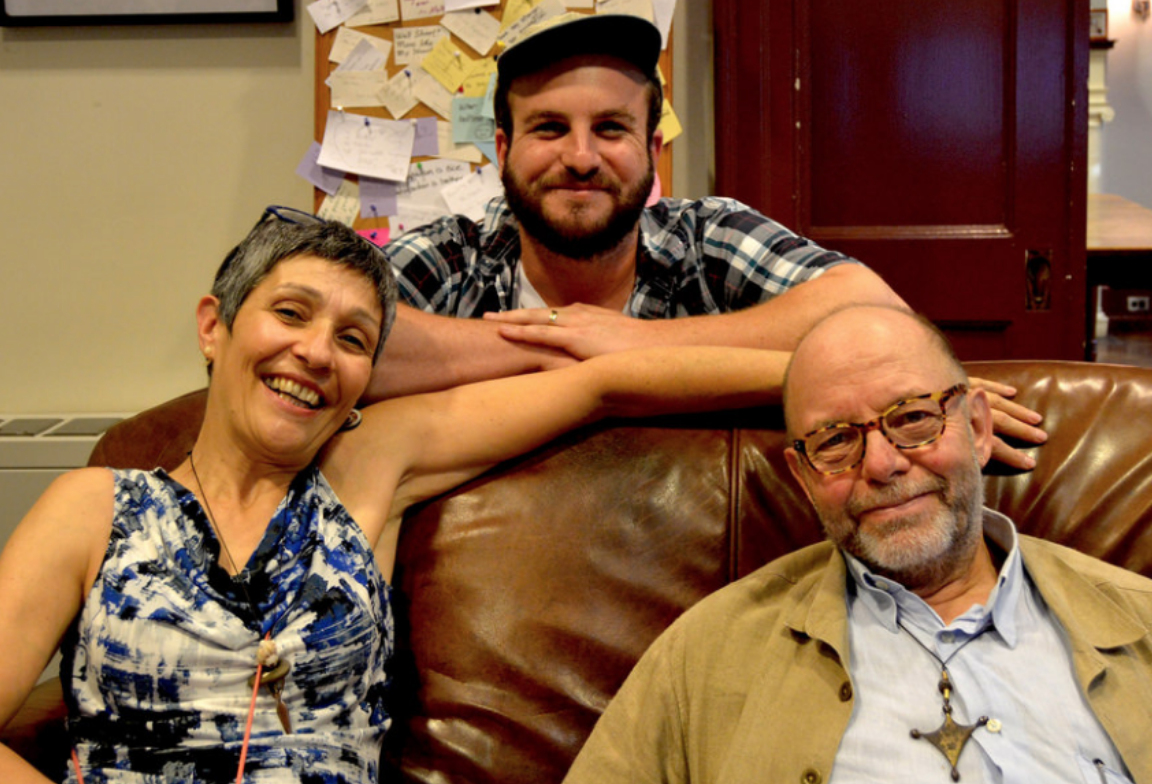
It is my great honor and pleasure to be here with you all this evening celebrating Pierre Joris, whose 80th birthday it is today, tonight, at this very moment. Pierre is no longer with us, a fact I am still contending with and everyday adjusting to wrapping my mind around — that he had to move on when he did and is now traveling safely, as he would always say of his own friends who had passed: travel safe poet, with no known return in sight. Diaspora even in death, even in dying a sort of diasporic release from any origin or center.
At the end of his life, Pierre was ready to depart, but he told me that he feared that we — those who loved him — were not ready for him to leave. And we weren’t ready, not in the least, one rarely (if ever) is; and his death was a tremendous loss for all of us.
Yet, the first time I returned to Pierre’s study after his death — the room where we had sat and talked and worked and wondered and wandered in our thoughts late into the night and early in the morning — sitting for the first time alone in Pierre’s room, I had a profoundly incongruous experience of his absence. In Pierre’s study, I felt more the sweet spaciousness of his presence than the claustrophobic void of his death — felt the opening of the space he had left when he left us, the space he opened for all of us in his generosity of writing and thinking, and for those of us lucky enough to have known him personally, in his friendship and love.
The poet Harold Schimmel used to say, my friends are never gone — look here they are in their words. And I feel this way about Pierre continuously, that he is never far from reach, even as far as his absence may stretch, for his words are bridges and crossings. As I sat in his study for the first time without him, I did not feel without him in the least, but rather intensely and intensively with him, through his notebooks and library, his prolific writings and translations, the long biography of his nomadics now inscribed within my own sense of how a poet (or noet) moves through and between worlds – as the Yiddish ethnographer, Shloyme An-Sky writes – across multitudes:
procession of planets
poured forth from drain of not-saying
reiterative, thought for thought
not from song exactly, but bewildering seedling, sensually green,
song nonetheless you tongue a corrective
springs forward gleeful greeting you at every opening
in tadpole vision—thin with purple lenses in
joy & possibility, irreparably
you signal a far star (mazl) for jerry to ferry
us here among the constellations
& there, pierre, dear infectious wanderer
pondering still, pours forth speech
in dense ice tread slipped to desert flow
or shaggy moonscape, a paradise of poets
my friends are never gone
in the slow suspended phrases I hear—
such unapologetic swagger, so very them
what the old rockers didn’t get
that these aren’t chords at all, their made up
only john & alice, pharoah & mingus
to think of jerry & pierre’s
california in this way
in encinitas, san francisco, or even berkeley
smacks ears with subtlest glimpse
& no small street mammal in the least
but to dwell in dense poem-scapes
& good to live with a cat (that’s jerry)
at calling forth—out from without
from within a wisdom in music
(the creator has a working plan)
that song soothes in song
& you begin at the beginning & go on
unless you live in the song, the music
the poem
my friends are never gone
you mutter the matter at-hand, upending
ceaseless voices living loves who join the ancestors
look, here they are in their words, worlds, thoughts, dreams
stay the course, pouring forth—
Ariel Resnikoff is a writer, translator, editor and educator. His most recent works include the poetry collection, Unnatural Bird Migrator (The Operating System, 2020), the chapbook, raisin in every bite (Furniture Press, 2022), and with Jerome Rothenberg, the translingual epistolary collaboration, A Paradise of Hearing (The Swan, 2021). His poetry and essays have been published widely and appear or are forthcoming in Boundary 2, Golden Handcuffs Review, The Brooklyn Rail, Dibur Journal and Full Stop Quarterly. Ariel is a translator of Yiddish and Hebrew poetry and prose, and his own writing has been translated into and published in German, French and Russian. He has taught poetry, translation, non-fiction and multilingual diaspora writing at the Center for Programs in Contemporary Writing (University of Pennsylvania), and at BINA: The Jewish Movement for Social Change. In 2019, he received his PhD in Comparative Literature and Literary Theory from the University of Pennsylvania, and in 2020 he was selected as a Fulbright U.S. Scholar.