
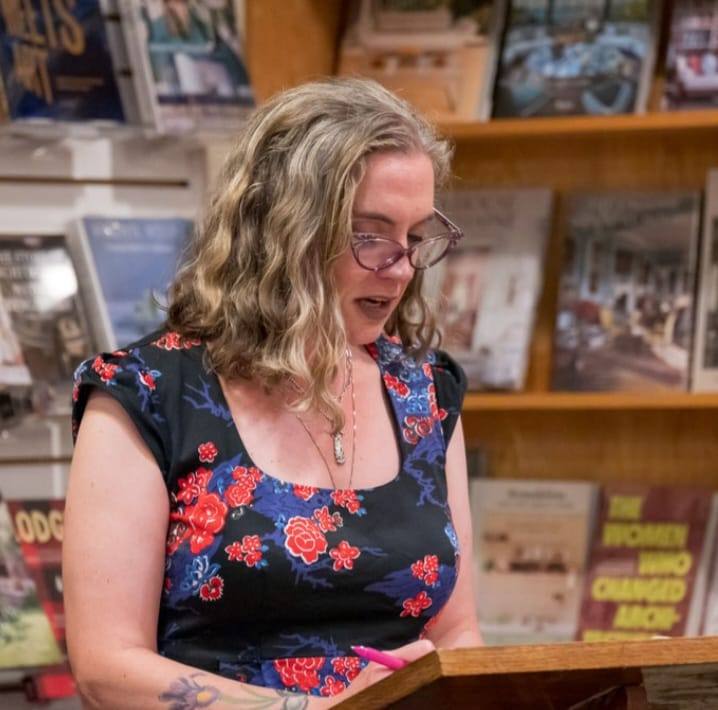
“Be Kind Rewind: Where Poetry Meets Proust,” an interview Series by L.J. Sysko
Poetry writing is a holistic proposition, and I believe we ought to talk about craft granularly while we discuss the psychological growth and wellbeing (or lack thereof) that drove it. Since high school, we’ve rightly been New Critically conditioned to separate the speaker from the poet, but I want to restore unity for the sake of this discussion about art making. While we’re feeling retrospective, let’s admit old-school pop cultural influences, personal milestones, relational drama, and makeover montages into the record.
L.J.’s rules of the game:
“The Proustian Questionnaire” is a parlor game lauded by Marcel Proust, the French writer, for its revealing power. To poet-guests, I present all 35 original quiz questions with the Be Kind Rewind version riding parenthetical sidecar—like a madeleine beside the tea. My poet-guests select six from the list to answer: two from The Now, two from The Then, and two from The Way Back When.
Let’s get started:
Jessica L. Walsh’s poetic voice is quintessentially hers–a distinctive, tell-it-to-ya-straight, hardscrabble rasp replete with nihilistic humor, punchy syntax, and a frank wish for our well-being. In her latest collection, Blowdown (Small Harbor Publishing, 2026), mysteries of family genealogy accompany first-person Gen X survivor retrospection. Walsh’s “scared-fierce creature / with neither path nor camouflage” is just one of many characters featured in her mid-life speaker’s commanding tableaus of will and woe. Ancestral receipts tally to this question: What price survival? Answers arrive in the form of Walsh’s finely staged narrative poems, which trace the overcoming of fear (and that survival-mechanism fierceness, too) in arriving at “blowdown,” a term borrowed from volcanic aftermath, which–in Walsh’s metaphoric reckoning–portends a family tree razed. This is a tree felled by natural causes, but it’s due now for a post-mortem: regret, remonstration, and–best and most optimistic of all–wizened and witty reconstruction. For those nostalgic for an earlier era, Walsh is from Then and she’ll dig Farther Back and Farther Still just to show us both our original hubris and then our nostalgic hubris, incisively impugning bloodthirsty quests for trauma’s inheritance. Blowdown is a complex project directed by a poet who’s fully herself–capable of managing a large cast and centuries of history–wielding a badass attitude just to cut the shit and tell it to us plainly: this time, don’t repeat history.
I interviewed Jessica about her book, her writing life, and the truth of how she got Here.
LJS: What is the quality you most like in a man? (The BKR version: When you reflect on your growth as a poet—in terms of craft, process, practice, or psychology—what sticks out in your memory as a seminal moment? Or has there been so much drama that it plays in your memory like entropy’s movie soundtrack?)
JLW: My most important moment was sobbing in the parking lot of a McDonald’s where I’d pulled over because I was crying too hard to drive. The short version is that I’d been crushed by the failure of friends, colleagues, and even family to show up for a book launch [two books ago: The List of Last Tries, Sable Books, 2019]. That was the worst I’ve ever felt as a writer, which is saying a lot, because creativity is inherently vulnerable and results in so many difficult moments. But what that crisis gave me, eventually, was a secret garden, to borrow a metaphor from a childhood favorite. Once I was inside, I understood that each poem’s significance lies in its existence, not its reception. That secret garden, walled off from almost everyone, is where I write now. My decision to come out from behind its walls and show what I’ve cultivated is a separate process with distinct meaning. How well or poorly my poems are received out there doesn’t change how much they meant to me back inside. I absolutely love connecting with readers, and their feedback means so much to me. But I cannot depend on others to feed me with validation. I needed that rock bottom to figure out how my poetry could matter to me even if it didn’t matter in what you refer to elsewhere as “Poetlandia.”
L.J.S.: And then, by absolute contrast, you’ve had the experience of total strangers showing up and ringing your poems’ doorbell unannounced! Your viral poem–”When My Daughter Tells Me I Was Never Punk” [from Book of Gods & Grudges, Glass Lyre Press, 2022]—do you mind very much telling me the story?
J.L.W.: You know, the funniest thing...I like telling the story because I think it lets everyone off the hook, okay? There’s a wonderful Gen X-ness to the fact of how it went viral, which was that I did nothing. The poem had actually come out, something like six months-maybe a year previously in a journal called Nixes Mate. And I had shared it, and, you know, people were like, “Ah, cool”: “like,” “thumbs up,” whatever. But then a marvelous writer named Jessica Cuello– she’s incredible–just happened to take a screenshot of the poem and share it on Twitter (back when it was still Twitter and not Elon-owned yet). It just started–for whatever reason–catching on, but I was unaware because I was only marginally on Twitter, until a couple friends of mine told me.
It was...I hate to say it, one of the most deeply uncomfortable experiences, the visibility of it. I hate to say it because it’s supposed to be what you want, right? It’s the thing.
L.J.S.: Yeah, like: “Man, if only we could rustle up some damn readers around here.” And then you get them...
J.L.W.: Right. I think what bothered me was that I started feeling like there was something I was supposed to do, right? I had a couple friends who do different things online–one who does some kind of influencer stuff–reach out to me and say, “Here’s how you need to work on this; you should contact this person, build your brand, do this tie-in; send to this person; work the phones; call this person at NPR, whatever; email these people and say, ‘Hey, I’m happy to talk about this poem...'”
L.J.S.: I see.
J.L.W.: And this was after the “lowest point in my poetry life.” I’d been absolutely devastated and it had taken me a long time to get back. In fact, I had just finished this essay where I was explaining how I had pulled myself out of it–how my therapist had pulled me out of it. I don’t want to say I did it myself because she really pushed me to do some incredibly hard work. And I had come to this place with Book of Gods & Grudges coming out where I thought: there’s this invisible jury of six or seven people in my head, and if they like it...if those people happen to respond to me and say they like the book, I’m good. That’s it.
And I was genuinely feeling that. I had truly let go of the idea that anything I wrote was going to be some kind of breakout. It was just a testament to being able to do it.
L.J.S.: Can I ask you, were those six or seven people hypothetical or real people?
J.L.W.: No. No, they were real poets in my life. I still have never told them. Some of them are poets most people would never have heard of; they’re just people I feel connected to because of the quality of their work, but also they’re genuine people, the kind of people whose opinions really matter the most to me. So, yeah, the viral poem was strange and then it was fun because I just let go of that expectation too, and I was happy to sell the books.
L.J.S.: That’s interesting to me. You actually saw conversion off of that viral poem to book sales?
J.L.W.: Yeah. Yeah. And, I mean, for poetry...but I still think I’m the kind of person who feels like I’m kind of not getting it quite right. I feel like I’m missing something all the time. I’m just that hard on myself. That doesn’t change; to have that poem out there and be a viral thing, I didn’t suddenly think, “Ahh, this is a peaceful feeling of satisfaction and success.” It still felt like....
L.J.S.: Did it feel like dangerous exposure?
J.L.W.: It did feel very exposed. I tell people, there’s no way to predict, there’s no way to write for an audience or predict who will get what. There’s no formula of posting, or, you know, search engine optimization that’s involved. It just...happened.
L.J.S.: I think the beauty of that is: you hung a painting on the wall and people walking by the gallery backpedaled and said, “Oh, shit! Did you see this?,” elbowing their companion in the ribs. On some level, that’s the best initial human reaction you’re gonna get to your art, you know?
J.L.W.: I can’t look back and recall the exact moment I started most poems, but that one, I do have a really very vivid image because it was during COVID. I was sitting in my garage because we have a townhouse, and the three of us were home, and I was gonna lose my mind; it was too small and I was too close to everyone.
And I sat in the garage with a space heater and my winter coat on–looking like Bernie Sanders at the inauguration–
[Laughter.]
And I’m out there writing to my best friend, Amy. We’ve been friends for over 30 years, and we had just been joking about some text we’d exchanged about something really mundane: just...she’s got three kids, you know, I’ve got one, we’ve got our jobs, we’ve got our spouses, we’ve got...our lives are “regular” now.
But at one point, we were really tearing it up when we were young. We were in trouble together a lot. So we would occasionally stop and just be like: “What happened?” Because...how did we become this thing we definitely were making fun of? 18-year-old us would have been like, “We’ll never be suburban sellouts. Moms who do whatever.” And there we were.
So we would joke about it, but then she’s also really helped me reframe a lot of things about some hard points in my life, and one of the things that she really emphasized was giving myself credit for surviving the hard things, not blaming myself that they happened. As in: “What were you thinking? How did you get into that situation? You shouldn’t have done that.” But saying instead: “You did want to live enough to fight through it.”
“When My Daughter Tells Me I Was Never Punk” was a poem I wrote, drafted really quickly, and I sent an early version to her and said, “I wrote this for you.” So, it’s this really specific personal thing, and I think that also made it strange to see so many people connecting with it because, to me, it was a poem for Amy. Even some of the choices that I made about what was in the poem were because of what she knew and what she could understand without me explaining it further.
L.J.S.: Salient details like the day you “threw [Charles’] keys in the snow?” We don’t really need to know that whole saga, but we can infer how much bullshit had been surrounding that moment because The Amy In Us already understands. That’s it! That’s why the poem holds us in thrall...because we feel seen, understood, known, and trusted to just get it. There’s real belonging elicited by the recognition of Gen X women readers feeling those contexts. Bless you for not explaining!
J.L.W.: Yeah. I was grateful, and I think one of the coolest things that has ever happened to me is getting emails and messages from people literally all over the world. People who would message me about what the poem meant to them. And... most often, they were not “poetry people.” They were people who were telling me about what they’d been through.
L.J.S.: Wow. Damn.
J.L.W.: You know, an email from somebody in Australia, who’s like, “I tried to kill myself when I was this age,” or “I’m over my addiction for this long,” and, I mean, I’m just getting chills thinking about it because it was so...remarkable...
L.J.S.: I can’t fathom it. I can’t.
J.L.W.: I spent the time to respond to everyone and tell them how grateful I was that they had found the poem. Somebody wrote to me and said he read it to a friend who was dying.
L.J.S.: Ah! [shouts]
J.L.W.: And she was... and he read it to her, and it made her happy.
I’m gonna start crying.
Genuinely, that’s the part that was amazing to me–that there were people–and that’s why when there are things said about “accessible poetry”–somebody just said it to me recently and I went on kind of a tear about it–because in Poetry Land, it’s not really a compliment, right? It’s like “commercial fashion.” To say “accessible poetry”...
L.J.S.: I think that’s a baton that narrative poetry is hit with, especially, and poetry that centers the domestic lives of women, too, gets cudgeled.
J.L.W.: The idea that that’s an insult, I... I don’t care anymore. I went to school, I got a PhD, I am reading Dickens for fun, I love dictionaries, my vocabulary’s pretty good, I’m a nerd, but I learned very much from my dad, who is probably the smartest person I’ve ever met, that if you have the luxury of getting an education and being somebody who can just pursue things because you’re curious, what that entitles you to is the ability to reach more people, not to hold them at arm’s length because intellect is not a weapon. You should not go, “Look at my language, it’s better than yours.” It’s not a cudgel that separates you from the masses. It’s not about hierarchy; it’s about you saying, “God, I’m so lucky that I got to go do that.”
It’s so cool to ask, “How can I reach people because of it?” And that’s it. That’s what we should be doing. We should be thinking about how can poetry actually touch other people, whether it’s to make them laugh or voice their political anger, or to just give them a minute to breathe, like a good haiku. You read good haiku, and you’re just like...
L.J.S.: ...when it sort of moves through you like a wind...
J.L.W.: Yes. And you get one deep breath? What a gift that is.
L.J.S.: Right, and how hard it is to do! I’m just thinking about these antithetical experiences for you–that you had to get the shit kicked out of you at your terrible book launch in order to write this poem to Amy. You needed to go through that whole churn to settle with an answer to the question, “Who am I talking to?” It turns out there are a lot of Amys out there.
That concertedness of your voice, the inheritance of real challenge and its conversion to something optimistic is what these poems are about in Blowdown. I really think that’s the subject matter of the book: moving from fear to new territory, traversing what’s in the middle–survival.
J.L.W.: I tend to go through these really deep dive, obsessive reading binges on a subject, and they’re usually non-fiction, usually history. Blowdown began with research about Mount St. Helens’ eruption, and then I starting reading about volcanoes, and I remembered how I thought plate tectonics were cool, how it was a big disaster for the lumber companies that owned huge swaths of land around Mount St. Helens because of this wave of heat and wind that descended down the mountainside and all the trees got blown down–millions of trees just blown down and stripped. So there are these great images of what looks like a close-up of hair on the back of an animal. But it’s all full-grown old-growth forest with trunks just laid on top of each other.
That’s referred to as “blowdown.” In the lumber industry, these trees are worthless, so I thought about surplus of this kind: lumber everywhere and also none. I was also delving so much into family history. (I reference in one of the poems about getting rid of the family tree: pulping it [“With My Boots On”]). And, so it was this fourth level reference to a worthless family tree. Here’s my family!
L.J.S.: [Laughs.] I know what you mean by “fourth level reference.”
J.L.W.: I was hoping to put together some pieces. How my family got to where it was because we–the four of us: my parents, my sister, and me–were incredibly cut off from the family beyond. A lot of it geographically, but the rest of it because of protectiveness; my parents decided that, and rightly. But I always missed extended family; I remember a girl at school, her grandma dying, and she was devastated, and she wept for days, and I was so jealous because I just wanted a grandparent that I loved enough to grieve when they died.
L.J.S.: There’s that poem in Blowdown, “Punchline, 1981,” in which you’re left with your father’s father so your folks could go Christmas shopping? And there’s a jump cut in the poem where you obviously don’t sketch in why you and your sister have huddled in the corner weeping, waiting for your parents to get back, but it’s effective! That’s what I mean by tremendous narrative control and skill to render a scene and invite inference without also recruiting frustration in the reader. Certain external conflict is withheld from the reader and we’re left to imagine; it’s like the volcano...you don’t have to see the volcano erupt in order to dwell in its aftermath.
J.L.W.: I tried a million times to explain, to fill in that part of the narrative, but it didn’t work because everything had started off from this really tiny spark that one of us wouldn’t eat the fried chicken he thought of as a big treat. And we were–my sister, or me, one of us–peeling off the skin and saying it was gross, and that was it. He flipped out. And he was drunk already, and then he was throwing food at us...
Like chucking it, and there was no way to write that without it belittling the sense of danger that you feel because it’s essentially a story about somebody getting mad about chicken. And so there’s not a way to divest that from the humor.
L.J.S.: I fully understand; there’s something underneath that about living with alcoholic inheritance and rage-filled houses and co-dependence and the acute self-monitoring that is required to be in those places. You know, it’s very hard to write those scenes because, in some ways, they come out...comedic. And it’s not...
J.L.W.: ...that’s been my defense mechanism on that story until I wrote this poem. My whole life. We would joke about it in my family. This was the first time that I just sat down and thought, I’m gonna recognize this as a really horrible, scary experience that my father, especially, was devastated about for the rest of his life because he felt that he had failed us by leaving us for a couple hours.
L.J.S.: Right, because he knew. He knew.
J.L.W.: He did, and he was hoping. So many children of alcoholics and children of the abused are always hoping that maybe today will be okay, maybe this interaction will be okay. I think, when my grandfather did finally die, my dad’s grief was a little complicated because he wasn’t sad about him being gone. But something ends then. The chance for there to be a good day is not available anymore.
L.J.S.: Atonement is never coming except in our fantasies, and even those have to be releaseed back into the wild too. Although this brings me to my next question about those for whom we hold out hope, imagining ourselves communing with them, even if only through poems:
Which historical figure do you most identify with? (BKR version: If time travel were possible, to where / to whom (poet) would you most wish to transport? Secondarily, which version of yourself would you like to send—current you, childhood you, struggling you...?)
JLW: When I was in graduate school for literature, I came across a somewhat lesser-known poet named Charlotte Mew. The faculty at Iowa wouldn’t accept dissertations based on a single author back then, so she was relegated to a chapter of my PhD work. But she sustained me in a dark, lonely time—her unmistakable style, the vicious tenderness, the sense that she was fighting for her life through such brilliant and frenetic poetry. I would go back to 1928, before she took her own life. And I’d hold her hand and tell her how 100 years later she’s still blowing the minds of her readers. That she’d be free to love and even marry a woman. That there were treatments for her and her family members’ mental health problems. I’d tell her to stay alive as long as she could, because we needed more of her poetry, and because every day would bring her closer to what’s unmistakably a better time for a woman like her (and how hard to remember in times like these—that this era is still better). And I’d listen as long as she wanted to talk. Forever. When I left, I’d tell her that I am the guardian of her own copy of her first book, and that I cry every time I open it.
LJS: What do you regard as the lowest depth of misery? (BKR version: When you’re most in need of reminding why you ever liked poetry in the first damn place, what do you read?)
JLW: I have three pieces of poetry that consistently bring me back to the art. First, and far more popular among today’s poets, is Brigit Pegeen Kelly’s “Song.” The strange familiarity of its landscape, the spell cast by its imagery, the deep pain that emerges without directive to the reader (I hate being told what to feel). Its cadence and wording, the sense of being thrown into an epic—I can’t even begin to describe it.
Second, there’s an excerpt from a speech of Othello where he defends himself against accusations of witchcraft in is courtship of Desdemona. And what happens is this perfect poem that absolutely sings, lulls, seduces. To the reader or audience, what becomes apparent is that poetry itself is, in fact, a kind of witchcraft, though not what he is accused of. [“She gave me for my pains a world of sighs. / She swore, in faith, ‘twas strange, ‘twas passing strange, / ‘Twas pitiful, ‘twas wondrous pitiful.” (I.iii.184-6)].
Third, believe it or not: Tennyson. I love “The Lotos-Eaters” with all my heart and maintain it’s one of the most remarkable poems out there to address today’s culture of optional apathy versus wretched reality. Formally, it’s brilliant, getting sloppier to mirror the cumulative effects of the flower. At its core, it’s about whether and why we should care when caring means such pain. Best of all, it doesn’t really ever answer its own question. One could read it and see surrender—reflected by the sailors who vow never to leave—or they could see the miserable, dutiful turn back to the world, suggested by the fact that the episode is adapted from The Odyssey and readers know the men do leave the island in the story.
This is a lot of words to say that good poetry brings me back to poetry.
L.J.S.: My favorite poems in Blowdown are next to each other: “A Girl Walks Out of a Bar” and “I Cry All Morning and Pick a Fight in the Afternoon.” I just love the tightly choreographed pas de deux between narrative control (mediated pace, deliberate withholding, eruptive dialogue) and voice (plain speech, varied syntax, sardonic tone). I mean, I feel like these are the t-shirt poems of this book. I crack up at the first lines of “I cry all morning and pick a fight in the afternoon”: “I hate myself for both / but I also get to hate / Tim the Librarian. / Breaks up the circle.”
Your wit is addicting. And offhanded nihilism as an antidote is ambrosia.
J.L.W.: Anger is something that has been the defense mechanism of women in my mom’s line, especially, and it’s a way to approach what’s wrong in the world– a last ditch effort to stay this side of the abyss, right? Because what’s your alternative? Despair.
I remember our English professors at the end of my undergrad did this funny little thing: they wrote Future Fortunes. It was a small liberal arts school, so there were maybe 30 of us; so you have the picnic on the professor’s lawn, and everybody knows each other so well, and they...share these funny little, “In 10 years, where will they be?” messages, and mine was: “Running a bar.”
I thought...wait, what?
L.J.S.: This was revealed in front of everyone else, too? Or was it given to you on a piece of paper?
J.L.W.: They read it in front of everyone, so it was meant to be a funny thing. A really good friend of mine was going to be a “New York Times bestseller,” and then...I was gonna run a bar.
L.J.S.: I’m not sure which of those is the worst curse, by the way. But... I’m so vicariously angry for you. This feels, again, like a very familiar way to marginalize a bright young woman who’s arriving someplace important in her development by dint of intelligence and some modicum of toughness, too. Not because she wished away her softness but because toughness was intrinsic to her survival. And then to be criticized for it, as though it were a liability? There’s no end to the looping fuckery.
Think about this in your poems!: the hard-won wisdom of your voice cuts right through to my soul. And the gallows humor is, unto itself, a bit of terminal logic. We’re presented with these antitheses: I could be good, I could be bad; my family tree could redeem or it could indict; we don’t know which one’s which, so what’s the inexorable truth of existence? We’re all gonna die anyway. With you, we end playing in a pile of bones and teeth.
[Laughter.]
J.L.W.: I reacted very viscerally when The Body Keeps the Score: Brain, Mind, and Body in the Healing of Trauma (Bessel van der Kolk, Penguin, 2015) came out. It became part of this pop psychology online where everybody was internalizing trauma response and victimization. It’s just the cynic in me, but it felt almost like letting myself off the hook for things in a way that I didn’t think I should.
What’s the role of generational trauma when the generations don’t pass on their stories?
LJS: Blowdown features no shortage of ancestor-self interrogation. Poems like “The Coldwater State School, 1927,” “Family Day at the Preventorium, 1930,” and “The Boy in the Barn, 1929” trace dramatic bifurcations in the family tree.
But, I was agog when I read the title, “Plymouth, 1620.” Come on, man! The Mayflower?! Really?
JLW: My mission is to atone for that. I found out I had an ancestor on the Mayflower while researching this book. But he was their mercenary, Myles Standish. The Mayflower Society and all of that, it implies elitism and generational wealth, but in my case, it’s not true. It’s important that I am actively involved in making lives better because I can look back and say this person hurt people, right? I can’t even claim altruism, right? I can’t even pretend that my ancestor was such a fervent believer that he risked everything. No, I think he just talked himself into a corner. He probably was like, “I can defend you; yeah, I’m a captain; yeah, I’ll take some money for it.” And then all of a sudden, he’s on the fucking Mayflower, and he’s like, “Oh, these people are annoying.” He literally–once they got settled–he just left.
L.J.S.: He said, ‘I’ve had enough of this religious sect. I won’t be...’
J.L.W.: He literally did. At one point, he tried to negotiate a peace treaty and came back carrying someone’s head. And I thought, Oh my god! It was one of the Wampanoag chiefs.
L.J.S.: Oh my god.
J.L.W.: And I was like, where’s the part where I’m supposed to be fucking proud of this? No, I’m horrified. But that’s what it is to grapple with white American genealogy, which is extremely focused on redemptive moments, like when I found the Underground Railroad guy and that’s what I’m supposed to do is tell everyone, “You know, one of my great-grandfathers made his house a station on the Underground Railroad.”
That is a thing that exists, but it does not exist independently, it doesn’t erase blindnesses and injustices.
L.J.S.: If you cast the net far enough back–provided there are records available to you–you’re bound to catch all manner of angels and villains–the occasional saint or odd criminal–but mostly folks will be in-between. Sorta boring.
J.L.W.: Well, and, you know, six or seven generations from now, they’ll be able to look at my life and ask, “How could she? How could she have just done that without thinking?”
L.J.S.: Yes! On any number of issues: sat through climate change...
J.L.W.: Completely. I had to move away from some of the results raked in by genealogists because there was the tendency to seek little badges–good stories of people doing the right thing–but I also need to acknowledge that in ways that I can’t even fully understand, my life is the result of terrible things. And even though I am not somebody who is upper class, we still have had opportunities through the centuries that undeniably were just stolen from other people. So what’s my responsibility as their descendant? And I think that poem was really about not picking a comfortable way to understand this but selecting the realism instead.
LJS: What is your greatest extravagance? (BKR version: Describe The Zone—your most luxurious and extravagant minutes or hours spent writing a poem, a book, a line, a rhyme.)
JLW: Two years ago I went to a retreat center for three nights. This wasn’t a residency or workshop, which I rarely apply to (if I’m lucky, I get 10 hours a week for writing, so spending half of that putting together an insanely long-shot application for something funded or a slightly less long-shot application for something I can’t possibly afford isn’t worth it). This was just a center that holds group retreats but leases out the little one-room cabins individually between events for a very cheap rate. There are no lights on property outside your cabin, no wifi or signal, no phone, and it was half a mile to my car. In the cabin were some basic instructions, including where to find the birdseed to fill the feeder if I wanted to. And reader, I did not. I was so desperately in need of time in which I tended to no one that I told even the birds that they were on their goddamned own. What felt unsettling for a few hours soon became magical. I drank coffee, ate my desserts before any meals I’d packed, wore pajamas, and wrote like crazy. I think I drafted 10 poems in those days, an unheard-of pace for me. One of the poems ended up being “I Fed No Birds,” and it’s in Blowdown. The selfishness of it was absolutely luxury. And I know we’re in the “self-care” era when I’m not supposed to see it as selfishness, but that’s what it was—and it was a luxury a lot of people never experience.
LJS: How would you like to die? (BKR version: As you stride to the podium to accept your Giant Award, what does the speech in your pocket say?)
JLW: I can’t stay true to who I am and think much about awards, but I love this question because it gives me a chance to say that my speech would just be Aaron Smith’s “The Pulitzer Prize”:
He won the Pulitzer Prize
and died. She won the Pulitzer
and also died. He died,
but before he died, he won,
too. He won a prize
that wasn’t important
and died. He won the Pulitzer,
the National Book and died
eventually. He won more prizes
than she did, then he died
and she died. He won the Pulitzer
young, but nobody read him
after he died. Someone told her
she’d grow into her Pulitzer,
and die. He said he nearly died
when he found out he won:
he hasn’t died but will
and soon. Everyone says
he deserved the prize after
he died, but they gave it to her
who was alive, and she finally
died. He won the prize in two
genres and died. They split
the prize and will die.
The runners-up the year
they gave no prize died.
This year’s winner will die.
Last year’s and next year’s, too.
I’m not trying to be an asshole about prizes in general, but I do think they have the power to reinforce hierarchies in problematic ways (re: who is fit to judge, the illusion of objective ways to assess art, the status of winners versus the rest of the world, the prize as key to the gates) and are quite often reliant on networks of power that people like to pretend do not exist. And please note that Pulitzer Prize winner Diane Seuss herself sent me this poem after she won it, which cracked me up.
LJS: What do you most value in your friends? (BKR version: What advice have you gotten in workshop or elsewhere that’s stuck?)
JLW: There are two items that have blended together to become the best advice ever.
First: My husband believes in me to an extent that amazes and humbles me. He’s not terribly interested in poetry, but he’s intensely supportive of me. Years ago, around the time of that major breakdown / breakthrough mentioned previously, I was spiraling a bit about how I would never make it to any bigtime level of success. I mentioned some people who seemed (I know, “seemed” is a problem) to rack up win after win, spend their summers in Tuscan villas or whatever, and just generally live charmed poetry lives.
He leaned forward on the couch, pointed his finger at me like a coach at halftime and said, “Walsh! Look at me. Do you know how those people got to where they are?”
I said yes, mostly.
“Okay,” he said, “Tell me what they did.”
I did.
“And do you want to do that? Do you really want to play that game? Because you can. If you want to, you can do all that. You have the ability.”
I thought about it. “No,” I answered. “I really, really don’t. It’s not me, and I’d be faking it.”
“Okay. Then you play your game. Play your game, Walsh. Stop trying to win theirs.”
I mean, what a goddamned gift.
Second: Diane told me years ago to trust my gut. This was in the context of a longer conversation, I believe, but I haven’t dug up the emails or messages and wouldn’t want to share that anyway.
For decades of my life, I had a hard time figuring out what was “gut” versus, say, my old friend “anxiety.” But through doing some uncomfortably hard therapeutic work, I have come to understand how there’s a frequency in my body that differs between instinct and fear. I physically feel them in different parts of my chest and stomach, so I can distinguish one from another.
So every single time I make a decision about the poetry world, I say to myself, “Play your game, Walsh. Trust your gut.”
I say it to young writers in my classes now: Play your game, trust your gut. I see it wash over them like most everything else. Sometimes I think about not bothering to even pass along advice when they look so bored. But we don’t know who’s hearing us, and how. Just like with writing–it’s what we’re always asking: Who’s really out there, listening?