
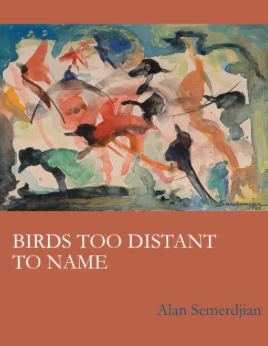
Alan Semerdjian is an award-winning Armenian-American musician, writer, educator, multi-disciplinary artist, and the 9th Poet Laureate of New York’s Nassau County. He is a veteran of the Long Island/NYC poetry and music scenes and has performed and read all over North America and beyond while teaching English in public education for three decades. His latest collection, Birds Too Distant to Name, is forthcoming from BlazeVOX Books.
KMD: Congratulations on your forthcoming book. What are three things you’d like readers to know about Birds Too Distant to Name?
Thank you, Kristina. I think probably the first and most important thing that I want readers to know is that it’s a book for the now. And by that I mean, I’m attempting to get at the things that impact us all over the last, say, decade or so: the fragmented nature of digital life, mortality and the pandemic, cultural polarization, etc. More than ever it feels that our collective humanity is vanishing as we move boldly/blindly into various technological and political and economic futures. Birds Too Distant to Nameis a phenomenological exploration of the ephemerality of modern existence and resiliency in the face of erasure. To write something universal as an intention is impossible, of course, but to dive inwards and to possibly make the personal universal, I think, is maybe the point to writing.
The second thing is about the form of the book. The poems are written in loosely symmetrical couplets, and every title begins with the article “the,” which helps shape the collection as a kind of field guide of sorts to these experiences and aspects of modern life that are ineffable and perhaps even evanescent. The thinking behind this last decision was to dramatize the subjects of the work, which are targets for a poetic meditation that is akin to what Alex Lemon has described in poet Li-Young Lee’s work: a “near mysticism” that is “fully engaged in life and memory while building and shaping the self with words.” The titles are conduits into other imaginative worlds. We see this conceit in popular music as well—songs such as Radiohead’s “The Bends,” Kate Bush’s “The Sensual World,” or TV on the Radio’s “The Wrong Way.” A good “the” acts as a frame or platform for observation.
Finally, I think these are all love poems in a weird way. Even the intense examinations of geo-political conflict. Hence, the couplets.
KMD: The title suggests a tension between the desire to understand something and the recognition that it may remain beyond one’s grasp. How did you arrive at this title, and what does the act of naming—or being unable to name—mean to you as a creative practitioner?
The title comes from the last line from “The Rising,” a poem in the collection that ends with the image of my aging parents at the window of my childhood home waving goodbye to me and my young son in the backseat of my car as we drive away. Something about the particulars of that moment transformed the image for me. In the poem, they become unrecognizable and rise into the air and ether and maybe outside of time too and start dancing with these nonfigurative winged things. My father became quite ill and passed away during the writing of this book, so death was really on the mind too. That tension you identify in your question is alive and well in that moment in the poem and, perhaps, a generative engine in my practice. It’s a good question, I think. What brings us to the page? Anger? Disgust? Joy? Love? For me, it’s something unclear that I want to try to understand (like a transition into an afterlife or whatever, if anything, comes next). Or maybe it’s something too clear that I want to make less clear in order to…well…understand it better. That too. Either way, the line felt right as a title for the book.
KMD: The book is divided into two sections, each introduced by a constellation of epigraphs from other writers, artists, and thinkers. Could you speak to your decision to structure the collection this way? What conversation did you want to establish between these epigraphs and your own work?
My first collection, In the Architecture of Bone, has two sections as well. I guess it’s easy to think in binaries though I know there is an infinity of notes between, say, a C and a C#. I think of it as the intrapersonal and the interpersonal. The family and the world. The inside and the out. Birds Too Distant to Name lands the same way. The first section is really introspective and mines the domestic—parenting and partnership, love and loss—for some attempt to define modern life in a world where real connection is a disappearing act. The focus shifts in the second section to an extroverted lens through which our fractured contemporary political landscape and regional and global issues that have defined the 21st century take flight. The epigraphs certainly can be a constellation. That’s a great way to describe them, actually. Or a flock, a murder, a gaggle, a parliament, a kettle, or possibly even a murmuration. Still figuring that one out.
KMD: As a reader and an editor, I appreciate that this collection takes a risk, and doesn’t follow the conventional three- or four-section format that seems to pervade the poetry landscape. What advice do you have for poets who struggle to find an architecture for their book-length collections?
I’d like to say I empathize with the struggle. This book had a few formats over the last decade as it evolved. It shapeshifted and moved through different titles and hues and forms. On the one hand, I’d like to say that we should lean towards invention and what feels organic and true to our sensibilities. The dominant format that has this kind of emotional rise and fall feels too cinematic to me and not the business of poetry. For me, while there is a thread that moves through all the poems in the collection and certainly certain aesthetic continuities, each poem is its own thing in the air and has its own aerodynamics. And, at the same time, keep it simple. See the shape of the thing you’re making by stepping away from it. I have what might be a common situation that’s happening with my eyes as I age. I can’t see writing clearly when I’m too close and I can’t make out the characters when I’m too far. So I seek the middle sweet spot. Seek that sweet spot with your work. I still print out copies of the poems and lay them out to get new looks at old configurations. That’s a way to organize parts and see how poems live together from afar.
KMD: In poems such as “The Naming,” “The Good Light,” and “The Airplanes,” fatherhood becomes a way of encountering the world anew. How has becoming a parent changed your attention to language?
My goodness. In every way. Seeing how language is acquired and processed and understood and manipulated is fascinating. And that back and forth teetering between two worlds is interesting too because my son has also been learning and hearing Armenian since he was born, which involves a different alphabet. And then there’s music too, which, now at 11, he reads better than I do. I’m fascinated with the syntax of language and how we can think in one language and articulate in another and how that delivery embraces surprise. That surprise is poetry. Pretty sure the language poets kept this close. All children are language poets, I think. The poems you list here, in different ways, paint these moments where language and parenthood and childhood wonder all intersect.
KMD: What are you currently working on? What else can your readers look forward to?
In terms of poetry, I’m drafting towards a book that might be about education…or maybe my time spent in education. I’ve been an English teacher at the secondary level for almost three decades, so teaching and learning are dear to me, and I keep writing these little hybrid pieces that explore those ideas. I think I should reread Carson’s talks and other texts that blur genres. We’ll see. I’m also updating a web shome at www.alansemerdjian.com. There’s also music. I have this ongoing project on bandcamp that involves archiving all the music I’ve ever recorded and leaving these annotations about the songs on there. And I just released a new single I recorded that’s out in the world streaming everywhere. It’s called “Nico’s Song,” and it’s a very Leonard Cohen-esque folk thing that is dedicated to my son. Marrying the poem and the music for me. That’s a future I can really wrap my heart and mind around.