
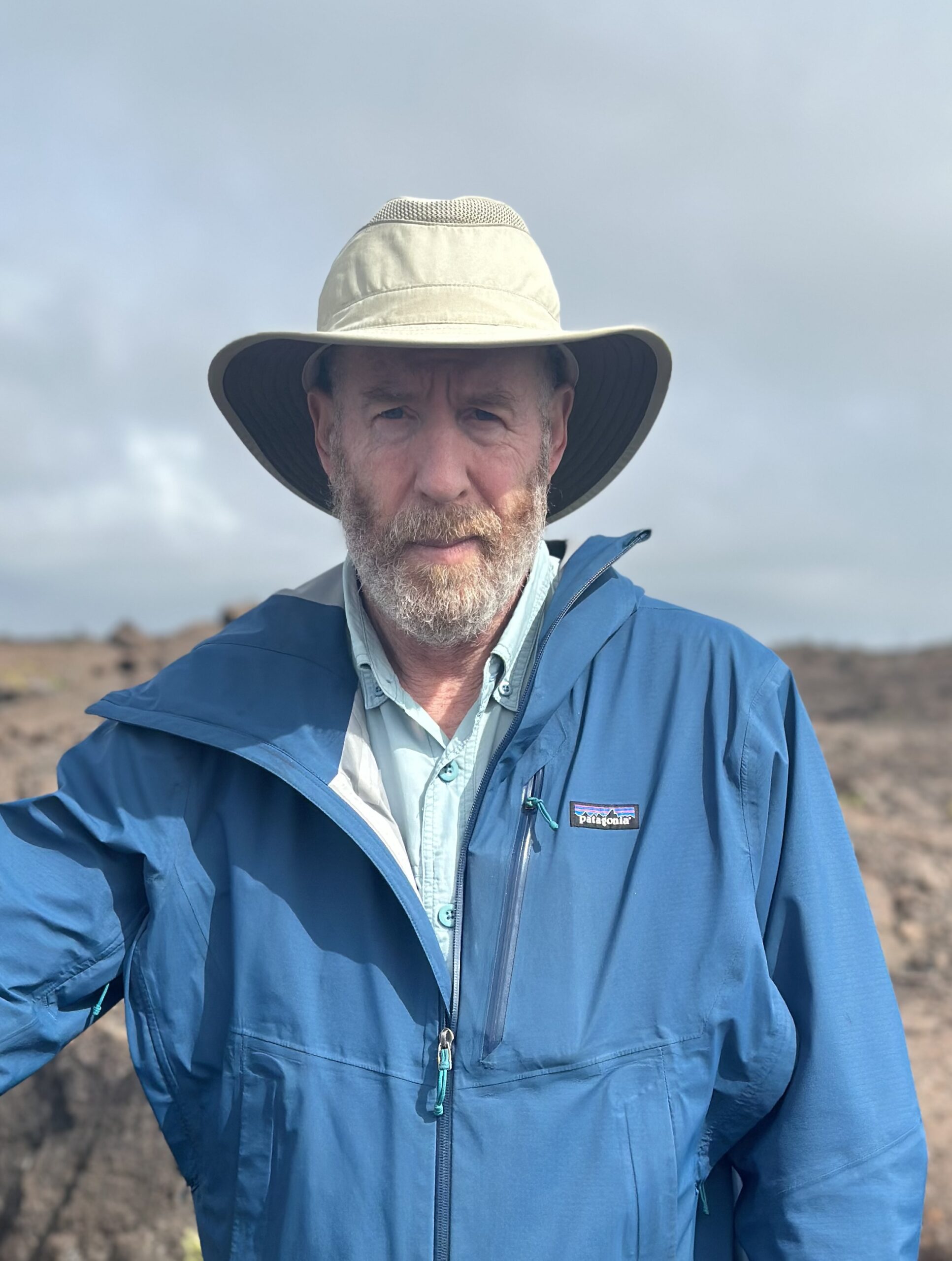
Born in Chicago, David Breskin first made his name as a freelance journalist, writing for national magazines such as Rolling Stone, GQ, and LIFE. He has published six books of poetry, including RICHTER 858, a multimedia inquiry into the abstract paintings of Gerhard Richter, with music by Bill Frisell and contributions by thirteen American poets; Supermodel, a one-sentence-long epic poem, or novel-in-verse; and DIRTY BABY, which marries sixty-six ghazals to an equal number of pictures by Ed Ruscha and music by Nels Cline. He has also published a behind-the-scenes account of the recording of “We Are the World”; a novel, The Real Life Diary of a Boomtown Girl; and a compendium of interviews with film directors, Inner Views: Filmmakers in Conversation. Breskin has worked as a record producer since the early ’80s. In addition to Frisell and Cline, he’s collaborated with leading-edge musicians such as Mary Halvorson, Kris Davis, Craig Taborn, Ingrid Laubrock, Ches Smith and Patricia Brennan. David Breskin lives in San Francisco.
Kristina Marie Darling: Timestamp is built on the discipline of writing one poem per day without revising previous work. What did that constraint unlock for you creatively?
David Breskin: I guess it was an act of self-extortion. I hadn’t written any poetry for eight years–other than for weddings, funerals, birthdays, art openings–the quotidian occasional poems for the special occasions. I wanted to get back on the horse, somehow, and see if I could make her ride through some tricky terrain without being thrown off. It started innocently enough with one poem on a single morning, simply based on the working theory that nothing beats a failure but a try. I had no grand plan. No expectations I would write more than a single poem just to see if I “had it” anymore, much in the way an older trumpet player might reach for a note or an older basketball player might try a step-back three to see if it’s still “there” for him or her. The next morning, I re-read that poem and judged it surely not the best poem written in the English language that day but perhaps not horrible. This encouraged me to try another that morning. Once I’d written the second one, I decided on two basic rules: 1. There would be no revising the previous day’s work–once I’d timestamped a poem and filed it, I would not allow myself to revise it, and 2. I would not permit myself to even re-read what I’d written (as I’d done with the first poem) so that I would quickly forget what I’d written. I would neither have the benefit nor the burden of any kind of self-reflexive understanding of what I’d already done. No rearview mirrors, only windshield. If this led to more repetitions, or word choices I might otherwise avoid, so be it. The advantage of this perverse self-coercion is that it forced me to put-up-or-shut-up and allowed me to be the Bad Boss I’d always deserved. I told myself I was going to do it so I had to do it. With no revising and no self-assessment of the strength or weakness of what I was doing, I was sort of lashed to an even keel: couldn’t get too high or too low about anything, just kept plugging away. That’s sort of liberating. I had no idea this would make for a book, or ultimately be a book. This was 100% process, and 0% product. Write a poem, forget about it. Write another, forget about it. Rinse and repeat. A nice way for commodification to get washed down the drain.
KMD: The poems feel both immediate and deliberate, almost like “controlled improvisations.” How do you balance spontaneity with craft in a daily practice?
DB: Perhaps a useful way to think about this is that all first drafts of every kind of writing–from sestinas to CEO memos to IKEA assembly instructions–are actually “controlled improvisations.” And in some cases without much control. There is the controlling force of simply the knowledge that I have to do this today and I might even have a pressure of I have to finish this by noon before the rest of my day attacks me. That will definitely limit the improvisation to a certain durational length if not a word count. It can’t just be Keith Jarrett playing the piano forever, and a day. Then there’s the control of choosing a form–this one feels like couplets, this one like tercets, this one in one chunky stanza slab–and whether I’d want my taxi ride metered, which I usually do, often biased towards a ten-beat line. But, and it’s a big but (as Pee Wee Herman used to say) that’s it for control. The rest of it is very much about no control. No planning, no agenda, no “proper” subject, no themes, no tonal restrictions, no worries about offending anyone, no focus on creating “publishable” bon-bons or hand-grenades…just free expression. I don’t think of “craft” and “spontaneity” being necessarily in conflict with each other, so i didn’t feel I was walking on a balance beam there, but craft itself doesn’t count for much in my book. While we all know a certain amount of craft is important for the sake of delivering the goods, craft (or the over-reliance on it) can also be the enemy of art, and art’s what I ‘m going for. The craftsperson always knows what they’re trying to create: they actually know everything about it before they start–they have a plan, an objective, they know what it should look like, how much it should weigh, and what kind of wood to use for the seat of the chair, versus the back, if different. How close to the ideal, optimal form the work takes will tell the craftsperson how successful the work is. The artist never knows (or should never know) what form or shape the work will take before starting out. There has to be an element of discovery, of not-knowing, and here craft is not always your friend and may be your sworn enemy. Another, maybe better way, to say this is that when the jazz musician is standing on stage about to solo on a tune she’d better have thousands of hours of practice in her horn, but if she’s thinking about craft just then her solo is going to be Dead On Arrival.
KMD: Did you ever feel tempted to break your own rules during the writing process?
DB: Never. Because the rules were the cog in the middle of the track lifting my little car to the top of the roller-coaster’s first rise. Whoosh. Now there were three different occasions during the run of poems when I realized–owing to other responsibilities, work, travel, family–that I would not be able to give myself over to writing a poem a day, or if i did the odds were good I would produce a steaming pile of slop, so in those cases I simply stopped. There are two big breaks that are marked by INTERMISSION title cards in the book (literally inter-mission), and a shorter break towards the end which just has a few days missing. I think I have to quote my favorite third-grade teacher here, Mrs. Frank, who informed us that if we cheated on a quiz, We would only be cheating ourselves. Her ethos stuck with me.
KMD: Your poems engage directly with contemporary events, from elections to global conflict. What responsibilities do you think poets have in responding to the current political moment?
DB: None. And I’m not being facetious here. I think poets, as well as musicians, painters, sculptors, filmmakers and choreographers, should be as irresponsible as possible. I would draw the line with architects, because they have to be responsible: we can’t have their buildings falling down or doorways that won’t open. They have to function. But there are no bathrooms in poems, no HVAC systems, no Emergency Stairs, so we get a hall-pass away from the Responsibility Classroom. Here’s another way I might answer this provocative question: would we want the politically conservative poet, or say one who leans towards kleptocracy or fascism or the Supreme Court’s gutting of the Voting Rights Act of 1965, would we want that poet to feel responsible to respond to our current political moment? Didn’t think so. Someone, perhaps even someone like me, might feel like our society is being actively and perhaps permanently disfigured by a kakistocracy of almost unimaginable venality and incompetence, but someone else might think things are peachy or might just not care, or, even if they care, might have nothing to add to the various debates about how we got here or where the fuck we’re going, if not straight to hell. But all of us should have the freedom to not write about it, or have a different opinion. Is the dude writing a poem about giant sequoias or nudibranchs any less responsible than the dudette writing a scathing (or a supportive?) sonnet about Amy Coney Barrett? I think any poet who thinks they are going to fundamentally change the way someone thinks, or someone votes, through the sheer force of their splendid rhetoric, is as delusional as the dufus in the MAGA-hat thinking that the president cares about her and her four children.
KMD: In addition to your achievements as a poet, you’ve worked extensively in music production. How does that experience inform your sense of rhythm, pacing and tonal shifts in poetry?
DB: Rhythm, pacing, tonal shifts and just about everything else. It’s all relational aesthetics and it’s all worth fighting about. If you’re in the studio and you cut five takes of a song, which take is best? Discuss! How does the take you pick relate to the still-unrecorded next song which might be next to it, or far from it, in the sequence of the album? How can this album seduce the listener? Jazz musicians are among the smartest, most sensitive people on the planet, and much of what little I know about aesthetics I’ve learned from them. A rejection of corniness. An endless battle to avoid cliche. A passionate pursuit of the sound of surprise. A reluctance to play to the house. Against preciousness. No pussyfooting. Poets could do worse than following this road map.
KMD: Can you speak to the value of the experiences outside of and beyond the literary community for crafting poetry?
DB: My biggest influences–at least the ones I know about, or perceive myself–are not literary. Architecture, music, sport (particularly basketball), and the whole range of visual arts, including film, have nearly surely shaped me as a person and as a writer more than literature. Someone might say this is a shameful and disqualifying admission. Someone else might say this is a breath of fresh air. And someone else may put their hands up in the air and wave them around like they just don’t care!! Is the newspaper literature? Since my teen years, I’ve surely read more words on those dead trees than in my well-stocked but mostly unread library. Beyond this, my experiences as a journalist–from the late ’70s until the early ’90s–were a great ticket to learn about the world in an active way, and yes, write about it. It was only later that I learned the grim lesson that most of the poetry world (however we might define it) looked down upon this work and was suspicious of it–even investigative pieces on Big Subjects. You wrote for money? Hmm….. I guess I was more of the mind that working on a whaling ship or at an insurance company or as a beat reporter or at a hedge fund or a gas station might actually help you know things about the world. Even though being a journalist put me in the “underclass” of writers, for me, it was a privilege to be on the road with Willie Nelson, in the studio with Michael Jackson and at the practice court with Michael Jordan. Likewise, being in the woods at night with angel dusted teens for a Rolling Stone story about a ghastly murder–I can assure you that this is an active and not a passive activity. As much as jumping the fence at Corbu’s Villa Savoye to contemplate that house in its green field. I probably get more from having an annual waffle breakfast with Ed Ruscha than I would reading all of Auden. That’s no diss of Auden, but just an admission of my peculiar design–surely damaged but held together by the duct tape of my personal experiences. (Obviously, one should take anything an artist says about their own work, including this very interview, with a quarry of salt.)
KMD: What’s next? What can readers look forward to?
DB: Listeners might look forward to a series of albums by some of the hippest geniuses in jazz and new music–Patricia Brennan, Ingrid Laubrock, Modney, Ches Smith, Dan Weiss–but but for readers, I can provide no trail of bread crumbs. I have no idea. Beyond this, I can say I’m motivated to write another book if only for a ridiculous reason: Timestamp is my tenth book, and even numbers make me nervous as a cat on a hot zinc roof. Well, whatever gets you through the night, and into the light…