
Tiffany Troy: You begin LION with “The Document of Invisibility,” a justified block of text which begins: “The document of invisibility states that I must first recollect the beginning of my erasure, which would summon me to a crag where I stand before my birth.” To me, the poetic form of the first poem announces that it will be a collection that places emphasis on the visual form, and in making sense of the Asian-American female self (“born an ember of wanting”). How does this poem set up the readers up for the poems which are to follow?
Tina Chang: Since I was a child, I read myths from all over the world and I was intrigued with symbols and the development of larger, collective stories as they are reflected in singular characters. “The Document of Invisibility” series appears in every section of the book and calls into question larger themes of visibility, invisibility, surveillance, and power. One figure is born and, in that instance, becomes a visible entity. They transform from being an idea toward being a physical object of reality. From that moment forward, their interaction with the larger structures of which they are a part—first nature itself and then man-made structures—dictates their safety in a world that can be both beautiful and brutal. These poems have the appearance of windows. Their rectangular shape could also gesture to a photograph or painting. That structure and lyric signals a series, a story to be continued, a seeking, movement, and a journey in a compact and visual form.
TT: In your 2019 conversation with Rachel Zucker on Hybrida, you detailed your interest in form as a poetry professor. You also spoke of your process towards hybrid form: first from classic forms you learned in graduate school (the haiku, sonnet, pantoum) and then claiming (or attempting to claim) forms of the mother/ mothering/ female forms as your own. What is your process (in experimentation with form) towards your poetic concerns in this collection?
TC: Forms are personal and expressive vessels. Each form—whether it be a haiku, pantoum, or an invented form—holds emotional intention and tension. Forms help us to work out repetitive interests, problems, or obsessions. They ask us to repeat, accelerate, backtrack, turn over, and examine moments that reoccur in the mind. The poet has opportunities to explore those obsessions via repetition, rhythm, patterning, and fragmentation.
For example, the zuihitsu when translated means, “following the brush.” It’s a female genre, penned first by medieval courtier Sei Shōnagon who completed a dream-like collection called The Pillow Book around 1002 AD which embraced the hybrid model: fragments, essays, poems, lists, musings. As the genre has been introduced and adapted by poet Kimiko Hahn into the Western canon (and those who have followed in her footsteps), texts, emails, to-do lists, and visual art have found their way into the vessel. Zuihitsu punctuates the most important moments in the collection, I believe. They allow me space to shape-shift, alter scale and velocity, and even change the volume and texture of voice. I’m interested in that.
When I created LION, the scaffolding of poems announced themselves to me. While I once wrote with strict forms in mind and wrote consciously into those forms, my process reversed in this collection. I tended to write freely and allowed the forms to appear unconsciously. While some materialized as prose poems, others were written in formal stanzas; the Japanese form of the pecha kucha was also pivotal for me.
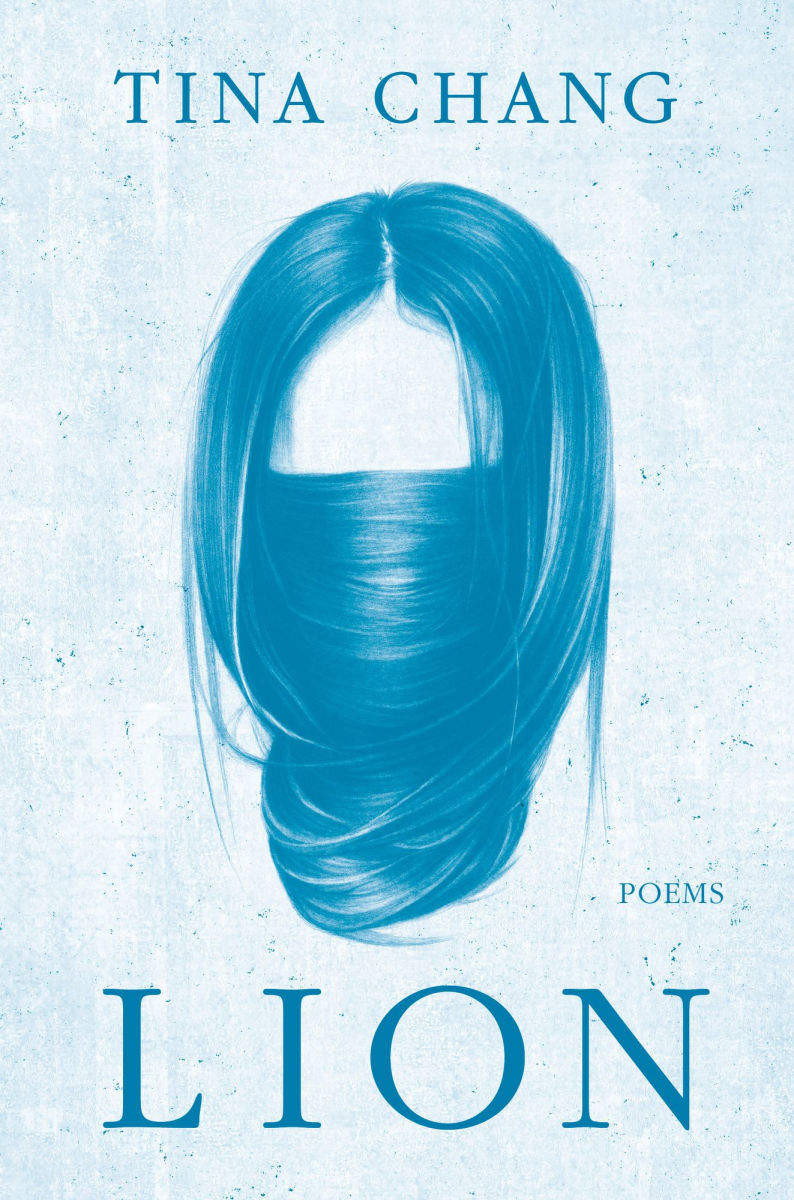
The pecha kucha is a longer series of twenty images and corresponding twenty stanzas, where I focus my attention on a body of work by visual artist Hong Chun Zhang. Here, I’m interested in the extended lyric and extended breath, punctuated by the powerful artwork of Zhang. Image by image and poem by poem, I meditated on Zhang’s ink paintings of long hair which signaled for me a source of pride, attraction, and even danger in association with Asian American female identity. As the series developed, hair became tied to history, family, dreams, and the lineage of women who I associated with survival.
TT: LION draws a variety of Asian/ Asian-American women artists in ekphrastic poems and poems which incorporate similar motifs (of the lion/ mother/ the hair). How did you encounter these artwork and how did you do a deep dive into them?
TC: During the COVID-era I was largely isolated like many people. I was afraid to step outside my home for fear of being seen, harmed, or worse. The activation of hate by the same administration in office now, placed forth rhetoric of, “the China virus.” Such language struck me with shame, fear, and outrage. I felt powerless working alone in my basement office.
In 2022, in the midst of creating a zuihitsu for The Margins’ Zuihitsu Notebook issue, two significant events occurred: the killing of Michelle Go and Christina Yuna Lee, two Asian American women who lived in New York City. This followed on the heels of the Atlanta spa shootings. As I composed my zuihitsu, I was overcome with anger and grief as I reflected on the lives of Asian American women who were senselessly killed during the height of anti-Asian hate crimes.
I began researching the lives of Michelle and Christina in order to try to understand their origins as opposed to their end. My research led me to a group art exhibition hosted by the Eli Klein Gallery where Christina worked for four years. The exhibition called With her Voice, Penetrates Earth’s Floor—a line borrowed from the 1982 book Dictee by Theresa Hak Kyung Cha—was curated by stephanie mei hung and gathered nine Asian American women artists who paid tribute to Christina’s life.
I was intrigued by the women artists as well as their work and I was moved by the communal response to honor and remember Christina. Their work startled me, shook me awake, and energized me like nothing had since the start of the pandemic. I could feel myself reaching for a collective calling and that arrived in the shape of this exhibition.
Diving into the artwork of this collective of artists made me suddenly brave and inspired. For years, I examined their work and I began responding to them in the form of poems. Only after I had finished the ekphrastic poems and with great trepidation and nerves, did I begin to reach out to the artists one by one. The women lived around the globe, from New York to California, from Vietnam to Korea, and they all agreed to speak with me. As we met online and as I listened to each artist speak about their projects, their concerns, their approaches, and the emotions behind their vision, we were often moved to tears. The feelings that seemed so singular to me now found utterance in our shared experience. My poems found their way toward existence and survival because of the insistence of their art.
TT: As I was reading LION I felt that compulsion and more particularly that sense of collective grief that in some sense could not be adequately captured as a screenshot of video stills, in comparison perhaps to having your poem side by side with the collective in a gallery, for instance. That jarring quality was likewise something I felt in seeing the R train route on the New York City Subway or the screenshot of an Instagram post of a screenshot of a Notes that is dated February 15, 2022: “I am tired of reading about brutalities against Asian American bodies.” Could you speak to: the layering of journal entries, social media posts (with dates, authors) with the visual art and film of the collective which I see as creating a front or critique of the erasure of hate crimes against Asian American women?
TC: We’re actively processing various styles and modes of communication in our hyper digital era. This can be a preoccupation and also a blessing. During the pandemic, many of us relied heavily on online life. Social media wasn’t seen as doom scrolling, but an active, essential pathway toward real community. One minute I was dancing to a playset by @dnice, the next minute I was trying to get a handle on baking sourdough bread (unsuccessfully), and the next I was nodding in agreement with empowering messages by Asians for Mental Health and, in the most surprising turn, I found women artists online with whom I would eventually share a lasting and spiritual connection. The layering of information and inspiration felt true to my imagination and the imagination of so many, I believe, who are increasingly met with disparate modes of communication and language. I hoped to replicate that process while embracing a collagist response to the erasure of Asian American women. For example, Hồng-Ân Trương’s work represented to me the hyper visibility of women as they were surveilled by American and Western GIs during the Vietnam War. Hong Chun Zhang’s artwork placed forth private and public perceptions of Asian American hair where women moved from being potentially invisible model minorities toward visible, sometimes sexualized targets. The journal entries were real time responses as I processed information, physically on my own, during lockdown. I tried to document my reactions of grief, of pain, and resilience to the material objects of my imagination.
TT: The motif of the lion (in its fabulist, familial or ancestral) form provides another mode of the collection, though it feels a lot less as the tangible animal but a symbol, an apparition in dreams, which fascinated me: in large part because of the resonances between hair and mane and the tension between silent erasure versus the loud roar. Why the lion (in lieu of the lioness), and how does it carry its duality or two faces?
TC: In Chinese culture the lion may also be equated with the foo or fu dog. Lions weren’t native to China so the lion feels like a dream animal and is often presented by artists as an amalgamation of many creatures including the dragon, tortoise, phoenix, and the snake. The mythic quality of the animal combined with its symbol of protection and power as well as its dual nature of being both predator and prey embodied my thoughts surrounding the perceptions of Asian Americans during the height of anti-Asian hate crimes. The lion is also a symbol of courage and strength. I see the collection and its namesake as a love letter as well as an elegy. It takes resilience to continue to live on despite the efforts of an administration to threaten, diminish, silence, deport, erase whole communities. I chose lion as opposed to lioness because I’m claiming spaces traditionally reserved for men; I’m occupying terrain that often excludes women and in so doing I hope for a universal approach to the word and ultimately a wholeness. Yes, you’re right, it’s an embrace of duality and not an easy one to hold at once: the collection seeks to access an archetype of authority while simultaneously foregrounding the experience of inhabiting a female body.
TT: In “The Warrior is a Woman” (after Yesenia Montilla), the speaker asks: “How does a woman become a heroine, / a muse in her own story? / How does she become a martyr / by laying down her knives, / alive, sleeping next to her own body?”
Who were some poets that you look to in your approach towards these questions?
TC: How does someone become her own form of inspiration and how does someone become more of who she is by choosing peace and becoming her own champion? These were some of the questions the collection was asking. I have so many poets who I look toward who live out these principles. Lucille Clifton, Lucie Brock-Broido, Linda Gregg are teacher/poets who lived life on their own terms. They each embodied their own language, a distinct way of living, and a poetics that were undeniably distinctive. None of them compromised but chose their own path to poetic spirituality and magic. Kimiko Hahn and Marilyn Chin show me the way as living heroines. Both are unapologetic, soft and strong at once and when I first started to write, they paved the way for me and showed me by example. Of my contemporaries, Aja Monet, Mahogany L. Browne, Hala Alyan, Nathalie Handal, Eugenia Leigh, are warrior women who are also creating unforgettable work as they each fight for a cause. These are just a few of the women muses I look toward.
TT: For emerging poets looking to write about “the journey of [their] name[s]” what tips or advice do you offer?
TC: Ask questions. There was a time from 1990s forward—with the publication of the Joy Luck Club by Amy Tan in 1989—that there were justifiable challenges to the “immigrant narrative,” and this was due largely to publishers pushing forth stereotypical Orientalist ideas as well as presenting characters of Asian descent as flattened and without dimension. Since that time, the growth of Asian American literature on its own terms has opened spaces for every kind of writer with a vast array of approaches, aesthetics, and deeply developed interiority. For the emerging writer making their way now, there are endless possibilities. Delve in. Ask questions of your family. When I was a young writer, I followed my grandmother around with a tape recorder. I was so afraid that after she was gone, a lifetime of stories would be lost so I documented and listened as I followed, “the journey of my name.” It meant that I came from a lineage of women who refused the limited life that was offered to them. They stood up, outlived famine, war, family hardship, the death of loved ones, and so many variations of loss. They traveled thousands of miles in search of safety and home. I’m only here because they were unstoppable and asking questions meant that I was invested in preserving their stories. I didn’t know what those stories would become and I held no intentions. You can spend your life being curious and that curiosity can become the roots by which your own story can grow.
TT: What are you working on today?
TC: I’m more than halfway through writing a poetry collection that arose from a long vigil of caregiving and what I now understand to be both a spiritual and physical rite. In the book, a husband is diagnosed with stage four lung cancer. The poems focus on pain, hope, and the complexity of living. The speaker is witness and archivist of a body transforming. My writing was inspired by Richard Wright’s collection,Haiku: This Other World, written during the final eighteen months of his life. Wright composed nearly 4,000 haiku after being diagnosed with lung cancer, describing the process as “a way of capturing fleeting moments of lucidity between waves of pain.” His work became a form of breath, an exhale when the body could no longer speak. Similarly, my haiku function as breaths in the stillness of care, as a speaker faces aspects of her spouse’s existence, and in the impossible space between love and letting go.
TT: Do you have any closing thoughts for your readers of the world?
TC: I wrote this collection in moments of great unknowing. I was in a state of unrest and apprehension but day by day I moved toward utterance and that came from a community who embraced me. Artist Hồng-Ân Trương told me in a public discussion that by making our work and by collaborating, we create the community we wish for. This idea heartened me and as I looked out at an audience who came together to receive a message, I felt the vibration of their presence. We were all a part of a greater energy, a wave of humanity who were all searching together. The loneliness and uncertainty I felt in moments of doubt dissipated and I was left with a lingering softness I could only dream of.
Tina Chang is an American poet, educator, and editor. She was the first woman to be named Poet Laureate of Brooklyn and she served in this role for over a decade. A graduate of Columbia University’s MFA program, she is the author of four critically acclaimed collections: Hybrida (W. W. Norton, May 2019), Of Gods & Strangers (Four Way Books, 2011), and Half-Lit Houses (Four Way Books, 2004). Her most recent poetry collection, LION, is forthcoming from W.W. Norton in fall, 2026. She is Full Professor of English at Binghamton University.
Tiffany Troy is the author of Dominus (BlazeVOX [books]). She translated Catalina Vergara’s diamonds & rust (Toad Press International Chapbook Series). She is Managing Editor at Tupelo Quarterly, Associate Editor of Tupelo Press, Book Review Co-Editor at The Los Angeles Review, and Co-Editor of Matter. In 2025-2026, she is a Co-Curator in Residence at the MinEastry of Postcollapse Art and Culture. In that role, she co-curates The American Wing, which features poets who shape the rich, polyglot and ever-evolving landscape of American poetry.