

Tiffany Troy: In your conversation with Tausif Noor for City Lights Live! on April 22, 2026, you said: “I needed the first person–rather than the third person–because of the freedom of syntax that for me comes with the first person [point of view]. A kind of punchiness... and the propulsivity .. of the first person narrator.” I am curious about how the freedom of syntax, punchiness of voice, and propulsivity of the speaker’s “immaturity” played out in the first person?
Wayne Koestenbaum: Keen pleasure comes from using a third-person “limited” narrative voice—the joy of indirection, displacement, funneling—but my primary writerly satisfaction comes from first-person explosivity, a lyric blast, an ooze, the “I” sending its gummy wishes into the predicate. Joe Brainard’s I Remember—a litany of memories–typifies the gusto that the “I” can provide, especially if the “I” multiples itself, goes fractal, thereby complicating the sometimes pigheadedness of a too-bossy self. I’ve written fiction in the third-person, and I’ve written nonfiction that tries to avoid saying “I”; but my peculiar idiom can move most sinuously and flexibly when the sentence’s engine is the first-person pronoun. Fewer antecedent (pronoun-reference) issues arise in first-person sentences. Here’s a nightmarish third-person example I’m making up now for the sake of demonstration: “He tried to buy Henry and Tom a Pontiac but he didn’t want a Pontiac, though he, the other he, had Pontiac inclinations that got in their way, so he turned down the gift, and he tried to come up with another idea for a present for him, maybe a Fiat or a Sprite, if his tastes ran in that direction.” That’s a deliberately clumsy sentence, riddled with “he” and “he.” A “he” glut, however, can grow comic, as in John Ashbery’s early poem “He”: “He turns up the music much louder. / He takes down the vaseline from the pantry shelf.”
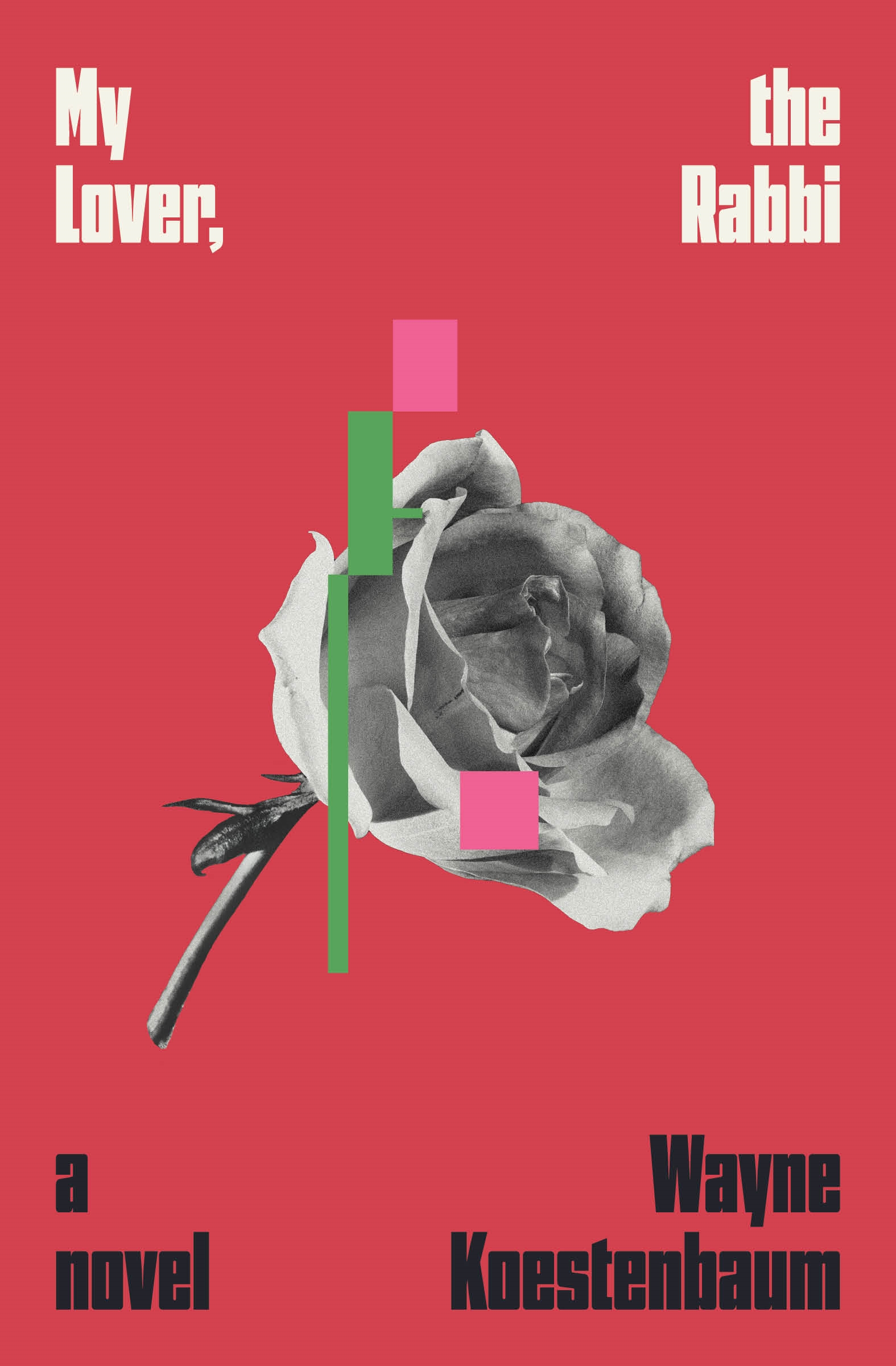
TT: The novel is divided into 188 sections, many of which begin, “My lover, the Rabbi.” And yet, the speaker is neither talking to the rabbi nor to us the readers. Instead, we get this increasingly clearer auto-portrait of the speaker (and the object of his obsession, manifested in the figure of the rabbi) who represents an abstraction (“torn between love and envy”). How did you land upon this motif and how did you choose (on a craft level) where to place the themes and variations of this motif?
WK: That initiating mantra (“my lover, the rabbi”) simply arrived in my hand and my brain: a basic, intrinsically comic phrase, like a gift certificate for unlimited purchases. When the phrase made its surprise appearance (I was writing in my diary), I told myself, “I want to write one hundred sentences that each begin ‘my lover, the rabbi.’” The four-word phrase appealed to me because it contained a covertly braggart claim: the narrator is at once boasting about his lover and exposing him as a comic, improbable specimen. Merely to say “my lover, the rabbi” seemed to assert preposterousness itself as a theoretical foundation: my world, the narrator implies, is upheld by a gleeful, riven paradox. As the book proceeded, I grew less dependent on this catch-phrase, “my lover, the rabbi,” but I could always, in a moment of despair or narrative drift, return to it, as anchor and motor.
TT: The novel traverses philosophical questions through vignettes as the speaker embarks on this journey (replete with references to classical music and literature juxtaposed with the ruggedness of the Pontiac, “urban revolutionary”, and movie-like encounters at the sauna, bathtub, etc.) As a poet, critic, short-story writer, and novelist, how is the approach shaped by the genre that you are working in, and how do you weave together these disparate chapters into a cohesive whole?
WK: A novel is, for me, the most difficult of genres. The whole construction needs to float, like a cotton-candy palace, in the air, or to hang suspended by invisible gut-strings. Writing such a confection takes time and belief and will-power; if I weren’t afraid of the challenge, its near-impossibility, I’d always be writing novels. Poems come more easily to me, though the process of composing a poem, too, can feel like stumbling through a treacherous labyrinth. But you can hold a lyric poem, conceptually, in your hand; the poem is simply voice, it’s not a verisimilitudinous map to a non-existent place. Whatever genre I’m working in, I always try to stay close to my actual desires and sensations, and to remember that I wouldn’t be writing in the first place if I didn’t have a surfeit of uncontained and unexplained yearnings, regrets, and shames to investigate. I became a writer to handle that surfeit, to prevent it from suffocating me. And so though writing is mostly a process of generating words and then degenerating them or regenerating them, rearranging them, omitting them, disemboweling them, that sometimes mechanical process wouldn’t have a reason for existing if there were not a locked trunk full of secrets that it is my strange destiny to break open by means of verbal prestidigitation. Language is a roundabout and sometimes counterproductive way of unlocking the shame-containing trunk, but I know no other method. And when I open the trunk, I discover that it contains not only shame but bolts of unclassifiable material resembling ecstasy.
TT: The novel is rooted in place, both New Jersey (the rabbi’s congregation, the Friendship Center, the houses of the speaker/ the rabbi) as well as the places where the speaker/ the rabbi has traveled (in the past) or travel. How did you construct place in My Lover, the Rabbi?
WK: My novel’s narrator lives on the outskirts of Hoboken. I’ve been to Hoboken a couple of times but I don’t have a clear sense of what it looks like. I didn’t do research on Hoboken. I didn’t revisit it to take notes. I let “Hoboken” remain, for me, a fantasy-town on a hill—a composite of looming houses I’ve seen from the windows of a moving train, certain haunting vistas... When I was a kid in San Jose, California, my family would drive once a week to San Francisco, and on the way to and from the big city I’d see a town named South San Francisco, or Daly City—which looked, from our station wagon, just like San Francisco itself, but slightly removed, off-kilter, detached, like a reproduction of the actual city but in a sleepier incarnation. I liked the notion of a city resting on its elbow and falling asleep, a city dreaming itself away from its actual identity. The outskirts of Hoboken was my way of imagining a locale in the process of drifting away from its own latitude and longitude; Hoboken itself, to me, was an unfixed, wandering notion, and by placing the narrator on Hoboken’s outskirts, I could push home and abode even further away from being available to the knowing mind. I wanted not to know the location; I wanted a somnambulistic sense of place. I used to sleepwalk occasionally when I was young, and I’m still attached to the notion of sleepwalking as an ideal (if utopian) state of narrative ambulation.
TT: At one point during the novel, the rabbi explained to the speaker (who he believed had shoddy teachers) that “he’d become infatuated with ‘close reading,’ the belief that everything in a work of literature could be interpreted apart from any consideration of biography and gossip externals” and further that everything “depended on etymologies.” In some ways, one of the central plotlines in the novel is the speaker finding out through his associates, the tragedies that made the rabbi who he is today. What do you feel about “close reading” as the novelist, and how do you portray the different ideas (and ideals) that your characters hold?
WK: Close reading is a philosophy I still adhere to, on the page and, as they say, “in the sheets.” The reason I write is to escape the world while increasing the tenacity of my hold on it; and the transformation chamber where I can perform escape and intensification is the sentence, into which I must burrow (as writer and as reader) deeper and deeper. Two writers whose work embodies this paradox (escaping reality while intensifying it) are Marguerite Duras and Clarice Lispector–two novelists whose novels aren’t quite novels but are prisms, echo-chambers, wish-machines, metaphysical interrogation-booths. “Novel,” for Duras and for Lispector, was a temporary residence (think of a lonely and dilapidated villa on the outskirts of a forgotten town) where a dreamer could plunge into her own fevered yet anesthetized consciousness and try to construct rescue rafts in the form of errant, chimerical sentences. Duras and Lispector closely read their own stupor, their own tendency to sink into inanition; they transformed anhedonia into liveliness by animating their depressive whirlpooling into enlivening fireworks-displays. But the crucial thing, for each writer, was slowing down, going local, and by “local” I mean the noun, the article, the preposition: slow the sentence down and tuck yourself into one of its phrase units, or maybe find a resting-place in the padded berth opening up between an indefinite article and the noun that comes afterward.
TT: What are you working on today?
WK: I just finished correcting the page proofs for my next book, a collection of my essays, The Imitation Mustache, to be published in March 2027 by FSG.
TT: Do you have any closing thoughts to your readers of the world?
WK: Try to find a book or an artwork that makes you happy to exist and that teaches you how the exact, often frustrating characteristics of your own life have a secret dignity, magic, excitement, mystery, neverendingness, and susceptibility to perpetual transformation. Once you find that book, or artwork, tell everyone about it. Don’t let anyone persuade you that you were wrong to have chosen this object as your gate to liberty, to an internal spaciousness at odds with whatever constraints hamper your way.
Wayne Koestenbaum—poet, critic, novelist, artist, performer—is a Distinguished Professor of English, French, and Comparative Literature at the CUNY Graduate Center. He has published 24 books of poetry, fiction, and cultural criticism. Recipient of an American Academy of Arts and Letters Award in Literature, a Guggenheim Fellowship in poetry, and a Whiting Award, he has also been a finalist for a National Book Critics Circle Award. A widely shown painter, he released his first vocal/piano LP, Lounge Act, in 2017. He lives in New York City.