
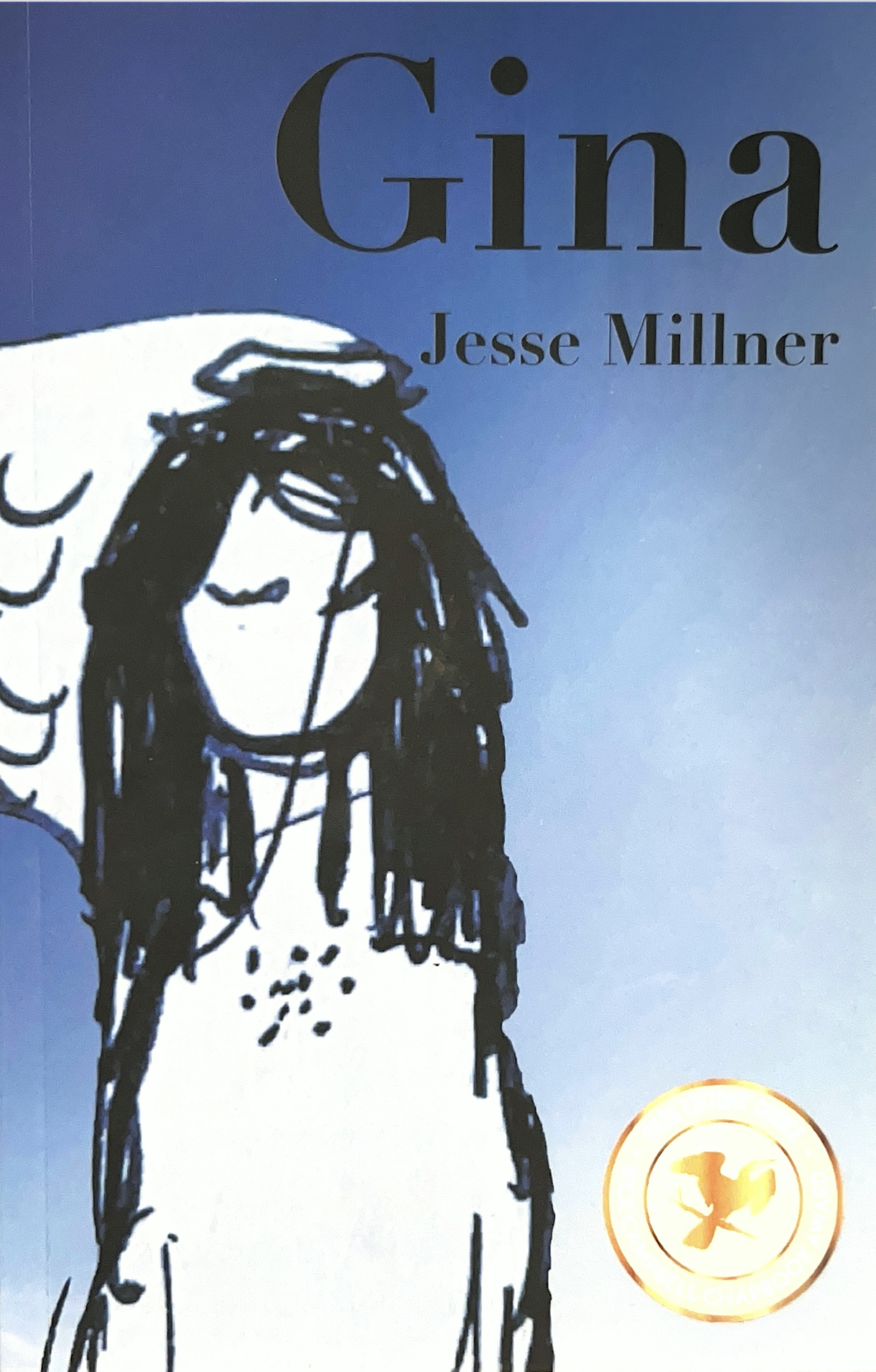

I first met Jesse Millner in a Composition class twelve years ago. He brought me and his other students who were eager to learn poetry into a life of attending open mics, days spent writing poems, campus swamp walks, and reading books that felt like they came from the angels: Walt Whitman, Denis Johnson, Allen Ginsberg, Federico García Lorca, Sylvia Plath, and all the heroes. We both came from the deep south—different worlds from the Florida strip malls decorating the edges of campus. His poems called to me from the same place as my grandparents’ Kentucky backyard.
Gina is Millner’s latest poetry book. The tension between the speaker’s Baptist upbringing in Virginia and our current modern world fight and dance tenderly throughout these dazzling pages, while Millner generously proposes a third option—a world of his own invention, a world that Gina inhabits. Millner asks,
...I would like
to drink their boozy hymns until I am floating above
every earthly slight and concern, until I am free of sin
and hunger. But what kind of life would that be?
For the reader who knows how to listen, Gina holds treasures from a Denis Johnson-like but deeply human underworld of motels, angels, emergencies, and miracles. Gina’s speaker stumbles into encounters of sudden shared spaces and intimacy with strangers that make life whole and holy again. In “Shirley,” angels come down “after dusk to drink ordinary air and to speculate about the tiny lives of humans” as “Half the patrons in the café held burning cigarettes, gestured at friends, poked bright holes in the space we shared.” The speaker dreams of shared spaces in an over-industrialized and lonely culture—a break from their current “stupid world of smoke and mirrors and strip malls and gated communities...and cbd shops, and banks...”. The world-building, both of the current world and the world in which Gina lives begins in the first poem, Gina. Gina is a fourth-grade classmate whose name was carved into the speaker’s desk, and in the world that Gina lives, moments like angels coming down and transforming a café into a shared space with smoke rising in the distance, happens all the time. The shift between the current dull world and the truer world of the past transgress time in these poems.
In the Americana that Millner envisions, a café transforms into paradise during the morning light and the speaker’s spirit stirs as they declare, “In those days, I never looked up.” In Millner’s Americana, strangers pump gas together and notice how tired one another look and in that moment, the world is electric: in “The Silence,” “You forget about your loneliness, forget about driving west toward a plateau...No, for an instant, you realize that the principal industry of America is loneliness, how the factories pound out product for 24 hours, day and night, year after year, until you’ve forgotten how beautiful it is to encounter another exhausted human being, who like you listens to the soft music in the background, and notices the light defining the gas pumps, the occasional car pulling up, triggering the welcoming bell, a sweet sound that for a moment fills the world and heightens the holy silence that follows.” Silence defines the holy moments of the speaker being thrust from the ordinary world into this underworld, and the speaker lets silence be silence instead of decorating it with more promises of heaven. Just when you suspect the speaker will not come back down from earth, they get pulled back by tragic and unfortunate events. However, they never cease to stop offering brutally beautiful moments of human compassion and solidarity each time they get hit on the way down.
“Solastalgia” is defined by Merriam Webster as “…sadness or melancholy due to environmental changes and related loss especially as it affects one’s home place.” It is mourning a world before it is even gone. The speaker deeply misses a lost world that has been replaced with a world of CBD shops and banks. He questions the reality of the lost world of his past on top of this, and still never ceases to strive for the light. In these pages, the speaker inhabits a doomed planet and the angel he encounters comes in the form of a waitress encountered during a hangover at a diner. The speaker wants to “Google how to make ice cream in the freezer” and “how to best get over a broken heart.” He misses his childhood “when the only answers came in playgrounds or parks.”
One wonders how this landscape of adventure and stunning beauty can contain such stark realism and staggering growing pains of a changing earth. He reminds us of the distance electronics can create from this old beautiful world, and proposes that it distances us even from our own breathing: Millner writes in “How We Once Measured the World,” “…I eulogize all we have lost to modern life and/ its electronic dances and trances, its cell-phonic / rants that take us further from our own / breathing, the way we once measured the world/ around us in careful steps taken in silence like / the old gray poet walking the New Jersey shore,…”. The world that Millner envisions is truer even than the world of the past that’s juxtaposed with the cheapened present, and it starts to live and breathe on its own in these poems. Gina’s world is truer than anything the speaker has experienced before.
Millner is a 21st-century Whitman if Whitman was a Chicago bus driver who became a poetry Professor. As he once drove the bus, he takes the reader through the cities of America and sings songs of the downtrodden, as well as songs of great beauty. He takes us on a tour through the arid commercialism of Florida, back to West Virginia, to Chicago, to Kentucky during a failed marriage, and across the plains to sing songs for the “poor,” “desperate,” and “fallen.”
Gina comes hurled from an ancient place and brings us far closer to “the meanings that might save our own lives” as we navigate our own fallen lives. Gina is uninterested in anything but the “real gospel;” “the terrifying truth that burns like fire or like battery acid through whatever lies our human hearts have been telling.” These poems crush the curated, pruned, and sanitized version of holiness that is sold and grasps towards the real gospel that was in one’s heart all along—a song of breathtaking and gut-wrenching ordinary beauty that sings all the way back to one’s childhood in which ones listens to their little brother breathing before dreaming of a life that no longer exists:
...sometimes you were lucky,
you’d fall asleep in the backseat
and your dad would carry you into the house
and you’d lie on the top bunk, listening
to your little brother breathing, feeling safe
as you fell into dreams of dark woods...
You never cheated again, after all, you were a good Baptist kid
and you didn’t want to go to Hell, where you’d heard
there would be no moon, no stars, no God, no pretty girls,
no ice cream, no baseball, no banana bikes with those
long seats you could share with a friend as you rolled
down long hills into canyons filled with rattlesnakes...
Gina does the brave and honest work of seeking to replace a joyless, false, foreign image of heaven with a soulful, transcendent, and above all, human, place for all—for the waitresses, for the sweet lost girls in elementary school, and even for the flawed but tender speaker who wanders across the country damned but still seeking the divine. As Michael Hettich writes, “He’s not playing games. This is real.”
These poems are filled and breathed with el duende, and the speaker dances on the edge of life and death, crying out, “...make my death car a 1962 Impala, its hood ornament glimmering in southern moonlight as I navigate narrow country roads decades from being paved.” In this dance between worlds and with death itself, Millner’s poems and pain do real work to mend his own corner of our fallen world while living through hell to tell the tale with exasperating beauty. In an act of redemption, the book hopefully and rightfully concludes, “We’re bound for some place / beautiful & we have to hurry” as the speaker is thrust back into their failed marriage in a dream where his wife never left him. The dream becomes a dream of mending one’s own past, of mending a culture that has become lonely and alienated. Millner gave me a copy of Gina on a hot day in April this year and aptly signed it, “It’s been a long road. Happy to have shared it with you.”
Jesse Millner’s poems have appeared in River Styx, Pearl, The Prose Poem Project, Gravel, The Florida Review, Wraparound South and other literary magazines. His poem, “In Praise of Small Gods,” was selected for inclusion in The Best American Poetry 2013, and his flash piece, “Last Night I Dreamed” was featured in Best Small Fictions 2020. He has published six poetry chapbooks and three full-length collections, The Neighborhoods of My Past Sorrow (winner of bronze medal in 2010 Florida Book Awards), Dispatches from the Department of Supernatural Explanation (Kitsune Books, 2012) and Memory’s Blue Sedan (Hysterical Books, 2020). His latest chapbook, Gina, Editor’s Choice winner of the 2025 Anhinga Press Rick Campbell chapbook contest was released by Anhinga Press in February 2026.
Kelly Canaday has an MFA from Columbia University, and her work has been featured in The Blue Mountain Review, The Sagebrush Review, Tupelo Quarterly, WGCU/NPR, and others.