
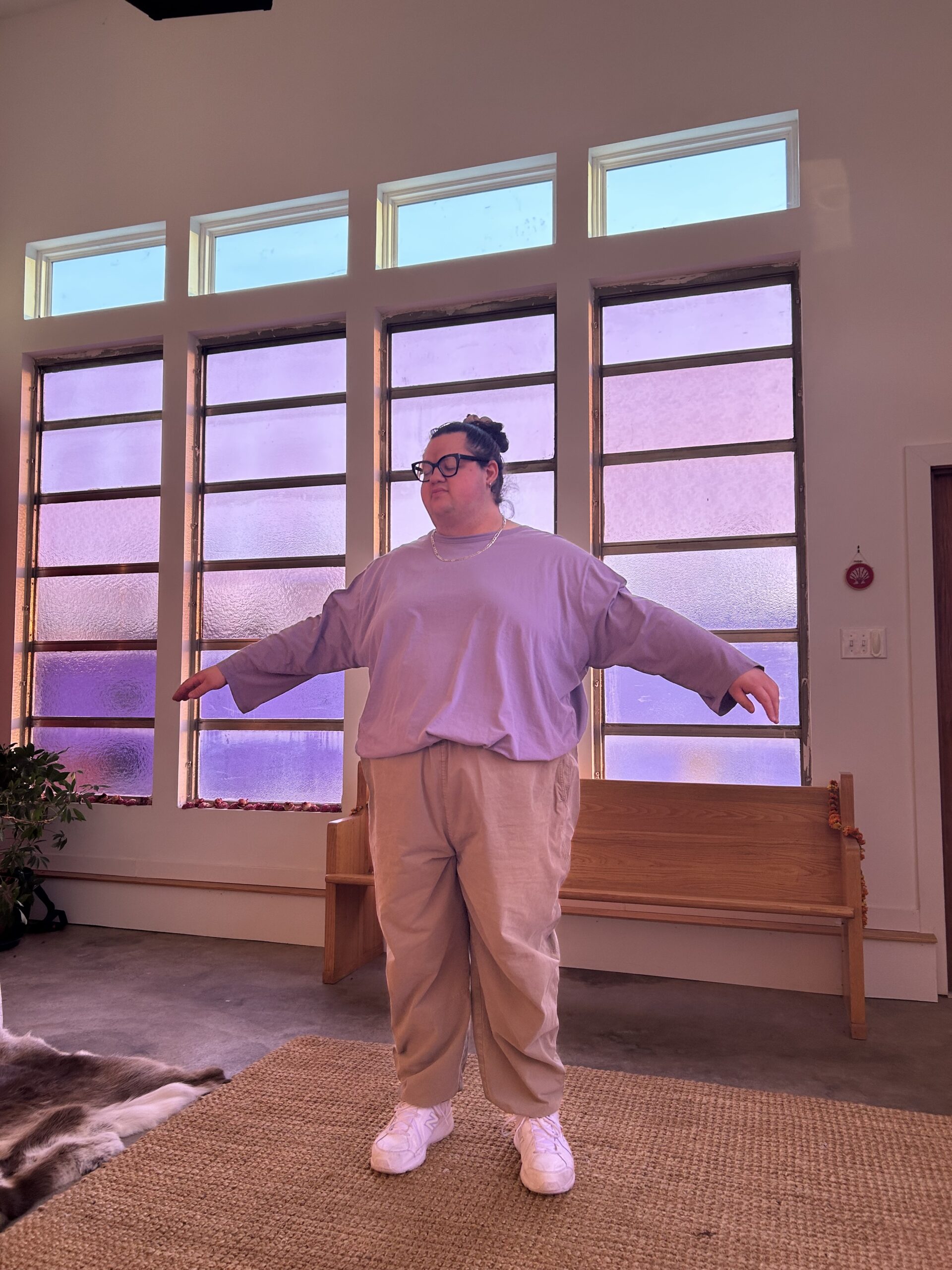
The white and grey neighborhood cat scampers off the corner of the front porch as I approach Sylvia Thomas’s door. Her bungalow sits within a row, a block really, consisting of 18 other houses, that is now dedicated to long-term housing for artists, a special initiative through the Contemporary Art Museum of Indianapolis (CAMI), which happens to be across the street, and another home for the block’s resident feline. As the door flies open into her home, her bright, cheeky grin radiates across her face. Her long limbs extend from her statuesque frame, welcoming me in. Sylvia’s presence is always striking with her rich voice.
There is art happening in every room of Sylvia’s live-in gallery/studio. At the moment, she is waiting for her new roommate to move in, so for now, she has decided to dedicate each room to a different medium in which she works. “I have one room that’s just music. I have one room where it’s like media art, I mean, with collage and writing, and then I’m just kind of singing all over the place,” she tells me as we get settled into her dining room area, now set up with naturally stained wooden chairs and a small table with a tarot deck at its center. Out of the corner of my eye, I see into a backroom full of papers and magazines sandwiched between pushies and other memorabilia like personal photographs, a spot of extra comfort among the moving emptiness.
Once in our seats, she continues to tell me about her Indianapolis, Indy for short, home: “I’ve been here about 3 years, really long term. There’s people who have been here almost 10 years. […] Yeah, we just participate by giving back. It’s an exchange we give to the museum; they give back to us. It’s really cool. Sometimes we get cool commissions, sometimes we get assignments that help pay the bills from living here, and then also I get to kind of invest more money into my craft instead of housing. Which is really nice. A blessing, for sure.” A special initiative indeed.
Compared to living in New York City, where I currently reside, the actual space and resources are limited just by sheer density of not just the population itself, but also the saturation of artists here, unlike in Indy. Where we live can play a major role in our own individual creative process, and for more reasons than one. Sitting here in a spacious place with many mediums of art in the heart of the Midwest, we, of course, have to acknowledge this duality, which leads us to the root of something larger: the red state of it all.
“I live in a blue bubble. […] In red spaces, red states, it can be very dangerous for certain people and populations. I think that can be true, but I do like living in a red area. I think part of my art, […] performing here it’s... You have an audience, but then you sometimes get the people from outside the city coming in to like an event, and they see you, and they’re confronted with you, and they see for me. I mean, people describe my work as emotional or beautiful, and so they’ll [relate]. It’s really cool. To change minds. It’s really nice to see the impact of [the] work is having more directly.” And isn’t this what all artists want? To know that their work is having some real contribution to the world? Which, I can hear my New Yorkers saying now, Yeah, but then you have to live in Indiana. Which is another interesting conversation to have all on its own.
As we listen to the rain wanting to properly drizzle from outside, Sylvia expands on the idea of surroundings, adjusting her flowing dark hair beneath her trucker hat: “One of my favorite movies is To Wong Foo, Thank You for Everything! I watch it to go to sleep sometimes, and I sometimes think as an artist that’s kind of what my everyday life is like. Even though I don’t live in a small town, where everyone knows each other, we kind of do in the same art scene. I feel that way living here, except the drag queens didn’t leave. I just stayed behind, and I just decided to live here and work here and work with other artists and influence them with my own inspirations and creativity as a queer person, as a transsexual, as a you know whatever [giggles with a twist of her hand] mess.”
There is indeed an idea of connection and community that is so much more nuanced than the blanket take of inherent, universal acceptance and positivity. Humans are humans, no matter the intent or wish. What does it mean to have more community outside of our prescribed identity?
With a glint of her wide smile that nearly closes her eyes every time, she answers my question, “I think we moved away from that 10 years ago time where community was based off of identity. Now, it’s more focused on interests, personal love, passion, and motivation. I think I surround myself with people who have the same interests as me or that want to create work that makes people feel a certain way. Even though I’m a queer trans person, I feel my closest friends are cisgender and straight. I go to the movies a lot; one of my interests is film right now. And I go up often, with these two brothers–one is a medical scholar, one’s a [biblical] scholar, and it’s so cool. We talk about movies differently. We see them differently, and we were able to introduce each other’s perspectives to each other. I think that’s more interesting and fun with friendships. […] In the last few years I surrounded myself with a bunch of artists cause I was learning how to be in the arts scene more, but then I wasn’t meeting the loves of my life that I want[ed].”
The diaspora of friendship continues to expand for Sylvia. She and I have discussed many times the importance of having old heads in our lives for these reasons of viewpoint, how we need to have their foresight, but also to be the old head as well. We must give and receive advice. Naturally, this brings us to,“[…] I love intergenerational relationships. They’ve been so important to me right now. […] If you can look in your close circle and you don’t have anyone that’s an elder, you’re missing out. So much of life, I love just hearing random stories about the past and also experiencing the future with each other.” An outside or othered point of view is important. This we both aggressively agreed on. We also agreed on how much it can influence our own work, to the point of inviting it in with collaboration.
As a former resident of Indianapolis and someone who runs a collaborative series here in NYC, I know exactly what she means. This is where so much creative and personal development can come from. She confirms this, “I’ve been able to receive a lot of collaborations with institutions and with spaces. I just finished a really cool collaboration for the new Contemporary Art Museum of Indianapolis. It’s a video piece with Jess Dunn, called drafts. That was one of my first real commission collaborations, where an institution we’re both working with made a decision [for it]. We worked with each other, and that was really fun, and it worked out really well. I communicated my insecurities that I wasn’t providing enough, and you know she affirmed me, or she communicated hers [insecurities], and I affirmed her. But I would say it’s hard to collaborate here because of the working aspect too.”
The interesting thing about collaboration is that it’s not always about the work itself, but many times about the process of making and post-completion of the art. In my own practice, I have found it to be complex and layered, like anything that deals with community and, well, human beings. Sylvia continues, “I’ve reached out to people about collaborating [with no response]. And I don’t know, part of me wonders if my insecurities come in, and I’m like, maybe it’s just my art is not vibing with them, and that’s okay. But like all of the insecurities of I’m too queer, or they don’t want to be seen with me, or they don’t wanna be seen in a certain light.”
Of course, not everything within community is positive, intentional or not. Even if folks are working to relearn negative norms, the residue of it oftentimes remains. Sylvia has experienced this too: “There’s such a bro hetero culture here in Indiana, even with the art. […] I still see some, you know, light homophobia, but I don’t think it’s bad. I think I don’t want to work with people like that. I don’t want to call anyone out. I have no time or energy for that. But I’m [still] enjoying collaborating. I do want to collaborate with some other music women.” This is a goal we both know would ignite the local and national scene, given her intense sound work and poetic installations.
Collaboration isn’t limited to just people, either. Collaboration can consist of other media and entities. When I ask about her perspective on poetry and collaborative poetry, she says this: “I consider myself a poet by nature. But I think I’m learning to be an artist by trade by learning certain skills, whether it be screen printing, music technology, or audiovisuals. […] I’ve really been wanting to collaborate more with writers cause I have some really amazing ideas for theater and stuff, but poetry, it comes when it can. I’ve always told people I’m not a sustainable poet.”
Why, I ask, does she feel this way? “I’m not someone that can write and produce for publishing deals all the time, never have and never will be. I kind of create collections, and then I release them like printed them myself, and I released them; I sent them all over the world [while] performing at World Pride or performing internationally or even when I toured with you in New York. I’ve been able to sell all the time, all over the place, and I know my work exists in several countries, but never through a publisher. With poetry, I think I’ve been really trying to come back to it. I’m more open to doing poetry again, and I almost feel lost in the lack of discipline, like focus on one discipline. Like when you came in here, I was singing, showing you some songs I was working on today, but also on Friday night, I was writing a poem, and I was like, ‘Oh, maybe this is an idea for a bigger concept.’ I kind of just make the work; I can’t just, like, think projects, but I gotta work on that discipline.”
This prompts the question I have agonized with for years now, since discovering Mei-mei Berssenbrugge and Kiki Smith’s Endocronology or Hannah Weiner’s work in grad school: What is poetry? She has a lot to say about this. “I used to say there’s poetry for the stage and poetry for the page. […] But now I also believe there’s a question of where, what surfaces, or what landscapes do you want your poetry to live on? That’s a question I ask a lot of poets right now. [For example,] I got to put my poetry on a mural. […] It’s the openness to what poetry can be. Also, though, it makes my discipline harder because then I’m like, ‘Wait, what am I writing for?’ Because I read it down and I go, ‘Okay, it’s on this page, but I don’t think it belongs here.” Maybe it belongs on the side of a bus, or maybe it belongs on the sidewalk in chalk, or maybe it belongs on an album cover of sorts. I’m always trying to figure out. I feel like poetry is the root, and I feel like it is by nature what I can create. I think poetry is just a sentence unbounded. […] It’s free. But, there’s gonna be people that are gonna go, ‘This isn’t poetry. I don’t like this,’ or there’s gonna be people who are like, ‘This is the poetry I’ve been waiting for. I didn’t know poetry could be like this.’ It’s fun to watch people who are the definition, and some people think that you are redefining it.” As a teacher who introduces their students to poetry by way of Chen Chen’s “Winter” and William Carlos Williams “This is just to say,” I appreciate exactly what she is talking about. Poetry can use everyday language, it can be gross, while still being deeply nuanced.
This makes me wonder, what sparked her interrogation of poetry? She starts with, “I was raised in the house of slam.” Sylvia slows down, takes a deep breath; she is not overwhelmed, but rather, reflecting. I can tell this is important to her. She rubs her knees with both palms as she looks away from me and out into the other room. “Being able to perform my work has allowed me [to gain] a confidence that I think many people strive for. I meet so many people who are insecure or so many people who are shy or quiet because they were taught to be or they were told to be, or that’s just like how their nervous system is. […] I just feel like it’s so amazing to be alive and like we should all be talking to each other forever in the same room together about art that we’re experiencing. […] Performing has allowed me that confidence to engage with the world. Which art is just that. The performance of art allows me to be a human and in a way that makes me feel not only in love with my life and myself. But there are people that surround me that are performing a certain way that doesn’t make them feel good, it feels like they’re surviving. And I can’t live like that. I have almost come so close to dying, so I don’t want to do that anymore.”
And there it is. It’s about people. There’s a slight pause before she adds, “Be[ing] unafraid and making things, or just like a writer thinking about what’s surrounding me right now,” she says, throwing her arm out to draw attention to the room we’re in, one I’d noticed and marveled at before we even began.
With that, she begins to speak on the importance of people, “For example, I guess a way that’s coming in my natural self again, like coming into what I want to make and what’s coming naturally and coming out of me, is the poetry recently I’ve been writing is because of a box of old gay porno mags. […] I’ve been obsessed with videos, DVDs, and I collect them myself. Part of that is also these magazines, and inside it is like this little tunnel to the past, for gay people.”
She and I knowingly eye each other, as fellow queers who not only grew up within conservatism, but also the fallout from that conditioning: “I felt like I started as kind of like poor, you know, kind of like redneck family vibes, watching whatever pop culture told me to watch. To eventually being able to go to college and study history, which allowed me to open my eyes to new perspectives and people and cultures that then led to understanding my queerness, who I am as a gay person, and being able to honor queer history. But then now I’m like, okay, like where else are we? Then I got all these gay porn magazines, which wasn’t a part of my upbringing as a gay person was magazines and porn magazines and it was nice to like go through them and understand what imagination we had to have. And like that, we just don’t foster that anymore, we really kind of just serve the porn on a platter and we’re like, ‘Here it is! Yum, yum, yum! And get off.’ I feel like taking the time to read a story written by someone else, an erotic [story] to get off, was like this imagination that I’m hungry to have. And it’s also an archive of desire. If someone were to be like, ‘Show me gay people, what they were like,’ I would pull up these magazines and be like, ‘Here’s an archive of what specifically these people who are gay, what they desired, what they’re looking for.’ And sometimes the only archive we have of someone is just this personal ad of someone from Washington, New York, or Alabama. So interesting to think about, so that’s inspired me to write.”
“Being able to explore these magazines and the text within them, which was something I feel like was shamed for a lot of my life, for any queer person, is to have shame around your stuff, I think like we wanna be more than just we wanna be more intellectual than just seeing for our queerness; but I kind of love taking it back to the basics and being like, ‘No, we are there’s so much too much.’ I am just so much more concerned with humans interacting with each other, even if it is a disgusting old gay porn mag.” We can’t contain our laughter any longer on this, shouting “yes, yes, yes!” Drinking in the moment, we know the unsavory complexity of the deliciously delirious intimate connection that starts with physicality.
This moment leads us down a rabbit hole of the concept of intimacy being enough within poetry, without the need to provide context to make it valid. Recounting my most recent book, face-to-faces, its focal point being the exploration of specific types of intimacy, Sylvia excitedly adds, “Because it’s medicine. It’s so necessary. Why do you need to know what I am as a queer person? If you’re into me, let’s just have sex. […] I don’t think you have to understand a concept to give people human respect, love, empathy, and a like desire. […] ...the necessity to understand people in the deepest ways. I wanna see the beauty that can be brought or the ugly that can be brought from stories that we’re experiencing.”
Has this been lost in recent iterations of poetry or art at large? Sylvia thinks maybe, “I just love watching people interact and write about their interactions with each other. That’s what I’ve been falling in love with. So that’s been a huge inspiration for the poetry I’ve recently been writing.”
Of course, not everyone feels this way. With the ever-growing distraction of the current administration, the development of AI ravaging land, communities, and potentially art, that leaves us creators in challenged spirits. “If I have hate or animosity towards something in my heart, it’s really hard for me to ever make work or create,” Sylvia says, circling back to the basics of observing humanity that can potentially provide that counterbalance for survival. On this, I would have to concur.
There is something Sylvia said early on that I keep thinking about: “It’s cool and sad to watch how artists are surviving right now and how they’re taking on so many forms of creation to keep themselves alive or keep their work alive or afloat.” With the current climate of grants being rescinded, cutting lower-earning degrees, and the unhoused crisis, she realizes the esteem and dignity needed in both her artwork and profession in harm reduction. As our time together draws to a close, Sylvia leaves me with this: ”My art practice and writing style begins with a social practice. It begins because of relationships and people.”
Sylvia Thomas is a writer and artist from Indianapolis, IN. From live performances, writing, and visual art, her work centers eroticism, grief, and history. She’s performed across North America and Europe. She is a long-term artist in residence at the Contemporary Art Museum of Indianapolis. She is also a Libra.
Kristine Esser Slentz authored EXHIBIT: an amended woman, depose (FlowerSong Press, 2021, 2024) and recently released face-to-faces (ThirtyWest Publishing House, 2026). A TEDx participant, organizer/producer (Adverse Abstraction and Verse & Vision), and regular contributor to The Saturday Evening Post, her work has also appeared or is forthcoming in TriQuarterly, Five Points, Tupelo Quarterly, and elsewhere.