
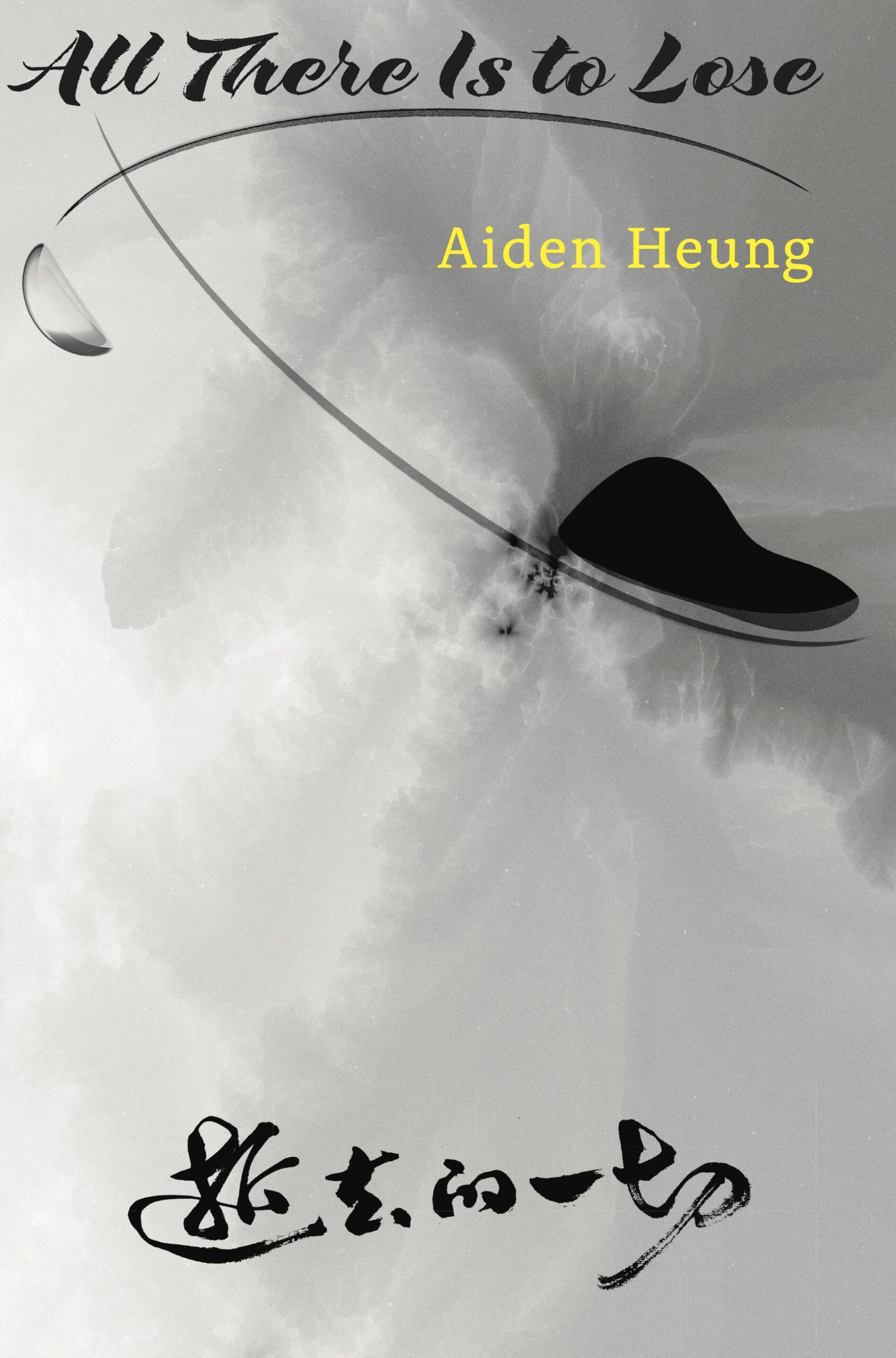
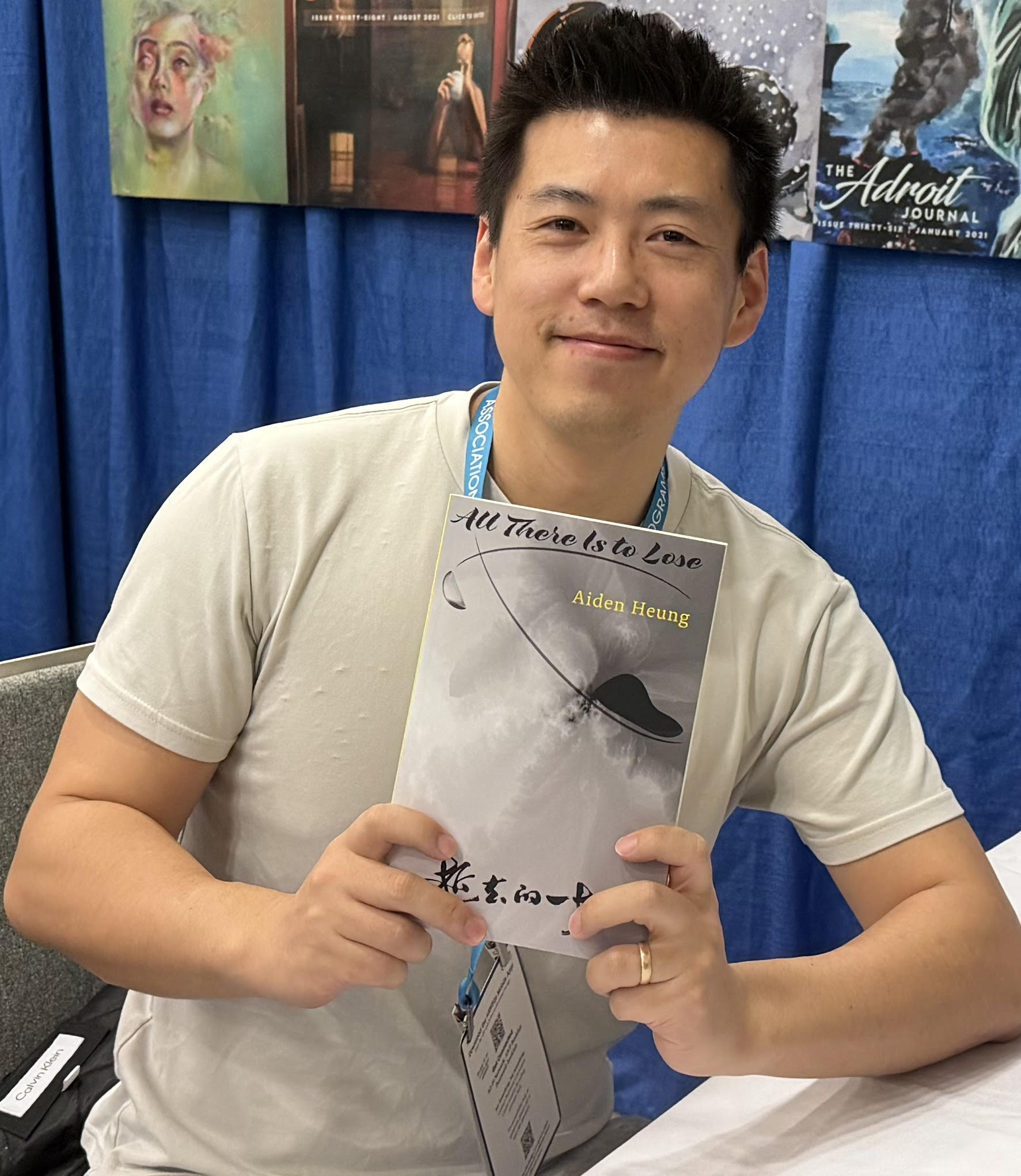
Tiffany Troy: You begin the collection with “At the End of the World,” and write: “I carve their faces into stones and bury them.” That immediately reminded me of the bassoon which begins The Rite of Spring: we are immediately situated in a place that is strange to us not only because of how tall in elevation we are, but also because the speaker is a master-carver who sits “where the land swallow sky.”
How does this opening poem set the reader up for the poems that are to follow?
Aiden Heung: The whole book is a journey. There is departure, how the lyrical I has to leave the beloved village where his parents stayed behind. There is also homecoming, where he returns years later knowing home, once lost, is something he can never go back to. But I also want the readers to feel that the journey is also a psychological one, that every poem is a crystalized fragment of my life, that this book is an invitation into memory. Therefore, in this poem “I cut myself open” I love your reference to the bassoon in The Rite of Spring. It’s quite unsettling. It’s like the images in this poem, I want them to be beautiful with a foreboding of tragedy.
TT: I love how you allude to the tension between the beautiful images with the foreboding of what is to come. What was the process of writing and putting together this collection?
AH: I put together a chapbook of 15 poems dedicated to the village and the people who live there. Naturally, I spent much time revising them. This book came into being during the revision process. I felt then that I had so many stories I wanted to tell, so many emotional truths I wanted to explore that I had to write more. It was a summer of intense writing, like finding the perfect puzzle pieces to complete the whole picture. Sometimes I find it easier to write when I have a project in mind, or a goal.
TT: And to build off that, I felt in some ways, you built a shrine to moments of being disheartened and the everyday reality of the Tibetan village (the winter, the mother’s lacerated finger and body wrapped in black, the revolution in the 1980s, belts striking like lightning) and the desire to pretend “they all have / happy endings.”
How did you approach writing about the personal with great intention and empathy and who are the literary guideposts (Virgils) in your journey? Who is part of your artistic canon most important to learning about the worldscape that you have built in All There’s to Lose?
AH: I think from the beginning I know this book is going to be a tribute. I dedicate the book to a generation of people living in the small village called 915. I planned to write more about the people, about their simple happiness and tremendous struggles. But when I was drafting the book, it occurred to me I have no right to write about their stories, what I know about them is only my memory and my feeling about them. Memory can be deceiving, therefore there are quite a few poems that read like surrealism or anecdotes. What I am sure of is my emotions–how I feel about them. That is the approach I adopted when completing the book. Are some poems a bit sentimental? I think so, only because I witnessed tragedies beyond my comprehension. I’m still trying to understand them, one of which being I had to leave my parents at the age of 9 and was not able to see them again until almost 10 years later. So yes, this book is deeply personal, where I’m trying to embed the personal narrative in a grander social scheme without explanation. What could I explain as a child ?
There are so many writers who have deeply influenced the making of this book. I’ll name three books that I return to often for advice and inspiration
- The Half-Inch Himalayas, Agha Shahid Ali
- Nine Dragon Island, Eleanor Goodman
- The World Doesn’t End, Charles Simic
TT: The five sections in the collection each begin with “Elegy,” which you note “began as a nonce form [you] created during Carl Phillips’s prosody class.” Can you speak to how you landed upon the collection’s five-part structure? What are the thematic or narrative arc that you hope to create with the “Elegy” as a type of guidepost, in the search of those who the speaker has lost, in tandem with his home and time?
AH: In Elegy, I wrote about a few moments of my grandma’s funeral process. From the time of her departure, to me gurneying her into the mortuary, to me kneeling before the incinerator and hand-collecting her remains and finally to the final act of burial. If there is a thematic and narrative arch I think it is a fragmented journey, pretty much like the book itself where I’m dealing with what’s happening without being able to understand the why. Most importantly, I believe there is a dialogue going on between each poem of the elegy and each part of the book, where they begin with loss and end with silent resignation. I certainly took this into consideration when I wrote new poems to complete the book.
I’m grateful to Professor Phillips for his advice that I bravely face one of the darkest episodes of my life. The poem began with a nonce form with haunting repetitions, where one image bled into the next line until the last line, which must loop back to the beginning image. In the revision process I found myself unable to tolerate the repeated stark images, and so I did away with almost all the repetition. Professor Phillips might disagree with this decision.
TT: My two cents is that your professor will see how you grappled with the deep sorrow of your speaker and that the reduction of the repetition (with repeating motifs) help build that sense of movement (and stalling) in the speaker’s grief over the mother figure. In that way, I feel the nonce is a scaffolding that fell away as you found your way to the poem’s final form.
Speaking of form, I am wondering if you speak of poetic forms and its relationship to time (as you build stories in which you can find yourself in some way). I am specifically interested in the contrast between the prose poems and the poems with much shorter line lengths. What do you feel comes first: the form or the content and how do you build the rhythm of 915 (that knocking) through poetry?
AH: Thank you. Scaffolding is the word! If somehow the new form works in ways that the original nonce form couldn’t, ( I hope) it is the sharpness of each image. Sometimes a single strong impression triumphs repeated emphasis.
For me every form–lineated or not–is a container which matters as much as what it carries, by that I mean the subject matter of the poem, though I try to understand the subject matter first and foremost before I decide which container is best for it. I’m particularly interested in poetry of the moment, or lyrical elevation as coined by Johnathan Culler, where lyrical poetry tends to lift one moment out of the confines of time. This is the goal most of my writings strive to achieve: by revisiting and reimagining a memory, an impression–the crystallization of time. For instance, in the poem Snow Country, I use haiku as the form to create an impression without description, and somehow, to me, that particular impression becomes the eternal time. If shorter lines give me moments of reflection, breakage, emptiness, the prose poem gives me continuation, movement, and panorama, which is good for stroy-telling, characterization, and description. So I guess with a combination of stillness and action I’m trying to convince myself that what I put on the page is not just a painting of the village, but a place where people live and die, where life happens in its mysterious ways.
TT: What do you feel is the role of the poet, once a boy who “wondered what lay/ beyond these intricate peaks”? How do you craft a sense of place, as the speaker searches for his Shambhala?
AH: There are so many fields when it comes to place-based writings: place, non-place, urban, rural, ecological, anthropological, etc. I’m particularly interested in the entanglement of place with people: how people adapt to and change a place while at the same time a place with its natural, cultural, social-political implications can influence people. So yes my understanding of place is always centered on human beings. My debut is about a place, but more than that it is about a child’s memory and emotion of it, together with the people living in it. What I want to express is that I was crafting an emotional landscape built on the actual one.
And the role of the poet? I don’t think I have ever thought of this question. What practical roles do we employ other than writing our heart out ? If I have to answer this question, I think the role of every poet is to know themselves, then write consistently, honestly and unabashedly. All poets are aiming for somewhere “beyond these intricate peaks”, but as suggested by C.P.Cavafy in his marvellous poem Ithaca, “Keep Ithaka always in your mind./Arriving there is what you’re destined for./But don’t hurry the journey at all./Better if it lasts for years,/so you’re old by the time you reach the island,/wealthy with all you’ve gained on the way,/not expecting Ithaka to make you rich.”
TT: What are you working on today?
AH: I’m finalizing my second manuscript, which continues the emotional landscape where the lyrical I, a travelling sales man in China, lived through the Shanghai city wide covid lock-down in 2022, after which he self-exiled to the United States in the Trump era, to live. I’m also reading Edouard Louis, Esther Lin, at the same time exploring my new home Philadelphia, which I know will be an inspiration for my poems. I love multitasking.
TT: Do you have any closing thoughts for your readers of the world?
AH: Nope. Readers are smarter and more knowledgeable than I am. I don’t think they need my thoughts other than what they can find in my book. But I do hope that in some mysterious ways my readers can feel connected to me personally and that they enjoy the reading.
Aiden Heung is a recent immigrant to the United States, originally from a Tibetan autonomous town in China. A finalist in the Disquiet Literary International Contest, he is also the winner of the Elinor Benedict Poetry Prize and the Levis Prize in Poetry. His debut collection, All There Is to Lose, selected by Ilya Kaminsky, was published in March 2026 by Four Way Books. He holds an MFA in Creative Writing from Washington University in St. Louis. He lives in Philadelphia.
Tiffany Troy is the author of Dominus (BlazeVOX [books]). She translated Catalina Vergara’s diamonds & rust (Toad Press International Chapbook Series). She is Managing Editor at Tupelo Quarterly, Associate Editor of Tupelo Press, Book Review Co-Editor at The Los Angeles Review, and Co-Editor of Matter. In 2025-2026, she is a Co-Curator in Residence at the MinEastry of Postcollapse Art and Culture. In that role, she co-curates The American Wing, which features poets who shape the rich, polyglot and ever-evolving landscape of American poetry.