
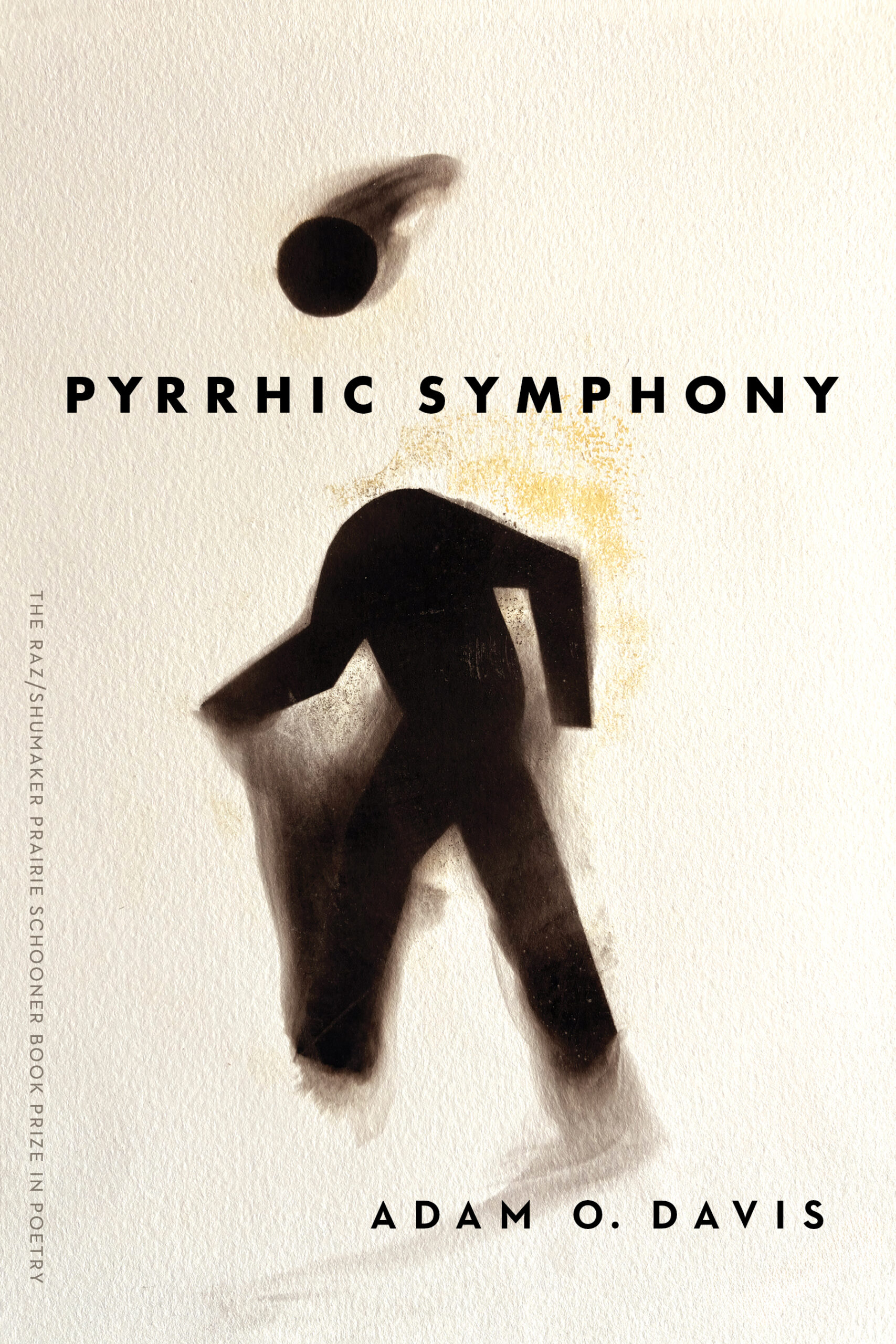
Tiffany Troy: The title of the collection, Pyrrhic Symphony, in its wordplay and the displacement of “victory” by “symphony,” focuses on attention to both music that is heard and overlooked. You write, for instance, “That when I was a child I watched a house burn down/ without thought of the people inside it.” How does the title serve as a framing of the poems that are to follow?
Adam O. Davis: Music being both “heard and overlooked” is a good way of putting it, and the quote you mention speaks to this: the music of the fire–its spectacle–overwhelming its destructive reality. In this poem–as with the entire collection–I was interested in the ways in which the spectacle of sound–its symphonic power–is a source of creation and destruction. It struck me that the endgame between those two possibilities isn’t unlike a Pyrrhic victory in which the winning side is all but indistinguishable from the losing one. This also spoke to the tensions present between poems’ speakers along with the personal, environment, and political tensions present in our daily lives.
Part of the happy accident of the title was that the word “Pyrrhic” comes layered with meaning, referring not only to General Pyrrhus’s melees with the Romans, but also the use of metrical feet in poetry, which points to the way form works to create music and meaning. As a poet, I love the richness of language, its textures and rhythms, but I’m also well aware–especially in our current political and corporate climates–of how it can be twisted to confuse or distract those it targets. And, equally, I’m interested in how sound works against meaning, like all those glorious pop songs, symphonies, and operas whose melodies sugarcoat the darkness of their lyrics or themes.
TT: That dichotomy/ duality between creation and destruction harks back to William Carlos Williams, who you quote in the epigraph beginning this collection: “What do we remember that was shaped/ as this thing/ is shaped?” In “To Whom It May Concern,” the speaker asks: “Should a poem be the pill or pharmacy?/ Should I pledge myself to this business as if it were Gerald Manley Hopkins or Jesus Christ.”
This is your second poetry collection. What was the process in writing and putting together the collection across its four sections? In what way does (your) photography shape the thematic and aesthetic structure of the collection overall and within each section?
AOD: In certain ways this was an easier book to write than my first, which relied on a substantial amount of retrofitting and reimagining as its conceit wasn’t immediately clear to me–that said, “The States”, which comprises Pyrrhic Symphony’s third section, was originally 50 pages long before I trimmed it down to 8 pages.
I know it’s been said many times before, but it proved true for me: writing the first book was my best education in writing a book. When I began work on my second collection, I was writing with a clearer sense of purpose because I knew that I wanted the new poems to look and sound different from the first. In particular, I wanted the new work to be more personal, more welcoming of the “I” which I’d done my best to resist in the past. In this book, I wanted to risk revealing myself, and by opening up in this way, I leaned into the pleasure of the words’ music for support. I wanted to luxuriate in language and, in doing so, amplify and distort meaning, raising questions for both the reader and myself. As I tell my students, verse is called verse for a reason–in poems we’re allowed to sing.
In regards to the photographic section breaks, I’m a deeply visual thinker. For me, photography and poetry are very much aligned in their focus (ahem) with composition, perspective, framing, and timing. In this, the photographs in the collection are there to serve as both mirrors and windows to the poems in the book. And, in two cases, documentary as the photographs depict the moments the poems came into being: the first photograph of the cruise ship anchored offshore is the cruise ship in the book’s title poem, and the photograph of the desert chapel is where “Terminal Felicity” began.
TT: The collection starts with a dedication to the Nurse, which serves as addressee, muse and persona for the speaker. How did you (on a craft level) construct the voice and presence of the Nurse with (or in contrast to) the speaker? I am interested in how the characters very much absorb the diction of the system that they poke fun of.
AOD: To riff on Donne, the Nurse is very much the three-person’d God who batters this book’s heart. She was present in the earliest poems, but it wasn’t until the twin forces of divorce and the pandemic arrived in my life that she took on a more pronounced presence. As it turned out, she was speaking throughout the book. Once I realized that, I understood that her voice was the counterweight the collection needed. Is she reliable as a narrator? Perhaps, but no more so than the other speaker. Like any conversation between two people, it’s what they don’t say that points to their truest thoughts and desires.
That said, in thinking on the cultural and professional expectations we have for nurses, it was important that she be more direct than the speaker–she’s less given to music, and more forthright in her statements, yet the absence of music doesn’t imply, as we often think, an abundance of honesty. Still, she’s asking the right questions by pushing back against the many party lines that are presented.
TT: I am fascinated by how that difference between the Nurse and the speaker is manifested through the poetic forms of the collection. In the holy sonnet by John Donne that you reference, Donne writes: “Take me to you, imprison me, for I/ Except you enthrall me, never shall be free...” and that of course refers to the three-person’d God as well as the poetic form as a restraint that allows (paradoxically) the speaker to be “free.” Your collection features a wide range of forms, which are much longer/ expansive than the sonnets, for instance. Do the poems find their form; or vice versa?
AOD: That’s the eternal question! How to find freedom instead of stricture through more stricture? This is the tension that I love about poetry, that even in the most freewheeling poems there is still form, that even the absence of form becomes a form unto itself. For me, one of the most pleasurable parts of drafting a poem is discovering what the poem wants to look like, which involves a lot of experimentation with both the eye and ear. How does the lineation guide the reader across the page? And how do the line breaks impact their being read aloud?
Also, because there were different speakers, it was important that their poems have a recognizable visual signature as voices have their own distinct shapes. For example, the Nurse’s poems are often more compressed and measured in their approach while the other speaker’s expansiveness demanded an expansiveness of form. In that case, I wanted to punctuate–or score–those poems visually by arranging them as a composer might with musical notation, leaving them looking like desert road signs pockmarked with bullet holes or threatening to explode under the force of their internal engine’s spinning.
TT: Relatedly, what do you write with or on? Your poems are also aesthetically pleasing (by that I mean looking sharp even in its caesuras/ indentations). Do you feel the medium on which you write has served as a type of lens or frame in this age of Aspirin?
AOD: Years ago I bought a manual typewriter in the hopes of returning to a more physical way of writing yet, vigilant as I am about saving things, the theoretical security of the laptop kept calling me back. Now I write my first drafts by hand which I then type up. I’d be lying if I said that the computer doesn’t help–or at least make more efficient–my experimentations with formatting. But I’m intrigued by your question of the lens as it brings up the question of what tools respond best to specific times. Microsoft Word, which remains my first and only computerized word processing platform, is indeed the viewfinder through which I’ve brought these poems to fruition. In the same way that photographers can now receive immediate playback thanks to digital technology, there is pleasure in getting to see what the poem will look like on the page, though that pleasure speaks directly to convenience, itself a questionable hallmark of this age and one that I grapple with, both in the book and in my life, constantly.
TT: In “The States” you write of the habituation and desensitization through language: “We can’t–and then we do” as a motif in the “misery of debt–I mean the mystery of the west.” Do you consider yourself a poet of place (with its attendant displacement)?
AOD: Having moved around so much between the United States and Europe, I’m always uncertain whether I’m a poet of place or a poet of places. But, being born in Arizona and raised partly in Utah and now living in California, the American West looms large in my writing, especially in the prospect of its vastness, its staggering distances that demand isolation juxtaposed against its unfurling, air-conditioned metropolises (writing this, I imagine the page as a kind of desert, with the poem appearing upon it like a much needed gas station or restaurant). This speaks to the displacement you mention–the physical and psychic displacement of these places demands the physical and psychic displacement of the self, all while challenging our beliefs in what we’ll tolerate in the name of survival.
TT: For emerging poets who are striving to write “Self-Portrait poems,” what are some tips or suggestions that you might offer?
AOD: During my MFA, I studied with Lucie Brock-Broido, who was and is the reigning queen of the “Self-Portrait” poem (seriously, consult her work if you need help in this arena), and because of her prowess I resisted writing such poems for a long time. It wasn’t until this book that I realized the ekphrastic power this approach could confer, specifically in how it complicates the role of the speaker by announcing a deep self-awarness–which is also a form of personal myopia–right out of the gate. (One word of caution: As with selfies, a couple of self-portraits go a long way...) The key for me is pairing the self-portrait aspect with something unexpected (in this book’s case, beehives, interstates, and parables), which got me thinking not only about the multitude of reasons we give in denying voices but also the mistaken representational value we hold for many places and things. So my recommendation would be to consider such poems under the umbrella of their title: What two wildly divergent worlds will you bridge by insisting on their presence together? And how then will they explain themselves, now that they, thanks to this title, have to?
TT: Do you have any closing thoughts for your readers of the world?
AOD: Reading poetry is one of the most quietly radical acts of self-preservation and social justice that anyone can perform and, especially these days, I’m grateful to anyone who reads and believes in the beauty of language and the restorative power of words.
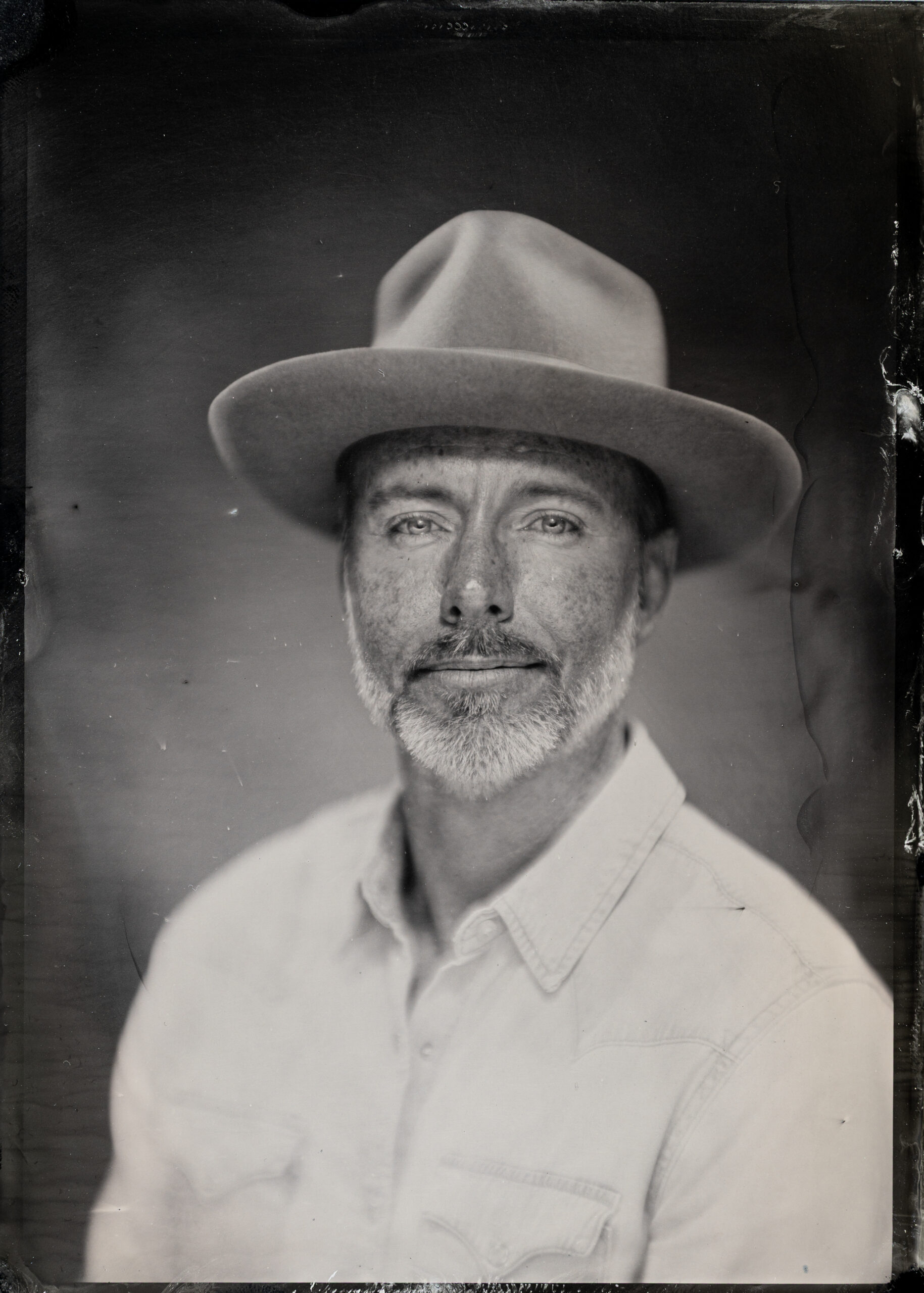
Adam O. Davis is the author of Pyrrhic Symphony (University of Nebraska Press, 2026), winner of the Raz/Shumaker Book Prize from Prairie Schooner, and Index of Haunted Houses (Sarabande, 2020), winner of the Kathryn A. Morton Poetry Prize and a finalist for the Big Other Book Award for Poetry. The recipient of awards from Poetry International and the Poetry Society of America, he has received support from Columbia University, Community of Writers, New Literary Project, The Prague Summer Program for Writers, and Vermont Studio Center. He is also, with Colin Waters, the co-creator and host of the Poetry Goes to the Movies podcast, along with its digital companion for Poetry Foundation. His work has appeared widely in journals and anthologies, including The Believer, The Best American Poetry, The Kenyon Review, The Paris Review, and Virginia Quarterly Review. He lives in San Diego where he teaches English literature at The Bishop’s School.
Tiffany Troy is the author of Dominus (BlazeVOX [books]). She translated Catalina Vergara’s diamonds & rust (Toad Press International Chapbook Series). She is Managing Editor at Tupelo Quarterly, Associate Editor of Tupelo Press, Book Review Co-Editor at The Los Angeles Review, and Co-Editor of Matter. In 2025-2026, she is a Co-Curator in Residence at the MinEastry of Postcollapse Art and Culture. In that role, she co-curates The American Wing, which features poets who shape the rich, polyglot and ever-evolving landscape of American poetry.