
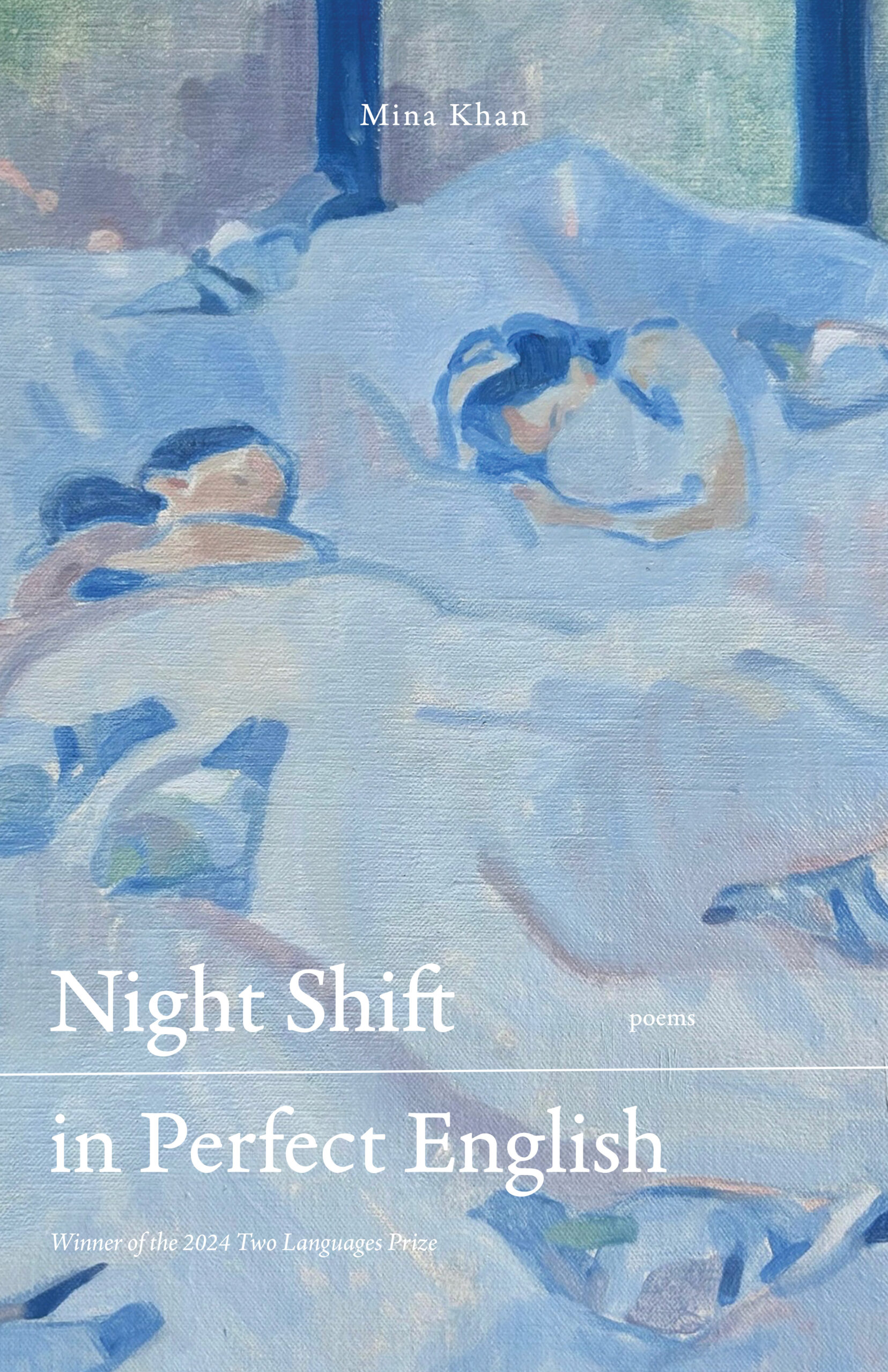
Tiffany Troy: I wanted to first offer you my heartfelt congratulations in your debut collection, Night Shift in Perfect English, which is a marvel of a book. As a fellow New Yorker and a daughter of immigrants, and having “lived there,” I was really moved by this collection. Could you tell us how you came up with the title and how it helps frame the collection in some way?
Mina Khan: Thank you, Tiffany! I’m really excited that you connected with the book-I was really hoping people would be able to see themselves in it. The title “Night Shift in Perfect English” is a line from the series of poems titled “the neighborhood is changing.” I chose it as the title because of: the working class themes of the night shift, the cheekiness of “perfect” English (what is perfect English?), and the dual use of night shift as a noun and a verb. Time passes, the night shifts, and so does the meaning of a phrase. It’s a title that, for me, rolls around with different meanings throughout the reading of the text.
TT:How does the opening poem, “and I lived there,” introduce the readers for the poems that are to follow?
MK: The opening poem situates the reader in New York, in a space of returning. The daughter returning to the mother, older and changed, and realizing that despite years and vastly different lives, things are the same. A key theme of this book is this idea of ourobus-that you can’t get too far from yourself. This is scary, and it is comforting. The opening poem prepares the reader for overlapping timelines. This book is not chronological.
TT: The concept of the ourobus is so fascinating amidst the speaker’s growing up and coming into or out of her identities in a gentrifying neighborhood that she called home. What is the process of writing and putting together the poems in the collection featuring these overlapping timelines?
MK: That’s a fantastic question. I’m having fun thinking about this.
When writing these poems, regardless of when in my life or in the world they took place, I had this strong sense of urgency. For better or worse, I felt I was placed back into the present of these still moments. That embodied feeling that comes with dissociation. A child, watching violence in the family, the feeling of powerlessness. My imaginings of my mother’s poverty as a child in Korea. The crushing knowing of all of these truths as an adult.
The reason why these poems, to me, felt very present while writing them, is because the emotions are visceral and ongoing. Need, want, desperation. It’s easy to set yourself into that time, and so it is also possible to make these timelines (decades apart) into a semblance of a narrative even when placed in a non-chronolical order. It’s the emotional throughline.
TT: I really admire how many poems in Night Shift in Perfect English unflinchingly looks at the genesis of cruelty (by the father and Umma figure) borne of circumstance, and also paints the heroism of the speaker who learns to kill a mosquito and juggle the good and bad parts of bodega life in the Bronx. How do you approach (with sensitivity and generosity) the writing of the cruelties toward and from those closest to you?
MK: Haha, heroism is a place to put it. Flattering. I was thinking about this recently; when I was young, a way that I made peace with the cruelty and the sadness of people around me was through this hyper-empathy. Maybe pity. I would replay an imaging of what it must have been like to endure the violence and poverty – the nonsensical hopelessness of the world they inhabited – during and before I was alive. I did this to justify their behavior, which helped me to love them. This has its pros and cons. It has taken a long time for me become comfortable in resentment. But regardless, what started as a way of coping has remained as an underlying current of hope. I do think that most people are just trying their best.
TT: That of course is tied to the languages in the collection, which you showcase. In “a thing that refuse to die” you write of “jaan / meri jaan / his coos in my chest/ without intention. A language I/ some things / I still remember.” How do you navigate being a multilingual writer, writing primarily in English? How do you choose what to gloss or translate for the reader versus what to keep in its original (or transliterated) form?
MK: I don’t think my poetry has to be entirely legible to an English-speaking audience. I hope that people find some emotional resonance in my work, but I’m not writing with the goal of being understood by any demographic group, including white Americans. If someone understands the Korean text or the romanized Korean or Urdu text in my writing, then they get a special nod. And I of course have no qualm with people looking up the phrase to get a better understanding of the content of the poem.
How I choose to write in a language’s alphabet versus the romanized version is dependent on:
1. The importance of the word’s syntax in the rhythm of the poem
2. How comfortable I was with the respective language at the time of writing.
I’m not a multilingual person; I’m proficient in English, and some, but not a ton, of understanding of my mother and fathers’ languages. I write in English and am influenced by the cadence of these two other tongues.
TT: Turning to the overarching structure of the collection, you have the proem, “and I lived there followed by five “sections” (you might call it) held together and separated by “scenes”. In “what we have done,” you write that “the world is a collection of scenes”: how did you land upon this structure?
MK: I didn’t consider the book to be split into sections, but that’s definitely how one could read it. Initially when sequencing this manuscript, I thought it best to do so chronologically. Then I thought–memory and life are both cyclical and concurrent. As such, I ordered the manuscript in a way where the emotions and themes layer over one another, creating something like memory in the reader. I have the “scenes” as solid markers of place/ additional context, and later as emotional landing spaces. I hoped they would add to a narrative throughline in an otherwise nonlinear text.
TT: Do you have any emerging poets about how to approach poetic form? I felt that your caesuras, indents, and the shapes of your poems (especially for the visual poems) to be so well-done.
MK: Thank you!! Horrible to say, but it’s all intuitive. My advice would be: if you want to break convention by creating a moment of absence, or a hiccup in the line, do it. It’s good to know how to do couplets, but you don’t have to stick to them.
TT: Something else that struck me while reading collection (and which harks back to MON (monuments monarchs & monsters) are the black-and-white polaroid photographs that progresses from unaltered photographs to these erasures that create a ghost-like transparency, which mirrors in some sense the emotional proximity and distance that the speaker navigates (in her relationship with her family and her loved ones). As you write in “September,” the readers see “you look just like your mother/ a red-bowed ribbon, zip-up sweater, Hello Kitty toothbrush/ my mother’s 노리개, / elastic tethered to two puffs” but also how you look just like your father, too. Something about the erasure, I feel, shows how the recurring imaginaries are daily by American society/ existence.
How does visual arts inspire your poetry and vice versa, both in terms of poetic/ visual form and what you write?
MK: I love that you’re familiar with MON as well. This is so cool. Thank you for following my work! This makes me feel famous.
Visual arts has always been integral to my work. As a teen, I would go to the MoMA and freewrite in response to thick paintings, often about war. I did the same activity, ekphrasis, as inspiration for the poem,“what the have done,” a couple summers ago at the Matisse museum in Nice.
I find that my work functions better in collection. This is because I come from a curatorial background; I’m interested in how to lead the viewer through a space, and the different narratives you can create with the same works depending on how they’re navigated. I like to provide visual breaks for the reader, whether through negative space or sparse imagery. And I like to do the opposite by make the page or poem busy and claustrophobic. I’m interested in that building sensation.
TT: Myth and myth-making take a central part of your collection. It’s based on history, on wars forged elsewhere and on American soil, fables, and stories that the speaker hear or observe from her family. What do you hope to achieve through poetry, whether for yourself or for others?
MK: I write with hyperspecificity about my own life. And you’re right, I am mythologizing. My hope with my writing is for people to be surprised that they relate to my experiences. Yes, you might not have an aging Korean mother in New York, but you do know what it’s like to watch a matriarch weaken. I look to create unexpected overlap and a sense of communal: emotion, mourning, celebration.
TT: What are you working on today?
MK: Right now, I’m writing less about childhood. I’ve become obsessed with dullness. We are so stimulated by horror, global and local, that it freezes us. I oscillate between panic and a numb apathy. I think that numbness is an interesting area to sit in, because it’s extremely uncomfortable and shame-inducing. I’ve realized recently that I write from a place of shame. So I’ve been observing the everyday, trying to sit hard in that uncomfortable numb space, and am finding myself hyper-fixating on the relationship between people and street animals. In many ways, this a continuation of my previous body of work.
TT: Do you have any closing thoughts for your readers of the world?
MK: Thank you, Tiffany, for this interview! And to Tupelo for featuring this work. And to everyone else, please buy my debut :)
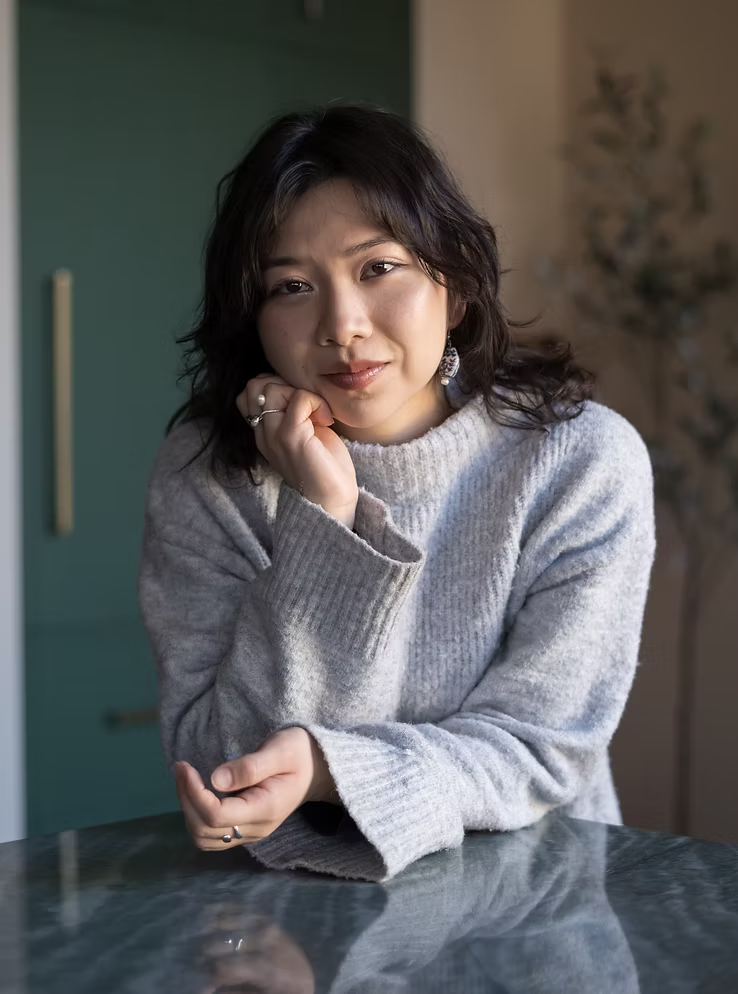
Mina Khan is a Korean-Pakistani American poet from NYC, based currently out of Chicago. Her writing spans across nations, generations, to discuss ecology, cyclicality, violence, tenderness, and the everyday. Winner of the 2024 Two Languages Book Prize, Her work has appeared in AAWW’s The Margins, Tupelo Quarterly, Epiphany Magazine, and more. Khan holds a BA from Wesleyan University, MFA from Columbia University, and is a Tin House alum. Her debut, Night Shift in Perfect English, is available now.
Tiffany Troy is the author of Dominus (BlazeVOX [books]). She translated Catalina Vergara’s diamonds & rust (Toad Press International Chapbook Series). She is Managing Editor at Tupelo Quarterly, Associate Editor of Tupelo Press, Book Review Co-Editor at The Los Angeles Review, and Co-Editor of Matter. In 2025-2026, she is a Co-Curator in Residence at the MinEastry of Postcollapse Art and Culture. In that role, she co-curates The American Wing, which features poets who shape the rich, polyglot and ever-evolving landscape of American poetry.