
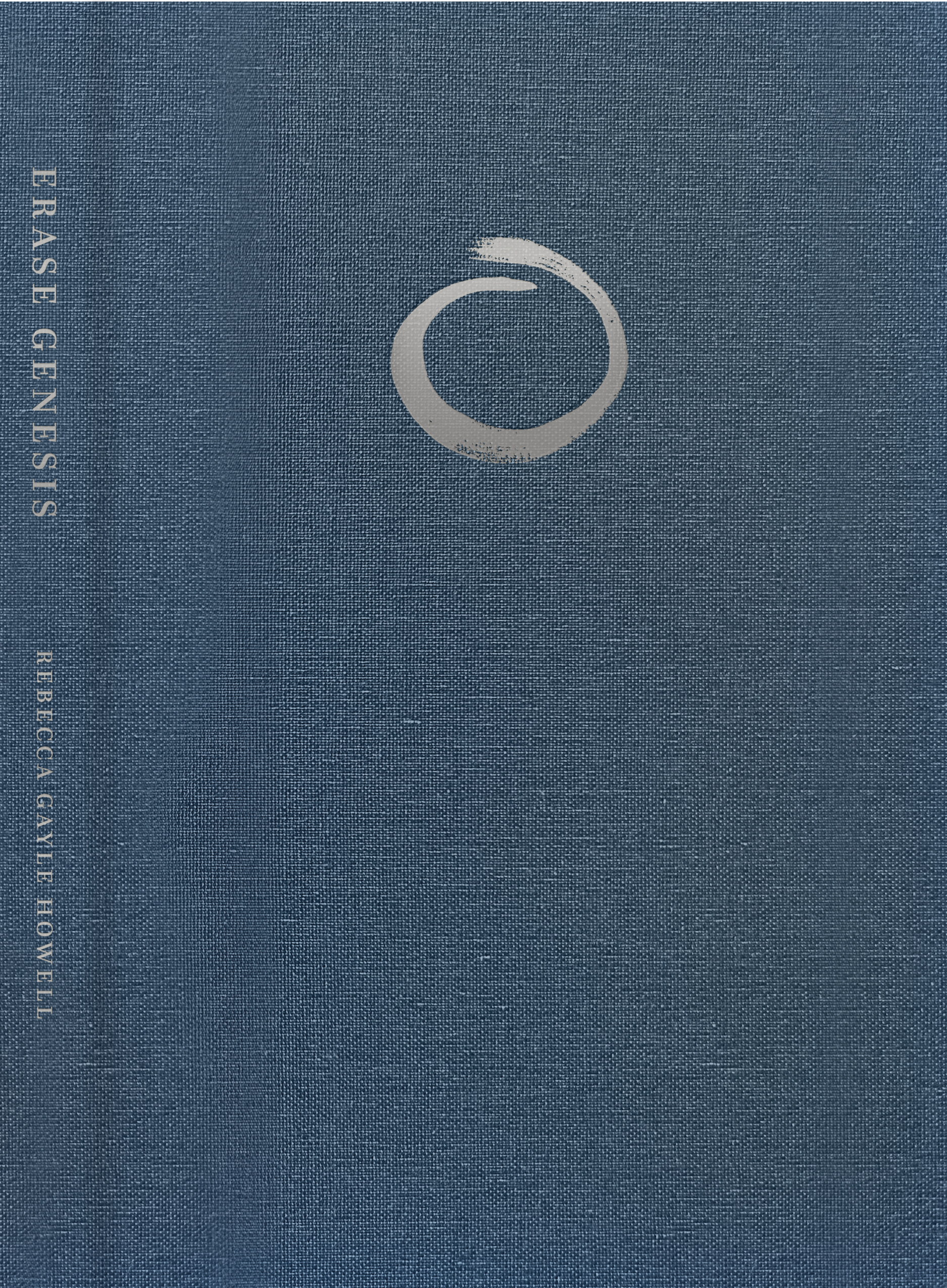
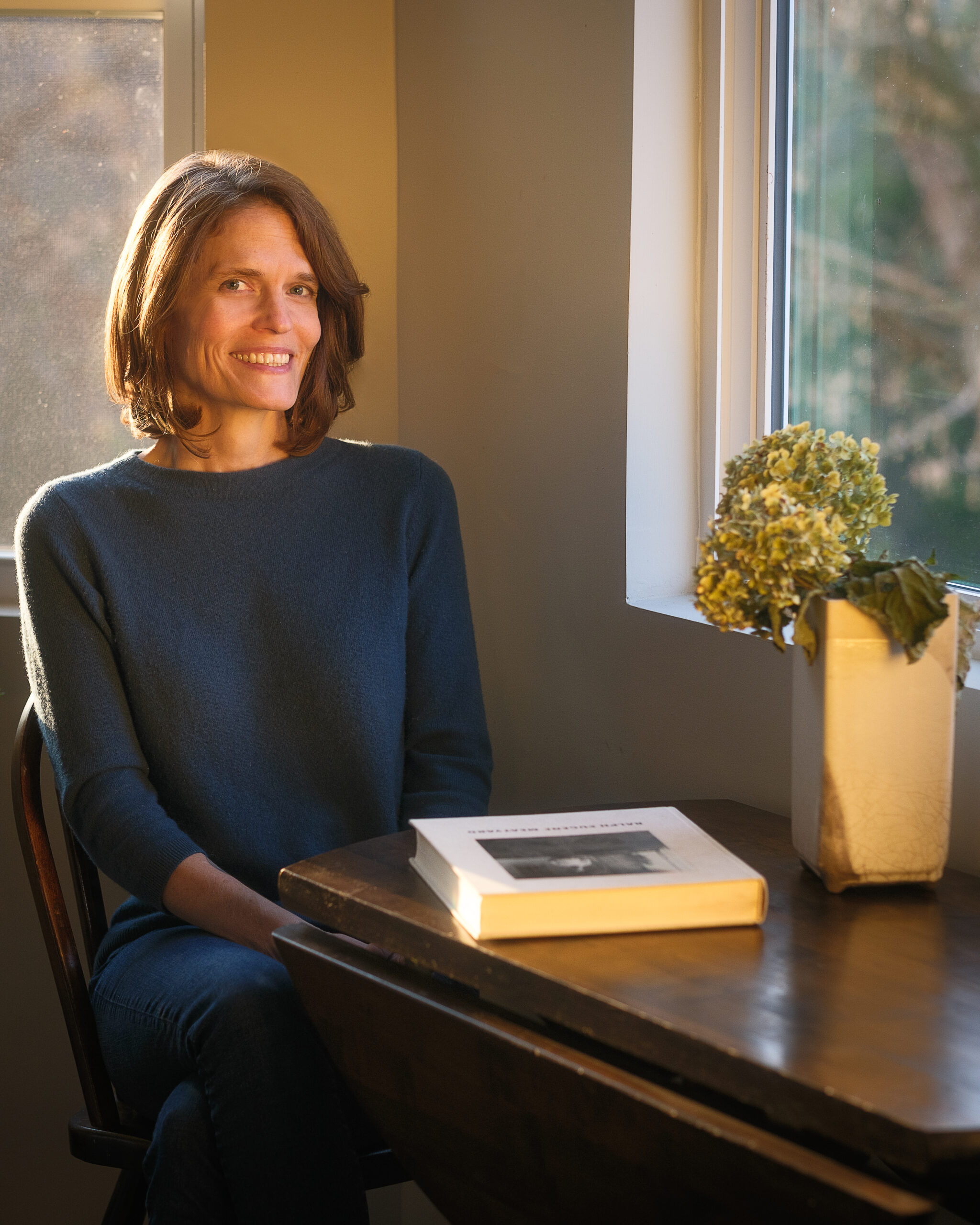
Tiffany Troy: In the “Postscript,” you write: “In the contemporary idiom, erasure poetry is most often used against texts. Texts that we need to challenge because of the lies they tell or the harm they cause. I respect many who engage the technique in that way, but it is not the tradition in which I work here.” Could you speak to the title Erase Genesis?
Rebecca Gayle Howell: I tend to title my books for what they are, a nod of gratitude to the mode I’m working in, its history. Render / An Apocalypse is an apocalypse myth and American Purgatory is a purgatory myth— both ancient genres. And Erase Genesis is an erasure myth. “Erasure” is another word for “redaction,” but it is also another word for what we literary translators call “loss.” Redaction is how many contemporary poets practice erasure, but what I see myself doing is closer to a practice of translation loss.
Loss is a natural part of the work of literary translation, because no language is a one-to-one match for another language. There will always be loss— semantics, images, sounds, words, scenes—artifacts that drop into the gap which separates the source and target languages. The literary translator must sometimes make their peace with losses they wish they did not have to lose. But sometimes they choose to make deft use of loss’s inevitability, welcoming it as an instrument to protect the most necessary and often underlying truths of the source text.
Sometimes, to guard what can’t be lost, we must let go of what can be. This is the way I approached writing Erase Genesis.
TT: I am curious about how you landed upon the Book of Genesis and the first three chapters of the Book.
RGH: The first three chapters of the Book of Genesis is where the creation myth is told. I wanted to come to the Bible in prayer, engaging this hybrid translation loss/erasure poetics as my meditation practice. I came to the text to listen more closely to the deep ecology I believe has always been there. What might I newly understand about our relationship to the natural world if I listen to this story’s most quiet parts? What might it be saying underneath the sound? These questions lived in my heart as I worked.
It’s also true that the King James Version of these chapters tells us we have the right to enjoy dominion over the earth. (Genesis 1: 26 – 28). I understand from the theologian Ellen F. Davis that this phrasing, dominion over, is a mistranslation, that the source text there actually means something closer to knowledge among. That’s a big difference. Can you imagine where we might be today, if such a foundational myth for Western culture had told us, instead, that we had a responsibility to be among the natural world with respect, ever learning from her? The stories we tell ourselves matter.
In this regard, I would argue that the KJV translation teams who worked on Genesis 1: 26 – 28 used another common technique that is the opposite of loss: import. An import is when you add something into the target language version, something that is not in the source text. To take the Bible’s creation myth, which encourages us to imagine that we are endowed with a responsibility to serve, and assert instead that it tells us we are the rulers, the ones who get served—that’s not just a mistranslation, it’s an import of positioning, of power.
Davis’s book Scripture, Culture and Agriculture: An Agrarian Reading of the Bible has been a big influence on all three of my books, but it’s at the root of Erase Genesis. The KJV teams imported an extremely consequential interpretation, one that underpinned centuries of abuse and extraction— all of which brought us to our era of climate change. My inciting question became: what healing might come, then, if I started re-translating it by using the opposite technique? What happens when I listen to this text, instead, through loss?
As I worked a new myth emerged, a story in which man exiles himself from the natural world by his very pursuit of dominion, while Nature unceasingly calls us back home. This, I feel, is where we are now, in this time of climate change. Nature is calling us back home, and she’s turning her volume up.
TT: How did the materiality of watercolor shape your meditative practice in Erase Genesis? How do you hear or see through the brush strokes?
RGH: I wanted a natural element to be the agent of erasure, in this case water, and I wanted the act of making the poems to be an embodied act. So each page in the book is its own painting; they aren’t made digitally.
My spiritual life is informed primarily by Buddhism and Contemplative Christianity, and I see my work here with watercolor as a kind of primitive Hitsuzendō practice. Hitsuzendō will teach you to clarify your mind by revealing your addiction to the ghosts of distraction. Sort of like how, when I sit in Zen meditation, suddenly my mind is wild with noise. That was also true for me as I made the paintings. The practice quickly showed me how easily I could lose control of the brush, once I’d started living in a thought rather than my body. In Zen meditation, you are taught to come back to your breath. With the paintings, I’d come back to the brush, the keeper of the strokes, which physically showed me my addiction to disembodiment. In short, I moved through many (many) versions of these paintings before I could harness my focus well enough to have a simple, clean, balanced line.
It is only through our bodies that we return to our membership with the natural world. The fantasies of dominion are fantasies of disembodiment—they require us to believe we are special and somehow separate from all other creatures, above and beyond the earth. I wanted the book to be made in a way that would welcome others into their own safe embodiment, a physical object that could offer a sensory experience, reminding the reader that their lives are natural, not digital. So Erase Genesis is designed to feel like an intimate Book of Hours: smaller trim size, linen hardback, a vellum flysheet, deckled edged italian paper, a hand-sewn ribbon bookmark. One thing I love about working with Bridwell Press is that they make all their e-books free to read. So if students are studying Erase Genesis as a text for a course, they can do so for free. As a teacher, that means a lot to me. But if you are a reader who wants this book as a companion to your own contemplative embodied life, the edition is there as an invitation.
TT: Who are the artists or writers that you are in conversation with, in thinking about erasure poetry in a new way? Do you think of the watercolor as a type of asemic writing? I am also curious about how you liken it to translation–in what ways is it similar or different from the practice of translation?
RGH: I think of myself as primarily being in conversation with the KJV translation teams, as well as those who practiced illumination and palimpsests over these texts. The idea of Biblical inerrancy is a very recent concept born of the late 19th century. Instead, physically engaging with scripture, becoming a culpable part of the text’s life—be it through translation or redaction or scraping or painting—has been a prayer method for centuries. We call these texts living texts, but what does that mean, if not that they live inside us? Life is change. Thatis a frequent Buddhist teaching. So, in my mind, if a text is alive, then it is changing, evolving. When it stops changing, it dies. Just like all of us. It is the very fact that these books have moved in us, through us, across time, across languages and places, pages and paintings, meeting each new collaborator with change—this is what has made scripture alive, and I see my work as one tiny movement in that lengthy collaboration.
I am also returning here to one of my deepest influences, a midcentury Central Kentucky artist collective that was anchored by Thomas Merton. Merton’s monastery was only a few miles down the road from the town where I was raised, and although he died before I was born, I read his books voraciously in my teenage years and thought of him as my neighbor. He practiced Zen painting as part of his prayer life, as well as poetry, and he also welcomed the interconnections between Contemplative Christianity and Buddhism, both Mahayana and Theravada. Around Merton formed a small group of friends who worked across disciplines and cared for and challenged each other. These friends included the Zen photographer Ralph Eugene Meatyard, the book arts printers Carolyn and Victor Hammer, and the painter and woodblock artist Harlan Hubbard, as well as the younger neighbors who started coming around, people like the agrarian writer Wendell Berry and the polymath artist and translator Guy Davenport. I think of myself as a lifelong student of this collective, and I see their thumbprints on every page of Erase Genesis. I’m thankful to Harlan’s estate for giving us permission to use his woodcut, “Trees in Snow,” as our endpapers.
I do think of Erase Genesis as a hybrid collection that merges my poetics more directly with my translation practice. When I work as a translator, I draft laterally— meaning, I will create several simultaneously credible versions of the same source poem. I don’t see these versions as being in hierarchical competition with each other. They aren’t first, second, and final drafts. Instead I see them each as equal teachers for the next day’s work. Erase Genesis makes this method public. Here I came to the same chapters repeatedly, finding new poems each time I came to the same chapter. Eventually, these poems compiled into the myth I described earlier. So readers will find that they are reading multiple versions of the same source texts, versions that are interdependent to create meaning.
TT: Has the process of erasure shaped your creative writing in some way?
RGH: Yes. In some ways I’ve always been interested in the balance between silence and sound in poetry. My students and I often have that conversation—I’ve found that a poet can substantially deepen their relationship to the art when they let go of the idea that manufacturing more sound, saying stuff, is the ultimate goal. The world is plenty noisy enough.
But I am increasingly interested in the idea that the soundwork in poetry is actually only there to point us toward the silence, to lure us into a silence that is shared among the generations and the natural world, one I think knows a lot more than I do. Erase Genesis is built that way.
TT: What are you working on today?
RGH: One of the things I’m working on is a new devotional sequence in which all the poems carry the same title: “How Will I Know You.” I have a few wild acres in Kentucky, and the poems are set on that place, where all life forms are understood to be the You, both dangerous and divine. You can read a few examples here, here, and here. These poems are my practice of daily attention, and they are also my practice of naming that attention while using as few words as I possibly can, housed in the slightest line. I am asking the poems to show me how to say only what must be said, must be—as Wallace Stevens once wrote.
I’m also writing a new libretto with my friend and collaborator, the composer Reena Esmail. This work is a 30 minute meditation on the divinity of silence, in which I’m merging new English language poetry with excerpts from Paul Celan, in the source German. We are writing it for the American violinist Hilary Hahn and the German baritonist Matthias Goerne, who will premiere it this October in Georgia and perform it throughout their upcoming US tour.
TT: Do you have any closing thoughts for your readers of the world?
RGH: One thing I’m grateful for is that Erase Genesis is being read and taught both inside and outside of poetry circles. It’s very moving to me when a reader of poetry respects my work, of course, but I’m also receiving letters from people teaching this book at their churches and Zen dojos, letters that tell me it is helping heal religious trauma for people who have been exiled from these books during the culture wars.
To know Erase Genesis is welcoming people into a safe space of spiritual autonomy means a great deal to me. I think the human spiritual imagination is each our own private treasure. It is one of the primary means by which we connect the past with the future, the self with the collective, and it has an incredible consequence upon our individuated and cultural actions. I think it’s an essential part of our intelligence, which I think of as our mental ecosystem, and like all ecosystems, its thriving complexity determines its health. One of my hopes is that Erase Genesis can help someone else pick up their brush and listen to whatever their own sacred silences might say to them, on their terms.
Rebecca Gayle Howell is a poet, librettist, and literary translator. Among her awards are the United States Artists Fellowship, two fellowships from the Fine Arts Work Center, and the Aiken Taylor Award for Modern American Poetry. Her latest is Erase Genesis, just out from Project Poëtica/Bridwell Press.
Tiffany Troy is the author of Dominus (BlazeVOX [books]). She translated Catalina Vergara’s diamonds & rust (Toad Press International Chapbook Series). She is Managing Editor at Tupelo Quarterly, Associate Editor of Tupelo Press, Book Review Co-Editor at The Los Angeles Review, and Co-Editor of Matter. In 2025-2026, she is a Co-Curator in Residence at the MinEastry of Postcollapse Art and Culture. In that role, she co-curates The American Wing, which features poets who shape the rich, polyglot and ever-evolving landscape of American poetry.