
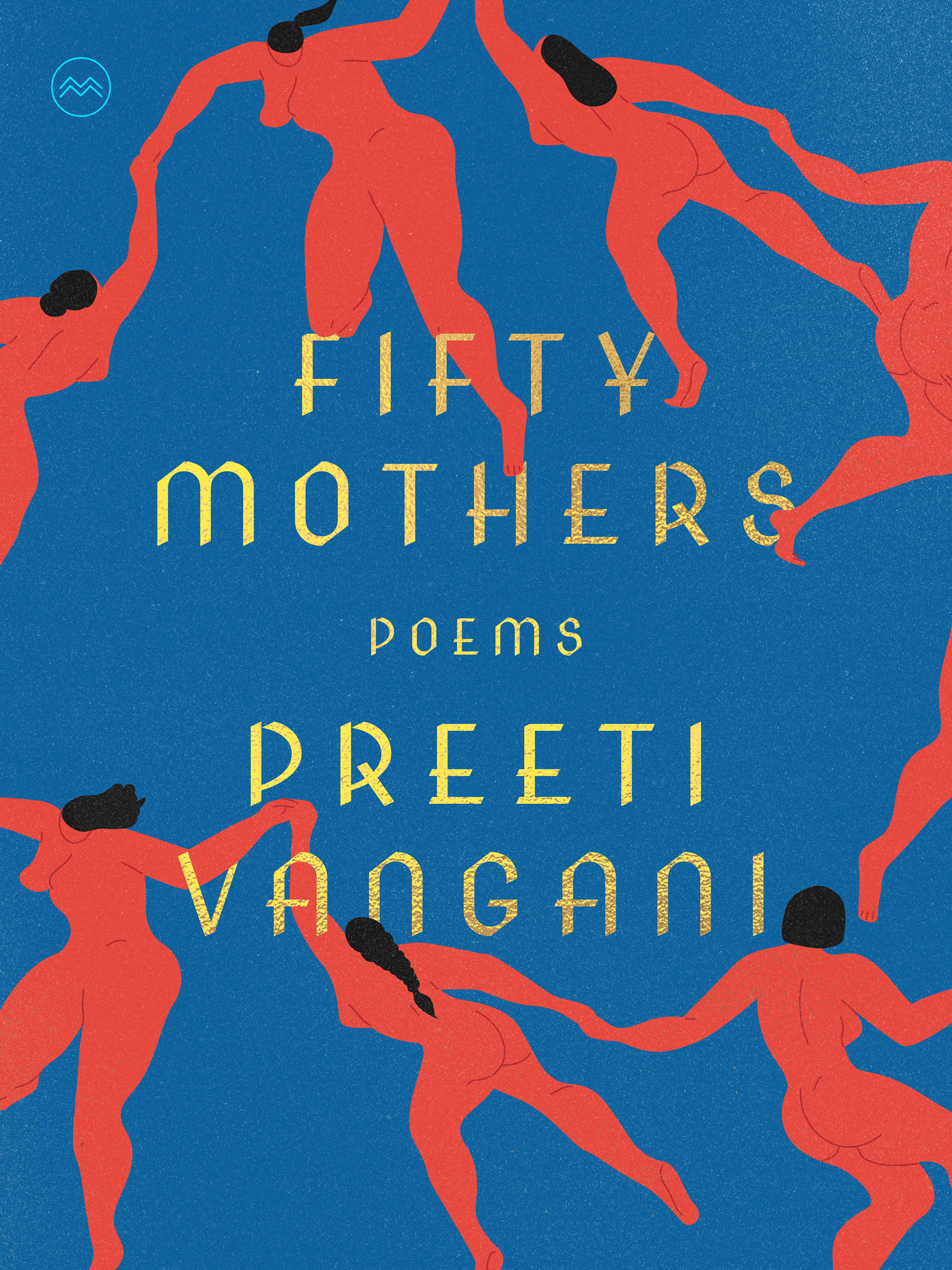
Tiffany Troy: Fifty Mothers’ book cover features a Matisse-inspired circle of paper cutout red nude women with black hair holding hands and dancing in a sea of blue, the title, poems, and the author at dead center. That is followed with a page spread of white on black: “Fifty Mothers” with the author name in gray. Could you tell us a bit about the cover and why you landed upon the cover design for Fifty Mothers? How does the visual elements help cohere the narrative that you’d like to build with the idea of your biological mother, your other familial mothers?
Preeti Vangani: When writing the poems that ultimately became Fifty Mothers, although not sure of the book’s final shape, I felt certain about one idea: that the book must embody joy. Although the central impulse is elegy; it is a tribute to my gone mother, my father’s witnessing of her passing, and our family’s sharp-edged griefs, I couldn’t imagine a world on the page where we weren’t laughing, feasting, scoring stuffies at the claw machine. As the poems unfold in the book now, the speaker’s mother figures expand to include her aunts, friends, stepmother, she even sees a mother in the option of getting an IUD. In my living and writing, I was tired of grief being so serious. Of the brilliant cover options designed by Alban Fischer, I was drawn to this route because it centered the joy I wanted to illuminate. Its simplified form and bold colors exuded vibrancy. It felt dynamic. Han Vanderhart, at River River Books noted poignantly how the fluid movement of the figures seemed to echo the sequencing of poems in the book: pulling the reader not into one forward emotion, rather in a dispersal of emotions as the kaleidoscope of love through which the characters are seen keeps twisting. A variation of Matisse’s La Danse, it’s harkening to continuity felt fitting for a book where I am trying to re-member my mother’s life. The black interior page was all Alban Fischer and the press. I love how cinematic that opening feels.
TT: The collection then continues with a picture of the first page of your mother’s college diary from 1984-85, wherein the “maiden name and address” were “scratched and replaced with married name and address in [her] father’s name in jest.” The opening poem, “Under the Lining in Papa’s Cupboard Drawer Hide Biodatas of Potential Brides,” continues that line of thought”. Can you speak to how the biographical (with its historical, cultural, and gender implications) and the speaker’s imagination help shape the “ministry of less” of the world that the mother has left behind?
PV: I wanted to begin with the photograph to set the context of arranged marriage. Hoping as the poems unfold, readers can see we’re encountering a woman whose several freedoms are curtailed or incumbent upon the husband, while love still keeps popping up in the relationship. And while the man, the system of arranged marriage, the medical professionals inch towards erasing the woman’s agency, it is really death that is the final erasure. My inkling therefore for the poems was to push against this final erasure. To ask, how this ‘ministry of less’ can be veered toward abundance, if at all. In a sense, questioning the erasure pushed me towards creating my mother’s voice on the page in the ‘Gone Mother’ poems. And bringing in the aunt figures, their stories, the father, expanded the idea of who all can be called mother in the aftermath of loss.
TT: Turning to the overarching structure of the collection, how did you land upon the two-part structure?
PV: I was drawn to two sections, one clear split, to record the physical journey of this speaker from home (India/US) and the emotional journey with the father (Acceptance/Freedom). The father’s and the daughter’s lives, within the narrative frame of this book, revolve around grief as their lives change, progress, and evolve. The daughter leaves. The father remarries. As the poems progress and time from catastrophe lengthens, the speaker invites more and more mothers to co-hold the grief.
TT: You recently gave a talk at the Queens Botanical Garden on “Inviting the Ghosts: Intimacy in Elegy.” In it, you quote D.A. Powell from “The Elegy’s Structure” when he writes: “Although the elegy is concerned primarily with loss it is embedded with implied love and with an overwhelming need to triumph over death.” Who are some of the writers that most inspire you as you search for “What this Elegy Wants,” which “is to never be caught alone at an Italian bakery/ buying a dozen cream horns, half-confessing, / half-flirting with the uninterested cashier,/ These are my mum’s favorite–are not were.”
PV: One of the first books to have inspired me into writing elegy was Elegy by Mary Jo Bang. Book of Hours by Kevin Young was very generative too. Other writers that open up the field of what an elegy can be a vehicle for include Gabrielle Calvocoressi, Ross Gay and Victoria Chang.
TT: In Fifty Mothers there is a push and pull between freedom and being held in, which is reflected in the forms of the poems as well. For you do forms come first or vice versa?
PV: The form comes later. I write early drafts longhand and they usually look like chunky blocks of texts. Slowly, I find rhythms or refrains within the block and lines and their possible shapes begin to emerge.
TT: What is your advice to emerging poets who are interested to write of or about their family and the ghosts that inspire them?
PV: To invite their fears and their curiosities into the poem. To open a portal into the imaginative realm to wonder upon the possibilities of the relationship, not just its reality. To write knowing everyone we write about will die, including the writer. Don’t cast the ghost away, converse with them.
TT: What are you working on today?
PV: More poems! And a collection of short stories.
TT: Do you have any closing thoughts for your readers of the world?
PV: Just gratitude for sitting with my work. For making time for poetry.
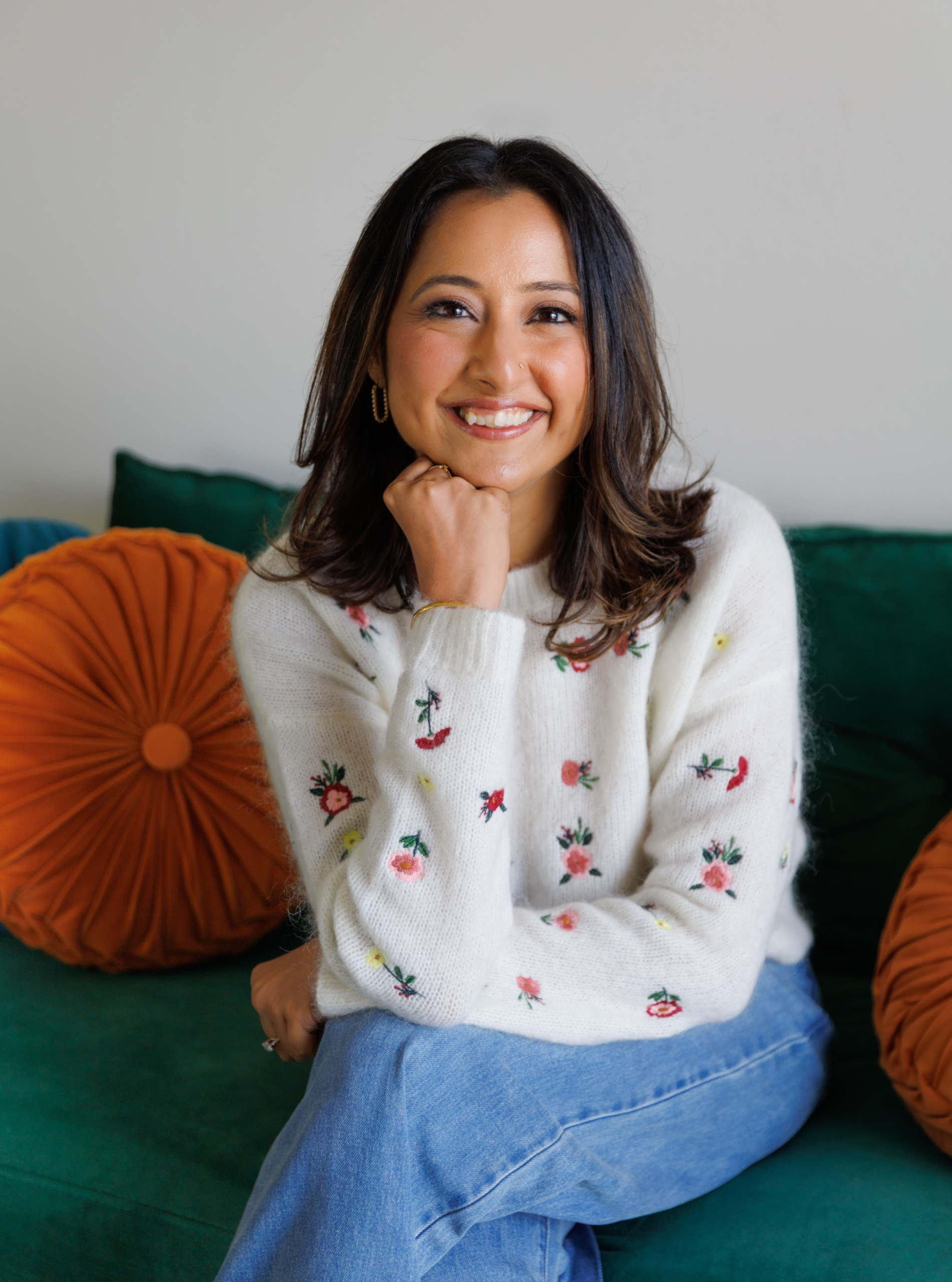
Preeti Vangani is a poet & writer from Bombay based in San Francisco. She is the author of the poetry collections, Mother Tongue Apologize (2019) and Fifty Mothers, (River River Books, 2026). Her work has appeared in AGNI, The Georgia Review, Gulf Coast, Prairie Schooner among other places. Her debut short story won the 2021 Pen/Dau Emerging Writers Prize.Vangani has been a resident at Ucross, Djerassi and Ragdale. She has received artist grants from San Francisco Arts Commission, YBCA, and is a current Steinbeck fellow. She holds an MFA in Writing from University of San Francisco and teaches in the program.
Tiffany Troy is the author of Dominus (BlazeVOX [books]). She translated Catalina Vergara’s diamonds & rust (Toad Press International Chapbook Series). She is Managing Editor at Tupelo Quarterly, Associate Editor of Tupelo Press, Book Review Co-Editor at The Los Angeles Review, and Co-Editor of Matter. In 2025-2026, she is a Co-Curator in Residence at the MinEastry of Postcollapse Art and Culture. In that role, she co-curates The American Wing, which features poets who shape the rich, polyglot and ever-evolving landscape of American poetry.