
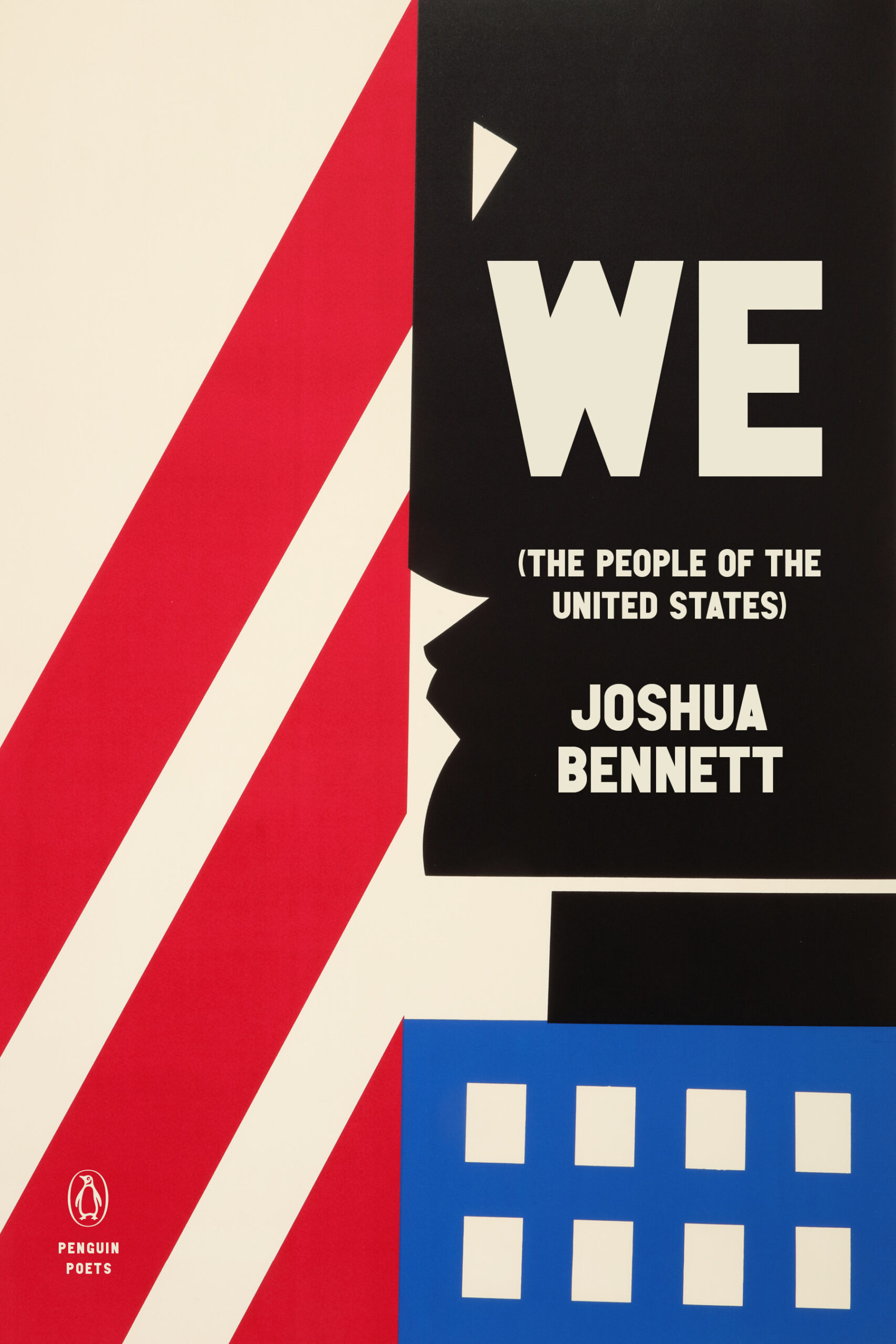
Tiffany Troy: The title immediately frames the collection as being in dialogue with the United States Constitution of 1789. That is then undercut by the parenthetical after the word “We.” How did you land upon this title?
Joshua Bennett: I’ve been thinking for a while now about the power of what Chris Spaide calls “the lyric we.” During a visit to my class on Social Poetics at MIT three years ago, our conversation about this idea helped concretize my sense that I should spend some time thinking about who and what constituted the versions and visions of “we” which meant the most to me. Who, and where, were my people? Spending time with that question led me to thinking more about my childhood in Yonkers, the family that raised me, the family I’m building with my wife here in Massachusetts, the poets who helped me hone my voice (Brooks, Clifton, Matthews, Merwin, Frost, et al), the ancient poets who preceded them, the animals, flowers, and stars that populated their verse. Suddenly, I could see it all more clearly. When I began searching for a frame for the poems I started writing from that place, the preamble, and a poem for every state, seemed like a generative place to begin. It eventually became an ode to invention.
TT: What you said reminded me of the poem, “Talbot County, Maryland,” where you stand before the crowd, thinking of Douglass, “his studied metamorphoses. How he spoke the images/ behind his eyes into colors we could carry & keep.” Could you speak more about your literary and spiritual influences within the context of the collection?
JB: Sure. My influences are everywhere in this collection. I’ve already mentioned a few of them here, but even outside of the influences on my approach as a poet, there are figures like Toni Morrison, and Frederick Douglass, who I read in high school and then reread again and again for the rest of my life, am still reading now for own edification and understanding. Anne Spencer makes an appearance, as does W.E.B. Du Bois and Ralph Ellison. Their writings help constitute the core of my larger intellectual project, certainly. But these are also the voices I turn to in the midst of my everyday experience, as I do my best to navigate the world with integrity, openness, and a commitment to wonder.
TT: In “First Philosophy,” which begins the collection, you ask, “What is your all-time favorite / phenomenon? Mine is when/ the error is as lovely as the aim.” How does this beginning cue the reader for the poems that follow?
JB: I’m not sure I would describe the first lines of “First Philosophy” as a cue, per se, but I do think they signal a few different things I’m interested in. One is how we fall short and love, sometimes, makes up the difference. How our dreams of another world, our striving toward it, are sustained by the abundant care of others.
That poem, at its heart, is concerned with how we tell origin stories. And how even with our entirely predictable imprecision, the telling must take place, hopefully from a space of the desire to share a deeper truth that is illuminated for both the listener and storyteller. There’s an entire world I’m trying to recover in this book. “First Philosophy” is an invitation into that endeavor.
TT: What was the process in writing and putting together this collection? You write, “[t]o celebrate the first is also, always, to honor absence.” What was the research process like, in moving not only across states but also across time?
JB: It was a daily practice of seeking out surprise. And remaining open to where the practice of writing toward each prompt led me, no matter how far I landed from my original intention.
TT: The speaker turns our attention in “Milwaukee, Wisconsin” to “[c]onsider that classic/ opening of those interviews with poets/ you love: what do you write with or on,/ and the history of typewriters/ embedded in it.” So I’ll turn that opening to you, mid-interview: What do you write with or on? What histories are embedded in the means through which you write?
JB:
I write with a laptop most of the time, though a fair amount of my note-taking now takes place on my phone, which is relatively new (I’ve been tracking the difference in tone, pacing, even diction when I’m working from one device in contrast to another, and been surprised by the results). The personal history embedded in this individual machine—the one I’m using to compose my answer to this question—doesn’t go back that far, but I’ve been writing on some version of it since high school. That was when I first started composing poems on both the laptop I got my freshman year and those spiral notebooks I would pick up from the 99 cent store near my house, and use to jot down each and every dream during the two-hour commute from my home to school. It wasn’t until college that the work I brought onstage was written on a computer versus longhand on the city bus, in my parent’s living room, or in the hallway after classes ended for the day. Thanks for asking this, and making room for me to return to that memory.
TT: Of course. Going down that memory lane, what is something that you would like to tell other young poets in developing their own voice, whether on a craft level or something else?
JB: Read everything. And spend time listening to a range of idiosyncratic voices. Listen to speeches, sermons, songs, whatever music finds you during the course of your daily life.
TT: What are you working on today?
JB: At the moment, I’m working on a new essay for The Atlantic on the future of liberal arts education. I’m also writing a book on dissemblance as a form of collective self-defense for a range of black artists, authors, and architects, as well as their beloved collaborators. That project is tentatively titled The Art of Opacity: Dissemblance, Design, and The Specter of a World That Could Be Free.
TT: Do you have any closing thoughts for your readers of the world?
JB: Thank you all, as always, for your continued support and encouragement.
I hope whatever you’re reading, watching, or listening to, is bringing a measure of loveliness into your life. Our attention is sacred. I’m learning anew each day how not to take it, and the miracles it makes more visible, for granted.
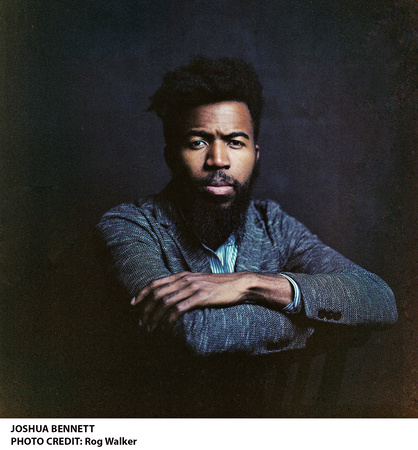
Dr. Joshua Bennett is the author of The Sobbing School (Penguin, 2016)—which was a National Poetry Series selection and a finalist for an NAACP Image Award. He is also the author of Being Property Once Myself (Harvard University Press, 2020), Owed (Penguin, 2020), The Study of Human Life (Penguin, 2022) and Spoken Word: A Cultural History (Knopf, 2023). He has received fellowships and awards from the Guggenheim Foundation, the Whiting Foundation, the National Endowment for the Arts, and the Society of Fellows at Harvard University. He is a Professor of Literature and Distinguished Chair of the Humanities at MIT.
Tiffany Troy is the author of Dominus (BlazeVOX [books]). She translated Catalina Vergara’s diamonds & rust (Toad Press International Chapbook Series). She is Managing Editor at Tupelo Quarterly, Associate Editor of Tupelo Press, Book Review Co-Editor at The Los Angeles Review, and Co-Editor of Matter. In 2025-2026, she is a Co-Curator in Residence at the MinEastry of Postcollapse Art and Culture. In that role, she co-curates The American Wing, which features poets who shape the rich, polyglot and ever-evolving landscape of American poetry.