
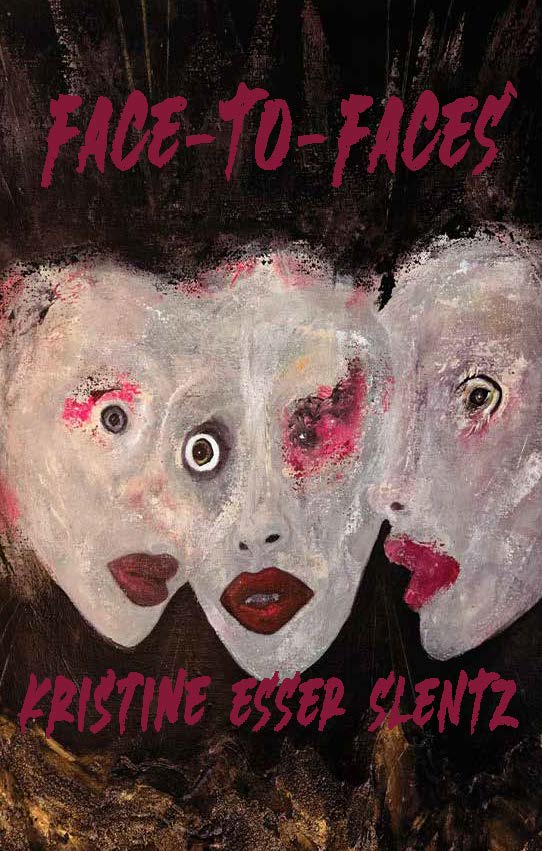
Tiffany Troy: How does the first poem, “First Friend Request: Resulted in the Ceremonial of Sacred Spouse” set the reader up for the poems that follow?
To me it immediately mirrors the fragmentary and performative nature of social media and what’s so interesting is that you achieve a kind of resonance with rhyme that undergird the quotidian and the grotesque with its own kind of music. That then is punctured by the familiar protocol unfollow : removed : blocked.
Kristine Esser Slentz: The entrance of the book wants the reader to examine what happens when all we have to rely upon are fragments of the self—the performance of self—to form connection and, ultimately, to make a judgment of a person’s character. More unsettling still is the moment this gaze turns back upon us, when we are forced to look through the telescope of our own digital footprint only to encounter unreliable narration, distortion, and faultiness reflected back. Romance alone has long possessed the power to blur perception in this way, but layered with our expanding virtual presence and months of confinement within a single space (lockdown), it becomes, if we allow it, deeply revealing.
There is something compelling about this perfected fragmentation. We have constructed a universe in which showcasing has become a mode of survival, a form of intimacy, and a measure of worthiness. The genesis of this collection emerged from the practice of personal archives we curate of ourselves, particularly through the exchange of nudes. It is not uncommon for people to maintain folders of images intended for someone with those they are romantically involved. These photographs are already carefully composed: the right angle, the right light, the desired feature accentuated. Now, we must also contend with the widespread implementation of AI in the generation and alteration of these very exchanges. In the midst of so much mediation and manipulation, an old question is renewed: what remains real within ourselves, and within one another?
However, even amid these shifting modes of communication and existence, the cadence of human behavior remains remarkably unchanged. We are still pattern-driven, breathing algorithms, endlessly replicating and revising ourselves across every facet of life: love, inadequacy, grief, desire, loneliness, connection. The mediums evolve, but the animalistic impulses and learned generational behavior beneath them persist. So much transforms, and yet, at the deepest level, almost nothing changes at all.
TT: That I feel, is encapsulated by the title as well as the thinking of and about the self through polyamory. What is the journey in the collection coming together? I’m curious about how you explore the cadences of human behavior through both documentation and artifice (and by that I mean the process of creation, accentuation, and transformation) that we encounter in the collection.
KS: face-to-faces has two primary influences: Bernadette Mayer’s Midwinter Day and the journal I kept throughout lockdown. Amid the collective grief and great uncertainty of that time, I found myself doing what many people did, turning inward to examine the romantic relationships that structured my everyday life – and sense of self.
Mayer’s Midwinter Day, famously written over the course of a single day on the winter solstice, offered a model for treating lived experience as worthy of documentation. Its commitment to observation, accumulation, and the archive deeply informed my approach. When I later returned to those journals, however, I became less interested in preserving the entries exactly as they were than in understanding what they revealed about intimacy, memory, and identity.
The collection’s journey was, in many ways, an investigation into the self through romantic attachments. The journal entries offered an archive of lived experience, but poetry requires transformation. Through revision, I compressed time, heightened certain moments, and arranged fragments into conversation with one another, framed with elements like photography, collage, paint, and digital replication. The result was less an attempt to record what happened than to uncover the emotional cadences, patterns of behavior, that live beneath the surface of those experiences.
Over time, I began to see the collection as a compilation of human cyclicality; we create the recurrence of similar desires, negotiations, miscommunications, and acts of care informed by not just previous partnerships, but also the original family, our parents. The work attempts to preserve the texture of lived experience while also acknowledging that meaning is often created retrospectively. The poems live between record and reconstruction, between the self that experienced a moment and the self that later returned to make art from it.
TT: A key takeaway from your talk at the Queens Botanical Garden, “In Honor of the Unpolished Poem: An Honest Mess” is to write and to revise not towards perfection or finishedness but towards a kind of honesty, akin to the showing of the unprimed canvas, the seams of the fabric. I am fascinated by the tightly controlled yet seemingly spontaneous forms (visual and lyrical) that we find in the collection. Could you speak to how your poems find their form and vice versa?
KS: I love this question! For me, personally, the challenge is not worrying about what a poem should become in the moment of its inception. That process can take many forms: a stream-of-consciousness draft, “revised” photographs via multiple prints, test paint strips, discarded duct tape, an old voice note to friends or lovers. Simply put, I’m interested in discovery over design. I see it as my task to uncover the poetry already embedded in the material, to notice what resonates, what speaks in a distinctly poetic cadence. Once I unearth those moments, my job becomes one of facilitation: to sharpen their existence so that the reader can experience them as fully and vividly as I did.
In this sense, form is rarely something I decide upon in advance. The material often suggests its own architecture. Revision is where I begin listening for those formal demands: obsession perhaps displayed through relentless and repetitive photocopies, generational trauma depicted in layered, handwritten collage, or deep desire shown through heightened soundscapes. While the finished poem may appear controlled, I hope it still carries evidence of its making, the places where discovery occurred: the rough brushstrokes, bleed ink, faded screenshots. For me, form is not a way of concealing the mess but of making the mess legible.
TT: Relatedly, how does technology shape your poetic sensibilities and forms?
KS: When it comes to this collection, technology plays a significant role because it shaped so much of our communication, and therefore our relationships, during the COVID lockdowns. Our reliance on digital platforms became essential in sustaining connection, community, and even our sense of well-being during a period of profound isolation.
That reliance called for examination. What are the benefits and limitations of filtering our humanity through internet code? How do these technologies expand, alter, or disrupt our natural poetic cadences? These questions remain part of an ongoing discourse, one I don’t believe we should shy away from, especially with the rise in AI. These deserve to be explored in their full complexity.
Because technology has become so pervasive that it inevitably shapes my poetic practice as well. Digital communication often fragments conversation, compresses language, and creates alternative forms of intimacy and distance simultaneously. Those tensions frequently find their way into my work. Sometimes they influence the structure of a poem through interruption or incorporation of found digital language. Other times they inform the emotionality of a piece, asking how attachment, yearning, or loneliness are processed through a screen.
In my opinion, engaging with technology on the page is another form of excavation. It is another attempt to uncover and understand the contemporary human experience.
TT: What do you write on or with? How has it affected the poems as they took shape?
KS: My go-to practice when writing is to begin by hand in a personal notebook. After the initial draft takes shape, I revise directly on the page before transcribing the work into a digital document. At other times, if a notebook isn’t within reach or pen and paper are unavailable, I use the Notes app on my phone.
There is something powerful to me about a poem’s beginnings occurring through the physical act of writing by hand. For example, being able to map the pace of thought through the pen strokes. Equally, I am interested in the lack of those occurrences within a digital space that can create both distance and alternative possibility. So then the ask is what a given piece requires. The method of composition can become part of the poem’s unfolding, informing not only its process but its final form.
My notebooks function as both documentation and archive, a living record of the present moment. Anything I find compelling, curious, or inspiring finds its way into their unlined pages, often affixed with the little bits of Scotch tape my cat will allow me to steal from the spool. I collect in order to create.
TT: What are you working on today?
KS: At the moment, I am writing toward questions of mental health and illness. Two years ago, I was formally diagnosed with CPTSD, and I have become increasingly interested in the realities of navigating treatment. I am exploring its effects on housing stability, employment, family relationships, friendships, and the often-overlooked experiences of those who step into caregiving roles.
I am also interested in the physiological aspects of CPTSD and what occurs within the brain and then body during periods of severe dysregulation. During a trauma response, the brain’s threat-detection systems can become jammed. The amygdala, which helps identify danger and initiate survival responses, may remain on high alert, while areas responsible for executive functioning, emotional regulation, and rational decision-making, like parts of the prefrontal cortex, can become significantly less active, in effect shutting down. What happens is than that the nervous system shifts its resources toward survival above all else. These changes in perception, memory processing, and bodily awareness can leave a person feeling bewilderingly detached from themselves, their surroundings, or even their own physical sensations.
How do you explain to someone you care for deeply what it feels like when your limbs no longer seem connected to your body but are floating at your sides? How do you describe looking at your home’s staircase, kitchen table, or a bedroom doorway and struggling to perceive its edges as stable or trustworthy? Of course, sadly, when this happens, a person could potentially start to view the body as a festering byproduct or worse, manifesting other illnesses such as eating disorders or mutilation.
I want to create work that offers language for these experiences, work that can provide recognition and facilitate those challenging conversations. Rather than simply documenting suffering, I hope to build a bridge of understanding between internal experience and external perception, making visible what is so often misunderstood and/or unseen.
TT: Do you have any closing thoughts for your readers of the world?
KS: Such a big question and so many ways to answer it! So, with that, I will leave one part of my favorite Tim Dlugos poems, “POEM AFTER DINNER for Tim,” for contemplation:
I want to walk beside you in the drizzle // and say you can move in with me / tonight, right away, even though / this time they’ll probably evict me / and although I’m moving out in 3 weeks anyway
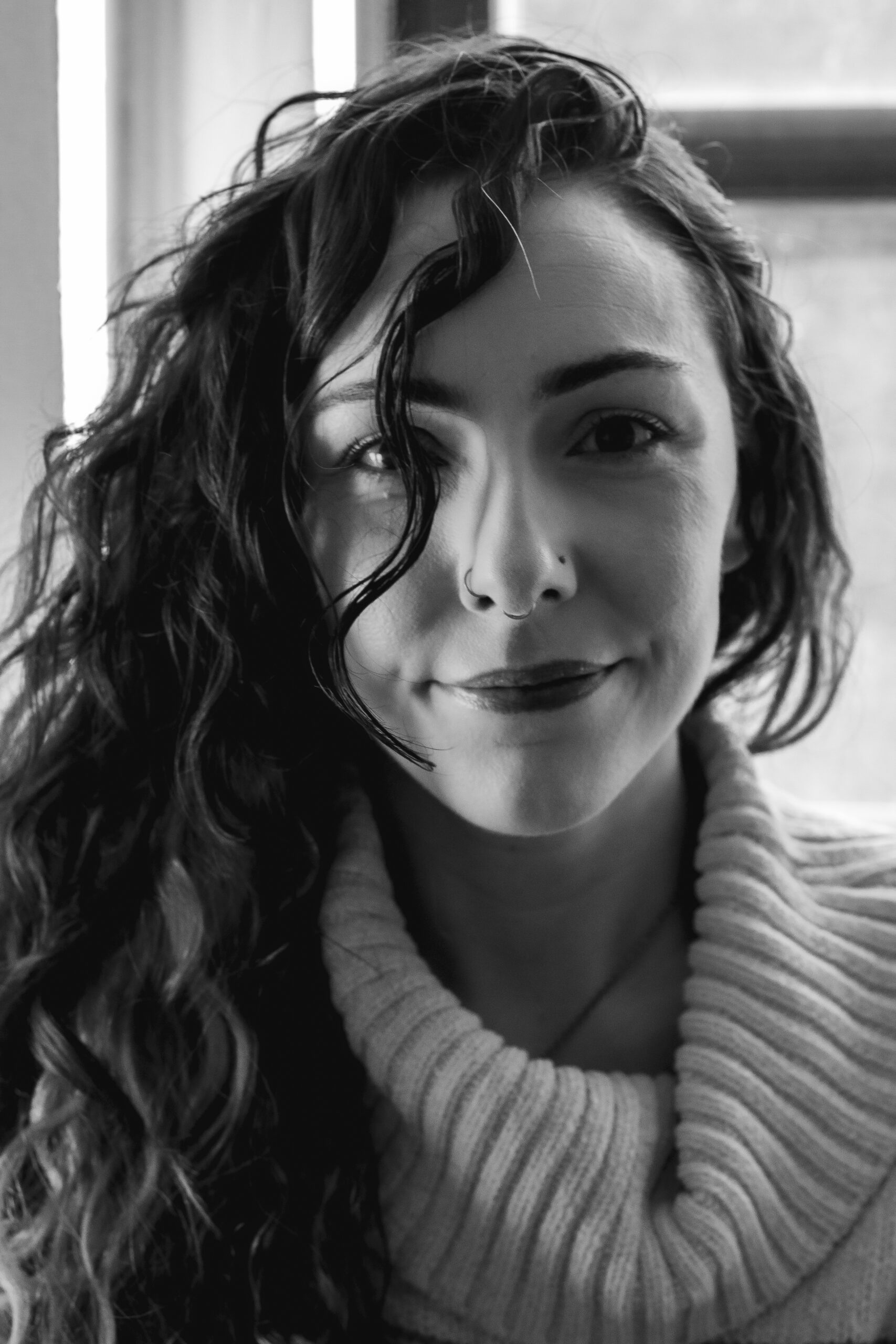
Kristine Esser Slentz authored EXHIBIT: an amended woman, depose (FlowerSong Press, 2021, 2024) and recently released face-to-faces (ThirtyWest Publishing House, 2026). A TEDx participant, organizer/producer (Adverse Abstraction and Verse & Vision), and regular contributor to The Saturday Evening Post, her work has also appeared or is forthcoming in TriQuarterly, Five Points, Tupelo Quarterly, and elsewhere.
Tiffany Troy is the author of Dominus (BlazeVOX [books]). She translated Catalina Vergara’s diamonds & rust (Toad Press International Chapbook Series). She is Managing Editor at Tupelo Quarterly, Associate Editor of Tupelo Press, Book Review Co-Editor at The Los Angeles Review, and Co-Editor of Matter. In 2025-2026, she is a Co-Curator in Residence at the MinEastry of Postcollapse Art and Culture. In that role, she co-curates The American Wing, which features poets who shape the rich, polyglot and ever-evolving landscape of American poetry.