
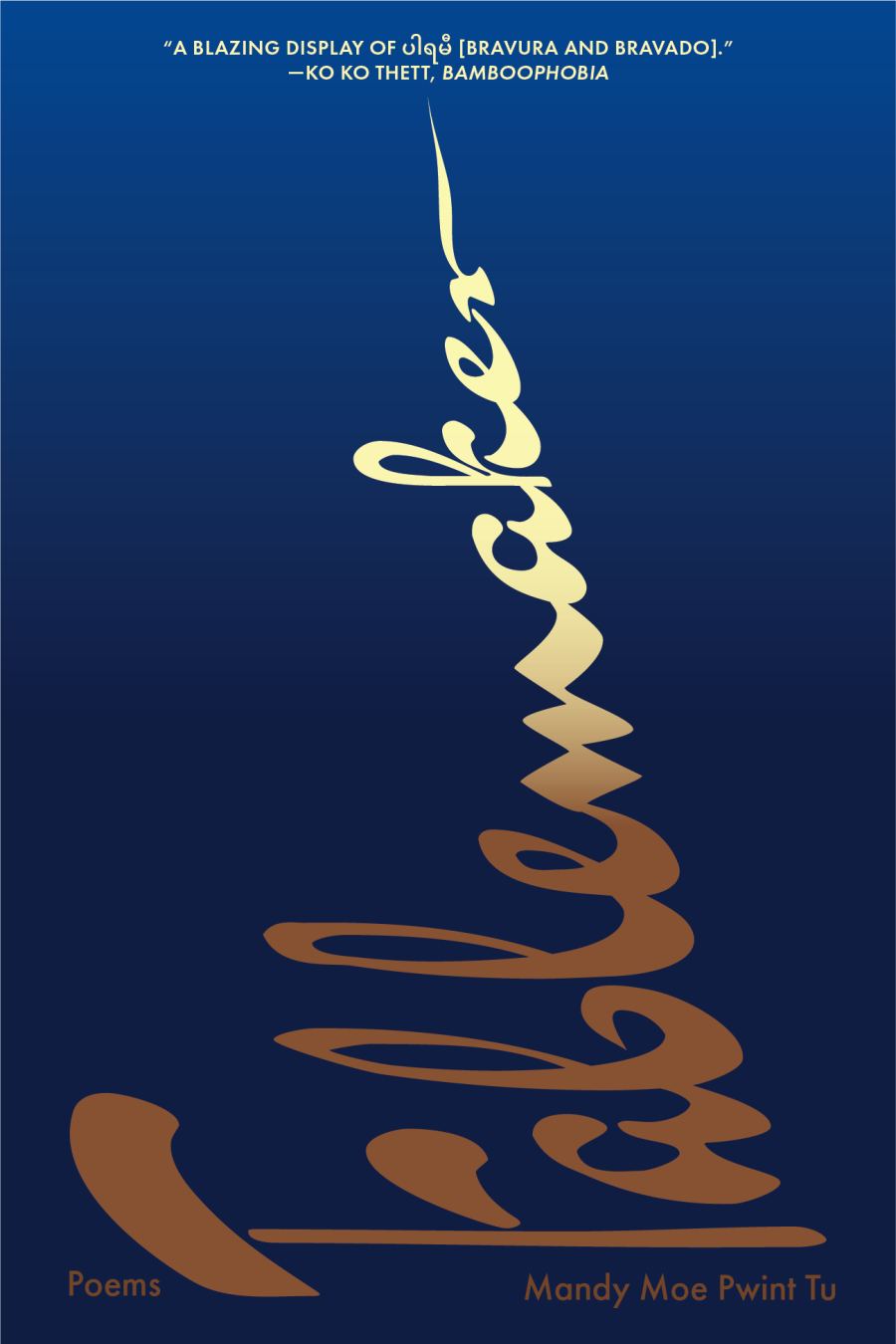
Tiffany Troy: How does the opening poem, “Dear Fellow Fablemaker” open the doors to the collection, Fablemaker?
Mandy Moe Pwint Tu: My hope is that it lends the collection a “Once-upon-a-time” quality—that the reader is invited into a story that plays by its own rules. By recognizing the reader as a fellow fablemaker, I am, from the first poem, assuming a kinship, wrought or established, and I am asking for their help in telling this story.
TT: “Dear Fellow Fablemaker” then becomes the title of many-such poems in the collection, forming a thread through which the three-part collection takes place. How did you land upon the three-section structure and how did you choose how to order poems within sections?
MT: As with most if not all of my work, when it comes to sequencing, I sought a narrative arc. The “Dear Fellow Fablemaker” poems—which entered the book last—helped to frame it more fully in terms of a story; but the collection was always meant to move in that direction. The first section introduces its central themes: the speaker’s estranged relationship with her father, concerns of migration and exile, context for a troubled country; the second section charts the aftermath of the death of the speaker’s father, as Myanmar struggles in the throes of a military dictatorship; and then the third moves toward a kind of acceptance of the grief. The order of the poems reflect that.
It made sense for the collection to have a three-section structure. I might liken it to a three-act structure, if pushed!
TT: In the back cover, you contextualize Fablemaker as being “[b]orn out of a myriad of griefs in the wake of Myanmar’s violent return to military rule” after the coup d’etat on February 1, 2021. Could you tell us how the collection came to be “during the Spring revolution”, as it “weaves together a troubled familial history and a national reckoning” with a speaker very much in flux/ in exile. What was your journey in writing the poems in the collection?
MT: When the military coup occurred in February of 2021, I found myself flailing. I was in a place of relative safety, at my college in Tennessee, watching cruelty after cruelty play out on a phone screen. But I was also witnessing the ways Myanmar people came together to protest, to engage in acts of civil disobedience. One of the ways I found myself processing all of this was through poetry. For example, “On Being Absent for the Spring Revolution” is one of the oldest pieces in the collection, but it captures most keenly what I was feeling in those early days.
Then, in July 2021, my father died of Covid-19 at the height of the pandemic, at the height of the Spring Revolution. Our relationship was strained at best when he died, so the grief of his passing was strange and unruly. I could not grieve him without grieving my country. So when I started my MFA that fall at UW-Madison, I was writing through my grief—for my father, for my country, and for myself.
What did it mean to be writing about military violence and the very real way it was affecting people on the ground in Myanmar when I, privileged as I am, was writing poems in an MFA? What could poetry do in the face of such atrocities? A large part of my journey in writing this collection was grappling with the limitations of poetry—what we ask of it, what it is capable of, and what it isn’t. Another piece of it, too, was this gesture towards the speculative: because I cannot confidently report what is or what happened, I must pull from my imagination. Death is a bird in Fablemaker. The speaker grows scales. Memory cannot hold the facts, but it can hold what is true.
TT: What you said reminds me of the epigraph which begins the collection, which is a quote by Maryhilda Obasiota Ibe: “I became a poet to understand how / so close to one another memory and fable can live inside us.”
Within the dreamscape of poetry, you pinpoint the limitations of even your imagination to transcend the perception of the Burmese in exile as a “pygmalion,” expressed in the question: “Can I see your invitation?” And part of how you pinpoint that limitation is through a variety of poetic forms, such as in the form of a series of multiple choice questions in “In which the White Man on My Thesis Defense Committee Asks Me about Nation” in which the question: “Tells us about imagination” pushes the limits of the speaker’s obsession with her absentee father, concern about her nation, and “the clatter // of a poet // trying to imagine // something other than // suffering.” Or in the yuzana form (itself a meld of the than-bauk and ya-du forms). Can you speak to whether poetry comes first or form comes first for you?
MT: I find that poems often know what form they want to take. Or at least, the formal poems demand to be formal poems, and won’t give me peace until I give them structure. In the instances that you’ve cited, though, form precedes the poem. “In which the White Man on My Thesis Defense Committee Asks Me about Nation” is an homage to Noor Hindi’s “In Which the White Woman on My Thesis Defense Asks Me about Witness” in Dear God, Dear Bones, Deer Yellow—so the form informed the poem. I created the yuzana in Amy Quan Barry’s workshop; the very first yuzana I ever wrote is in the book: “Yuzana for the Monsoon”. The yuzana is a form that prioritizes language: the mechanics of the form demands that you release control of what you want the poem to be, because if you attempt to control the language, the form will not hold. You have to follow the rhymes and the syllables until the poem emerges.
My chapbook, Unsprung, is mostly formal poetry. I think it’s because form allowed me to make sense of my flailing: when everything around me was plunged in chaos, form gave me a container in which to hold my grief. In Fablemaker, I imagine that form allows for a kind of grounding as I reach for the speculative.
TT: Can you touch upon the use of Burmese language, and the incorporation of Burmese transliterations of the flora and fauna in the imaginary of Fablemaker? We begin sitting beneath the ngu-wa tree, where the dream begins; and this collection also revolves on thinking about “How to call နံနံပင် by another name.”
MT: I have a complicated relationship with Burmese: Myanmar’s colonial history meant that my parents favored English over Burmese, so my Burmese literacy is tenuous at best. But I wanted Fablemaker to feel as Burmese as it could; I wanted people from Myanmar to be able to pick it up and find parts of themselves and the country reflected in the book. As such, I made a conscious decision not to translate the Burmese.
Flora—and to an extent, fauna—is central to the Burmese identity. And Yangon, my hometown, is rife with frangipani trees, mimosa trees, flame of the forest trees. The ngu-wa refers to the golden shower tree, the love of which I carried to the ginkgo tree. It comes as no surprise then that these trees and flowers burst forth in even brighter hues in the imaginary of Fablemaker; the flora loom large in my memory, and so they take up even more space in the realm of the book. Some places are best defined by their trees, I think.
TT: This adds yet another layer to what at first feels to be a whimsical bio. In addition to Yangon, who or what are some of the inspirations that shaped your poetic sensibilities within the context of Fablemaker? Who do you feel your book is in conversation with?
MT: I’ll start with a few books that helped inform Fablemaker: Whereas by Layli Long Soldier, Dear God Dear Bones Dear Yellow by Noor Hindi, Deaf Republic by Ilya Kaminsky, The Night We’re Not Sleeping In by Sean Bishop, and Pilgrim Bell by Kaveh Akbar. I was also reading the anthology Bones Will Crow: An Anthology of Burmese Poetry, edited by ko ko :thett and James Byrne, to better immerse myself in the Burmese imaginary.
TT: What writing advice do you have for your readers (who you endearingly call “dear fellow fablemakers”)?
MT: Read! Read everything. This book is in conversation with so many people and so many books—read writers who are doing the kind of work you want to do and read writers who are doing vastly different work! That’s where things get interesting. Imbibe all the words, and see what emerges on the page. And go outside. Talk to the trees in your neighborhood. Talk to the moon!
TT: What are you working on today?
MT: I’m currently working on a novel about international students and ghosts. I can’t say much more at this point, but I’m very excited about how it’s shaping up.
TT: Do you have any closing thoughts for your readers of the world?
MT: Thank you for spending time in this world. Thank you for reading these poems. It has been the greatest dream of my life to have a book of poems out in the world—a dream I harbored from the age of fourteen, in Yangon, Myanmar, writing by the light of a single lightbulb in a bedroom I made my mother paint an atrocious lime green. I wrote verses to the melody of the bamboo trees in my garden, to the clatter of the train on the railroad. Fablemaker, all these years later, is nothing short of a miracle. So thank you. I hope this book takes you back to the softest day in your childhood. I hope I meet you there.
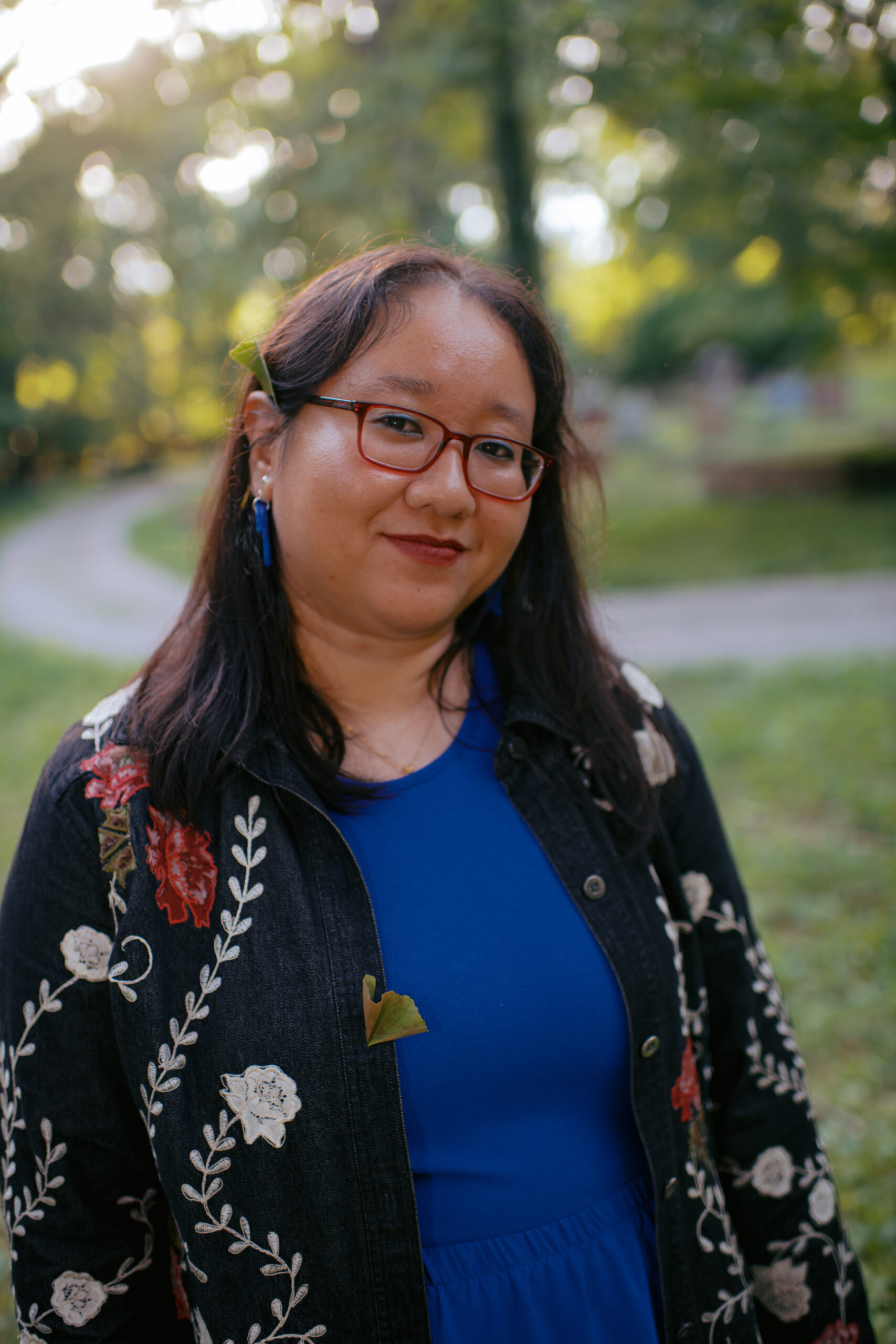
Mandy Moe Pwint Tu is a pile of ginkgo leaves in a trench coat from Yangon, Myanmar. Her work has appeared or is forthcoming in POETRY, Beloit Poetry Journal, Porter House Review, Waxwing, and elsewhere. She has published three poetry chapbooks, Monsoon Daughter (Thirty West Publishing House, 2022), Unsprung (Newfound, 2023), and Burma Girl (Gold Line Press, 2026). She received her MFA from the University of Wisconsin-Madison, where she was the Hoffman-Halls Emerging Artist Fellow at the Wisconsin Institute for Creative Writing.
Tiffany Troy is the author of Dominus (BlazeVOX [books]). She translated Catalina Vergara’s diamonds & rust (Toad Press International Chapbook Series). She is Managing Editor at Tupelo Quarterly, Associate Editor of Tupelo Press, Book Review Co-Editor at The Los Angeles Review, and Co-Editor of Matter. In 2025-2026, she is a Co-Curator in Residence at the MinEastry of Postcollapse Art and Culture. In that role, she co-curates The American Wing, which features poets who shape the rich, polyglot and ever-evolving landscape of American poetry.